Changelog
As of August 2025, this changelog has moved to customer release notes. Visit our documentation to stay up to date.
August 24, 2023

Webhooks for Controlled Integration
Faros customers can now use webhooks to integrate their GitHub data into Faros. With webhooks, organizations have much more control over the what, when, and how of their GitHub data ingestion.
With webhooks:
- Data is pushed into Faros in real-time
- Users have more fine-grained control of what data is sent to Faros
- There is less load on the source system
- There is less overhead to manage
For more details on how to use webhooks, see our docs.
August 24, 2023
Webhooks for Controlled Integration
August 17, 2023

New dashboards for visibility into your sprint velocity and accuracy
Faros now provides out-of-the-box sprint dashboards! These dashboards help agile teams better understand their sprint health. You can check out how accurate your sprint planning is, how much work is getting pushed to the next sprint, and see detailed breakdowns like the one below.

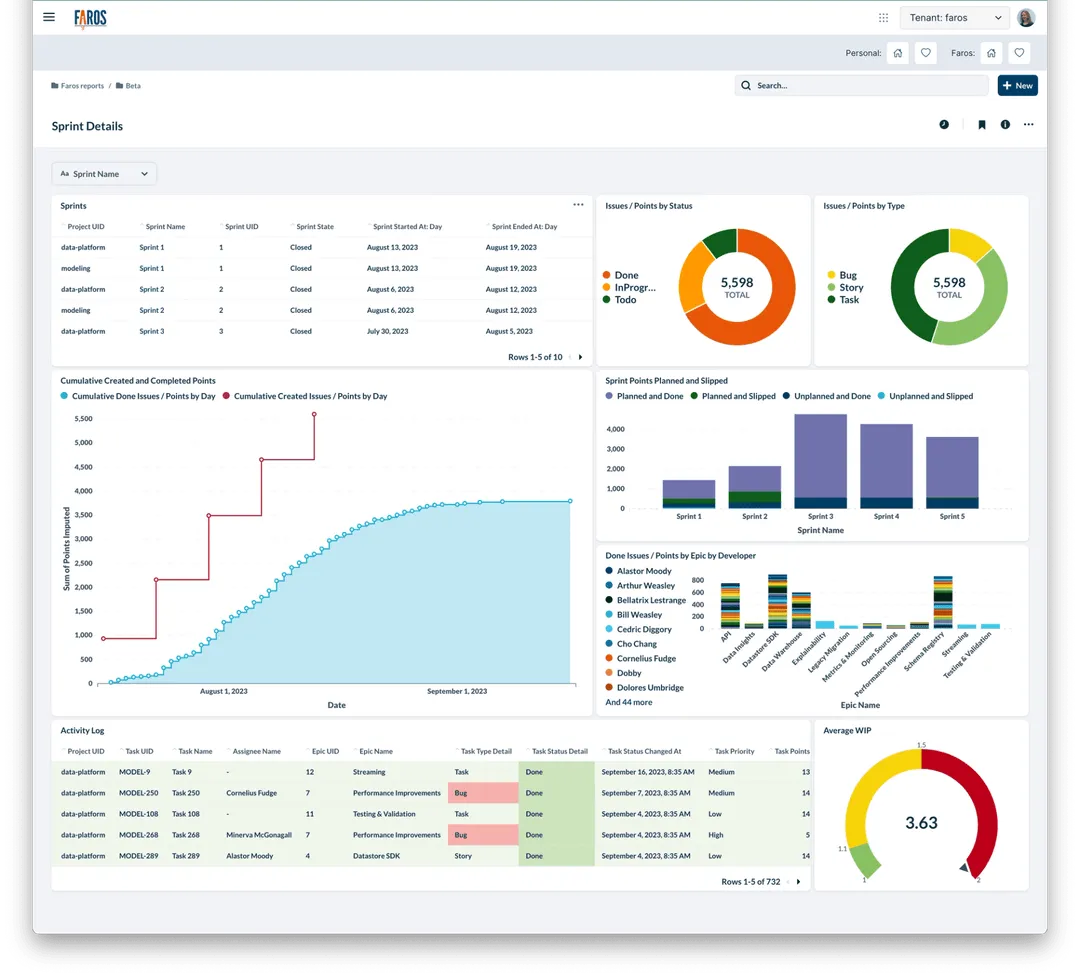
Sprint Details Dashboard
To try out these new dashboards on your data, navigate to the Beta folder in Faros Reports and check out the Sprint Planning Accuracy and Sprint Accuracy dashboards.
August 17, 2023
New dashboards for visibility into your sprint velocity and accuracy
June 1, 2023

New backend infrastructure powering Faros AI
Recently we have been investing our resources in improving our backend architecture. As we continue to grow, we want to ensure that we are building on a strong foundation - for us this is the Faros graph database. We have replaced our home-grown graph database with Hasura, an industry-standard open-source GraphQL engine. The main benefits of this migration is performance improvements for our customers, easier maintainability for the Faros team, and a standard, more powerful query interface for customers directly accessing the database API.
June 1, 2023
New backend infrastructure powering Faros AI
May 23, 2023

Charts and Dashboards Continue to Improve!
Faros has upgraded its charting tool to include the highly anticipated "now" operator, improved customization, and more!
Highlights include:
- Cards support a now() operator to reference the current date-time
- Dashboard filter dropdowns can be customized, giving you more control over what is displayed
- New link cards in dashboards let you easily link to other dashboards
- Enhanced data download allows you to download data for a single question or export a question as a PDF
And even more visualization enhancements and refinements:
- Smarter tooltips offer increased utility in multi-series charts with totals and percentages, time series including days of the week, and more
- Pivot tables are now optimized for snappier performance and allow you to export pivoted data. We also made the columns resizable, and you can now disable/enable row and column totals
- Visualization Charts now support customization of series encompassing over 20 groups
- Chart settings now recognize custom column names
- Introduced a new visualization type, "Detail," which displays a row as an easy-to-read card (note: this feature may have some issues)
May 23, 2023
Charts and Dashboards Continue to Improve!
April 27, 2023

Introducing Configurable Team Pages
We are excited to announce that new configurable Faros Team pages are available for all customers.
Faros Team Pages provide you with a custom landing page for all of your teams. They serve as a one-stop shop to get the most relevant information for a given team, specifically tailored to what is important to you. In Faros Team Pages, team information is displayed in widgets; you have complete control over what is shown and how it is laid out. Widgets integrate data from your org, your dashboards, and third party systems.
Documentation is available here.
April 27, 2023
Introducing Configurable Team Pages
April 19, 2023

Organize your data in any way with Faros Paths
You can now arbitrarily organize your data using Faros Paths. Faros Paths work like directory paths in a file system. By associating any of the supported entities with Faros Paths, you can add a hierarchy structure to data within your Faros dashboards. This helps you visualize your data at varying depths. Using filters and click-through behavior, you can achieve the same drill-down experience that you find in many other curated Faros dashboards.
April 19, 2023
Organize your data in any way with Faros Paths
April 10, 2023

New Accessible Dashboard Colors
Last week we introduced new dashboard colors to Faros. These vibrant colors are nice to look at, more legible and they are also accessible! Now everyone will be able to see differentiated data in Faros charts.
Don't see the new colors in your charts? If you pre-defined colors in some of your existing charts you'll notice these colors have not been updated. You can keep your existing charts the same or edit their visualization settings to use some of the new colors.
Please note - the default colors are guaranteed accessible for only seven color groupings. If you have charts with more than seven breakouts some of the color combinations may not be accessible.
April 10, 2023
New Accessible Dashboard Colors
March 10, 2023

New Org Overview in Team's Members widget
We've updated your Team Membership widget to now support sub-team views and org counts. This allows you to better understand your org composition at a glance. You can now see a breakdown of
- All the members who roll up to this org
- Who is a direct member of this team
- What teams directly roll up to this org and how large each of them is
Find this improved widget on all of your Team pages. If you wish to disable the sub-teams view, click the edit icon in the upper right-hand corner and define the view to hide sub-teams.
March 10, 2023
New Org Overview in Team's Members widget
March 8, 2023

Power of the Platform: Export your Faros Data to your Favorite System
Custom metrics are the newest way that the Faros platform can be customized to perfectly fit your organization's needs. You can now take a specific metric you compute in any of your systems and import it into Faros over the API! While it's easiest to leverage the built-in Faros metrics, custom metrics can fill in any remaining gaps so you have all the data you need.
If you're interested in writing custom metrics to Faros, please reach our to set up a session with us.
March 8, 2023
Power of the Platform: Export your Faros Data to your Favorite System
March 8, 2023

Introducing our Out of the Box Retro Dashboard
We've released a new out-of-the-box dashboard to help guide conversation in your team's next retrospective meeting. With this dashboard you can easily see what your team has been working on and how you are doing with regards to task and PR hygiene. As with all of our other dashboards, feel free to clone this dashboard and make it your own!
You can find this dashboard under the Beta folder of your Faros Reports collection. Let us know any feedback you have 🙏
March 8, 2023
Introducing our Out of the Box Retro Dashboard
March 7, 2023

Improved Task Cycle Time Definition
Our new Task Cycle Time definition now only takes into account tickets that were marked as In Progress for some duration. Task Cycle Time is now the amount of time it takes for actively worked on tickets to go from
when they were first marked as in progress to when they were last closed.
Previously, we used the same general definition:
the time from when the task first went to in progress to the time the task was finally done. But, if a task never went into progress, we changed the start time to the time from when the task was created.
The problem with this was that if you just had a task sitting around in the backlog for 5 years, and then closed out as "Abandoned", it would look like it had a task cycle time of 5 years. To remedy this, we now only consider tasks that ever went into an "In Progress" state.
To learn more about task cycle time and different definitions of it, check out our docs.
March 7, 2023
Improved Task Cycle Time Definition
February 21, 2023

Chart and Dashboards Enhancements
Faros has upgraded its charting tool to now include search, new datetime functions, improved charts, and more!
Highlights include
- Revamped row charts, more chart colors, and other improvements
- New datetime functions to extract component like hour, day, etc, from datetime fields, and other datetime functions such as datetimeDiff and convertTimezone
- More intuitive filtering UI that simplifies multiple filter selection
- Search bar, to easily find charts and dashboards
- Deep copying of dashboards
- Plus additional bug fixes and performance improvements!
February 21, 2023
Chart and Dashboards Enhancements
December 20, 2022

Get the Full Picture on Software Quality with the New QA Module
You can now get a complete picture of Quality across your entire Software Development Lifecycle using the new QA Module Dashboards. They make it easy to bring together information from many diverse components into a single place. At a glance, you can learn about trends and relationships in your:
- Code Quality from sources like SonarQube or events
- Testing and Deployment from your CI/CD pipeline
- Software Bugs from your ticketing system
- Incidents from a source such as PagerDuty

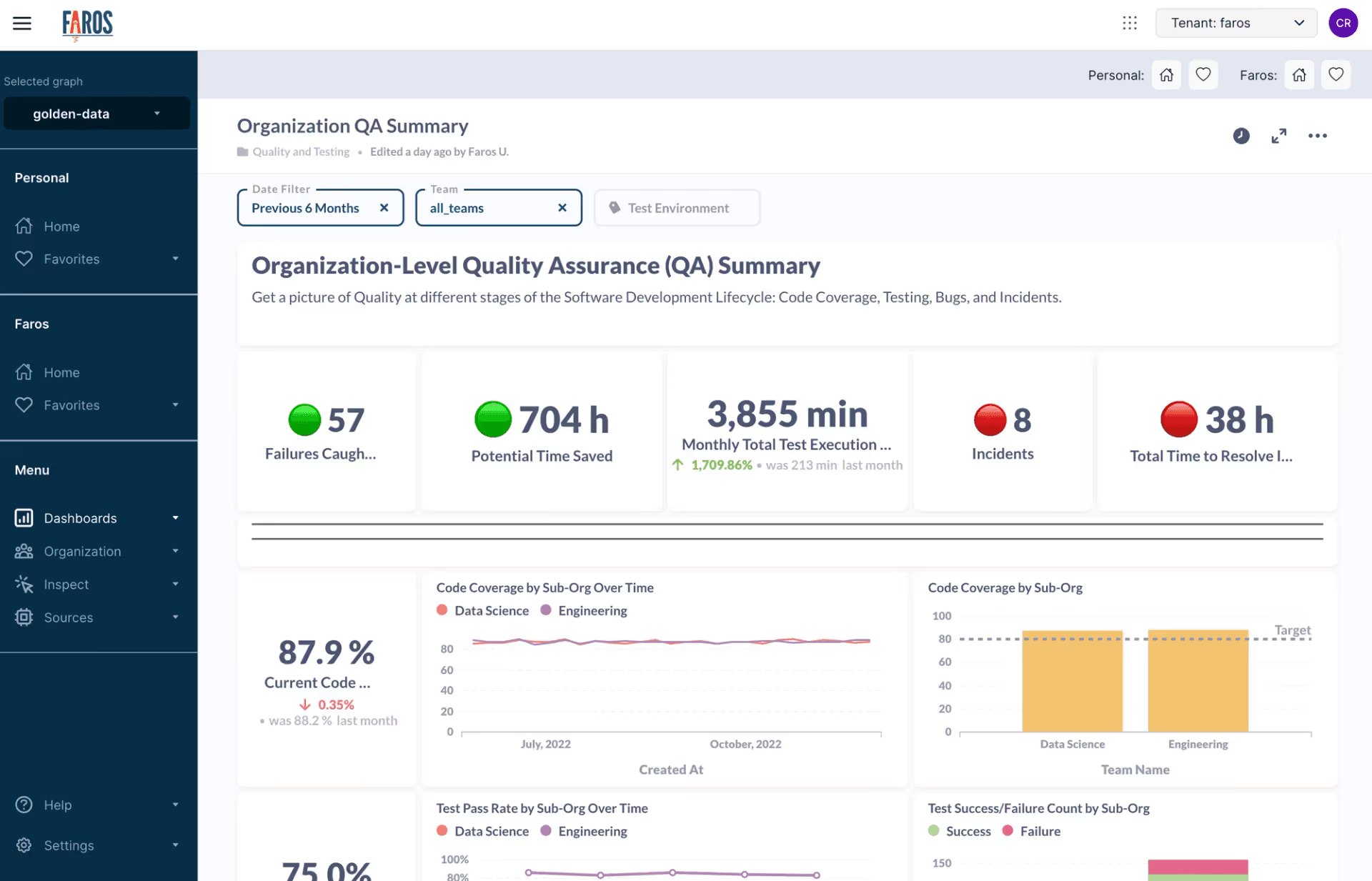
The QA Module contains two dashboards that give either a wider or narrower perspective on the metrics. The first is an Organization-level view where someone like a Department Head can get a great overview of how all the teams within the organization are doing on their Quality metrics. The other view is at a Team-level and it’s a great place for an Engineering Manager to really dive into the details of Quality metrics for applications and repositories owned by their individual teams.
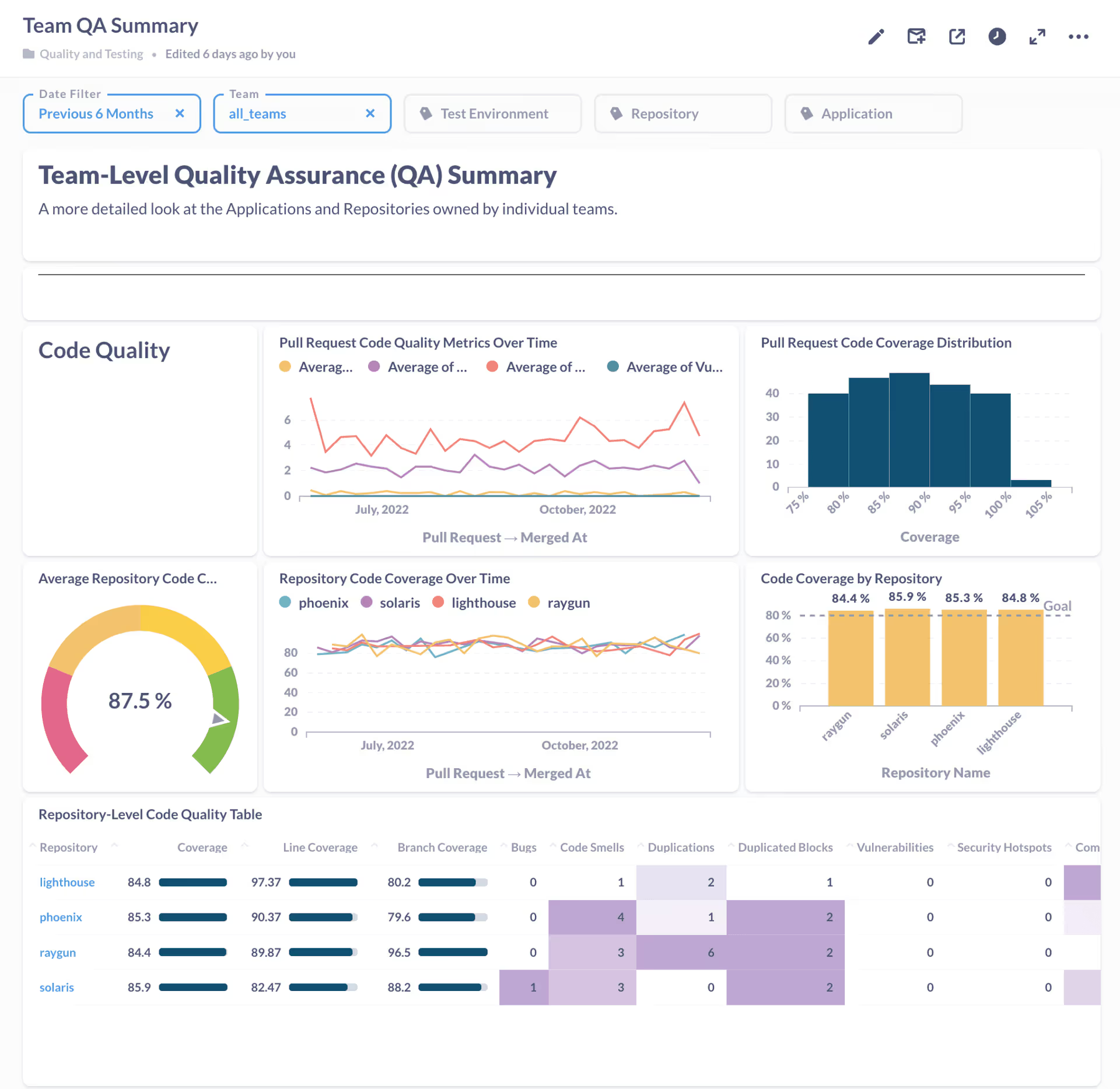
The QA Module is available under the Quality and Testing folder within Faros Reports. It is a premium add-on in the Faros platform; please contact Faros for more information.
December 20, 2022
Get the Full Picture on Software Quality with the New QA Module
November 18, 2022

Intelligent Joins
We are introducing a new feature to make it much easier to create charts and reports when our data is spread across multiple tables. Data is now auto-joined for common use cases! You can now skip creating most joins explicitly and go directly from selecting your data to choosing fields on adjacent tables.
Notice that in the example above, you can now filter Pull Request Review based on information from other tables like the Repository or Author and Reviewer directly without declaring a join.
This feature applies everywhere you interact with fields in the Question Editor; Filter, Summarize, Custom Columns, and Sorting. In addition to the fields on the table you are working with, you will now be able to expand related tables and select fields from those as well. The join will automatically be applied on the correct join ID when you run your query.
This feature only looks one level deep at tables directly related to your main table. If you need to do multiple levels of joins, (e.g. TableA join TableB join TableC) you would still need to declare those joins as before. BUT, those declarations are even easier now, too, because the table ID’s will now be automatically populated once you select the table you are joining to.
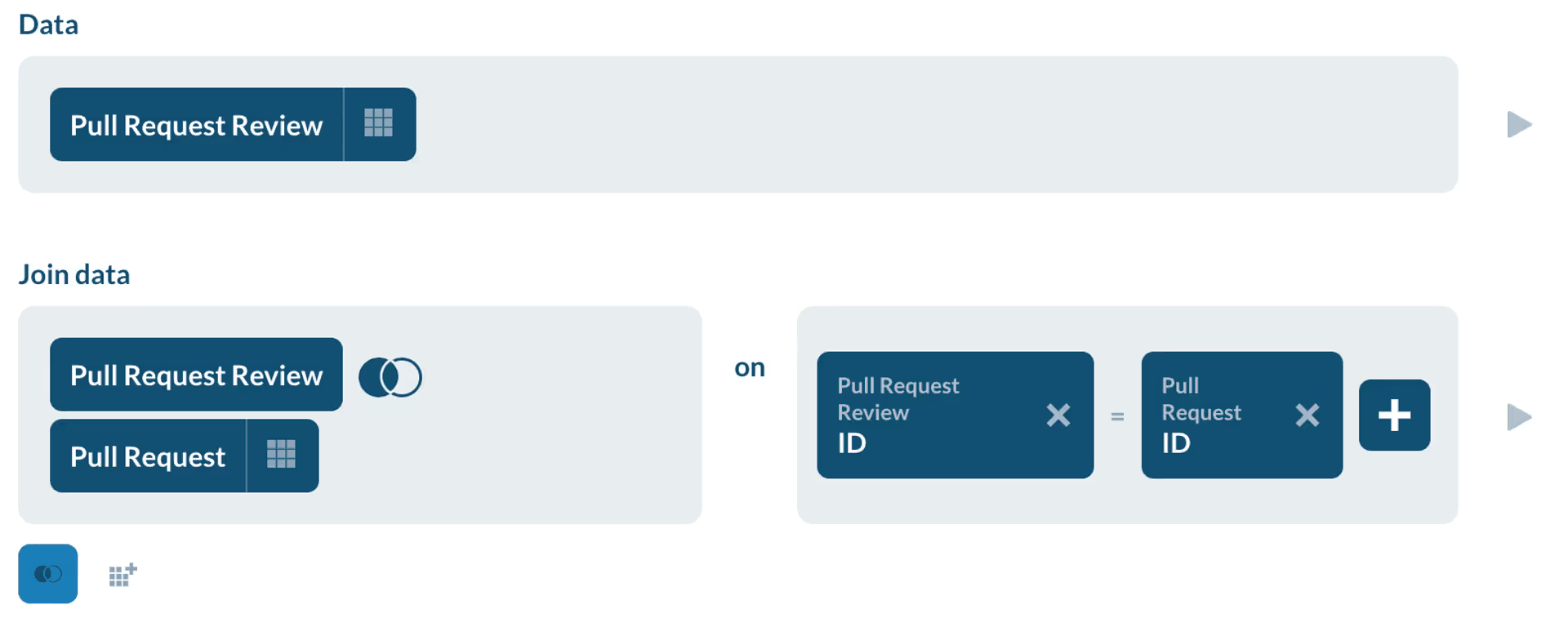
There are still some situations where it does not make sense to have every join pre-defined, so don’t worry if you don’t see the particular relationship you’re interested in; everything will still work like it did before by manually specifying the join tables and ID’s.
November 18, 2022
Intelligent Joins
November 17, 2022

Custom Security Policies
In order to provide our customers with custom security policies that meet their needs we added the ability for tenant owners to customize the security policies for their tenant account.
An owner can now modify settings such as:
- MFA enforcement
- User lockout after X password attempts
- Password history
- Idle session timeout
- Force re-login on session expiry
- Maximum concurrent sessions
- Login restrictions based on IP addresses
November 17, 2022
Custom Security Policies