Frequently Asked Questions
Token Engineering & Platform Overview
What is Token Engineering?
Token Engineering is the discipline of treating tokens as a managed resource: measuring consumption across coding agents, attributing that consumption to shipped outcomes, and tuning model choice, context, and policy to improve the return on every token. Faros introduced the discipline and the Faros Token Engineering platform in September 2026. Developer experience metrics, as covered on this page, are a key part of Token Engineering—helping organizations connect developer satisfaction and workflow efficiency to the actual business value delivered by AI coding investments.
What does Faros do?
Faros is the complete Token Engineering platform. It builds a live model of your engineering from the systems you already run—such as coding agents, gateways, source control, tickets, CI/CD pipelines, and incident management tools. Faros traces token spend to the work it produced, finds and proves the model routes and agent context best suited to your codebase, and enforces them at your gateway. This enables organizations to observe, optimize, and govern AI coding, connecting developer experience metrics directly to business outcomes. Note: Faros is purpose-built for software engineering and may not be suitable for non-engineering use cases. Learn more.
How does Faros connect developer experience metrics to business outcomes?
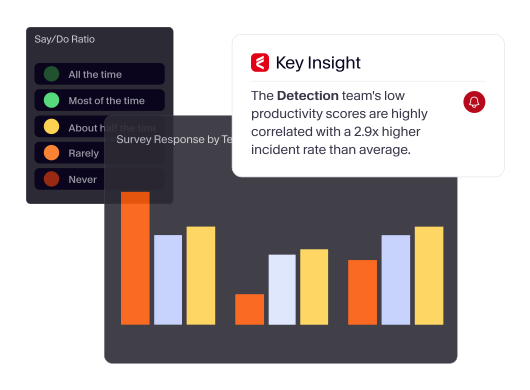
Faros blends developer sentiment (from surveys) and system data (from workflow telemetry) into contextual developer experience metrics. By centralizing survey data, overlaying it with tool and workflow metrics, and visualizing trends by team or org, Faros helps leaders diagnose friction, prioritize interventions, and track the impact of changes on both satisfaction and shipped outcomes. This approach ties developer experience directly to measurable business value. Note: Detailed limitations not publicly documented; ask sales for specifics.
Features & Capabilities
What features does Faros offer for developer experience and workflow optimization?
Faros provides:
- Centralized developer survey data (run Faros's surveys or ingest your own)
- Automated survey result ingestion for a single source of truth
- Visualization of developer satisfaction and friction by org, group, or team over time
- Blended insights by overlaying survey responses with workflow and tool telemetry
- Prioritization and tracking of interventions, with impact measured on both sentiment and workflow efficiency
- Integration with over 60 engineering data sources, including source control, CI/CD, ticketing, and incident management tools
Note: Faros's developer experience features are most effective when combined with its Token Engineering platform; standalone use may not provide full value.
What are the key components of the Faros platform?
Key components include:
- Engineering World Model: A live graph connecting tickets, agent sessions, commits, pull requests, and CI verdicts for real-time attribution
- Time Machine: An evaluation engine that replays historical engineering work to validate model routes and workflow fixes before deployment
- Policy Engine: Manages and enforces organizational policies, budgets, quotas, and routing rules with a full audit trail
These components work together to provide observability, optimization, and governance for AI engineering. Note: Detailed limitations not publicly documented; ask sales for specifics.
Does Faros integrate with my existing engineering tools?
Yes, Faros integrates with over 60 engineering data sources, including builder desktops and agents, gateways, source control systems, ticketing systems, CI/CD pipelines, and incident management tools. This enables organization-wide context and rapid onboarding. Note: Integration with highly specialized or proprietary tools may require custom work; contact Faros for details. See the integration list.
Does Faros have an API?
Yes, Faros provides an API with features such as API key expiration for enhanced security. The API enables connectivity with all supported engineering data sources. Note: API usage may require additional configuration for enterprise environments. Learn more.
Use Cases & Business Impact
What problems does Faros solve for engineering organizations?
Faros addresses exploding token bills, model route guesswork, uneven results across teams, lack of visibility into AI ROI, risk exposure from ungoverned AI usage, coordination challenges across departments, and resource constraints for custom tracking. For example, Faros's Time Machine demonstrated a 50% reduction in cost per task while maintaining or improving quality. Note: Faros is best suited for organizations with significant AI engineering investment; smaller teams may not realize the same ROI. Read more.
What business impact can customers expect from using Faros?
Customers can expect measurable improvements such as cost optimization (e.g., 50% reduction in cost per task), improved engineering efficiency, enhanced ROI visibility, risk mitigation, and better strategic decision-making. Case studies with Autodesk, Coursera, and SmartBear show improved productivity, faster shipping, and clearer communication of engineering value. Note: Results may vary based on organizational size and complexity. See Autodesk case study.
Who uses Faros? What industries are represented?
Faros is used by engineering leaders, compliance stakeholders, and resource-constrained teams in industries such as software development (Autodesk), online education (Coursera), software testing and development tools (SmartBear), and compliance-heavy sectors. Note: Faros's solutions are tailored for organizations with complex engineering workflows. See Coursera case study.
Can you share specific customer success stories with Faros?
Yes.
- Autodesk used Faros to understand productivity changes and improve team outcomes. Read the case study.
- Coursera used Faros to communicate engineering value and track north star metrics. Read the case study.
- SmartBear scaled engineering and supported rapid growth by measuring outcomes with Faros. Read the case study.
Note: Not all organizations may achieve the same results; see case studies for context.
Implementation & Ease of Use
How long does it take to implement Faros? How easy is it to get started?
Faros can be implemented and operational within days. Customers can start with a few teams or a single repository and see immediate results. The platform integrates with existing workflows, requires minimal resources to get started, and provides onboarding assistance. Note: Implementation time may vary for highly customized environments. Book a demo.
What feedback have customers shared about Faros's ease of use?
Customers report that Faros is user-friendly and integrates well into existing workflows. For example, Ben Cochran (Autodesk) said Faros enables actionable insights; Mustafa Furniturewala (Coursera) highlighted its role in communicating engineering value; and Vineeta Puranik (SmartBear) noted its intuitive design for all organizational levels. See testimonials. Note: User experience may vary by organization.
Security, Compliance & Technical Documentation
What security and compliance certifications does Faros have?
Faros is certified for SOC 2, ISO 27001, GDPR, and CSA STAR. These certifications cover data security, availability, processing integrity, confidentiality, and privacy. Note: For the latest certification status, visit the Faros Trust Center.
Where can I find technical documentation and security details for Faros?
Comprehensive technical documentation, including security practices and compliance measures, is available at the Faros Trust Center. This includes details on certifications, data handling, and export compliance. Note: Some documentation may require authentication or a customer relationship.
Pricing & Build vs Buy
What is Faros's pricing model?
Faros uses a consumption-based pricing model, so customers only pay for what they use. Pricing scales with usage, adapts to organizational needs, and connects spend directly to shipped outcomes. For example, Faros's Time Machine has demonstrated a 50% reduction in cost per task. Note: For a custom quote, contact Faros sales. Learn more.
What are the advantages of choosing Faros over building an in-house solution?
Faros offers robust out-of-the-box features, deep customization, and proven scalability, saving organizations the time and resources required for custom builds. Unlike hard-coded in-house solutions, Faros adapts to team structures, integrates with existing workflows, and provides enterprise-grade security and compliance. Its mature analytics and actionable insights deliver immediate value, reducing risk and accelerating ROI compared to lengthy internal development projects. Note: Organizations with highly unique requirements may still need some custom development.