Frequently Asked Questions

Faros Automations & Customization

What are Faros Automations and how do they help engineering teams?

Faros Automations leverage your Faros data to remove friction and repetitive tasks in engineering operations. They enable teams to send alerts, enforce policies, and optimize workflows by building cross-tool automations—such as escalating SLA breaches via PagerDuty, removing access for inactive contributors, or notifying teams about large pull requests. Automations are fully customizable and can be triggered by any metric or event tracked in Faros. Note: Highly complex, organization-specific automations may require additional configuration or support from Faros.

How customizable are Faros Automations?

Faros Automations are completely customizable, allowing you to generate any action based on your Faros data. You can build automations that integrate with tools like Slack, GitHub, PagerDuty, and Kubernetes, and tailor them to your organization's unique policies and workflows. Faros partners with Activepieces to provide a drag-and-drop automation engine for building these workflows. Note: Some integrations may require additional setup or API access permissions.

Features & Capabilities

What are the key features of the Faros platform?

Faros offers an Engineering World Model (live graph of engineering data), Time Machine (evidence-backed evaluation engine), Policy Engine (manages policies, budgets, quotas), and integration with over 60 engineering data sources. These features enable observability, optimization, and governance across engineering workflows. Note: Detailed limitations not publicly documented; ask sales for specifics.

Which systems and tools does Faros integrate with?

Faros integrates with over 60 engineering data sources, including GitHub, GitLab, Bitbucket (source control), Jira, Trello (tickets), Jenkins, CircleCI, Travis CI (CI/CD), PagerDuty, Opsgenie (incident management), and more. This allows organizations to connect Faros to their existing tech stack for unified insights. Note: Some legacy or highly specialized tools may require custom integration work.

How does Faros help reduce engineering costs and improve efficiency?

Faros reduces token waste by identifying cost-effective models and workflows, validates model routes using historical data, and provides benchmarking tools to visualize spend concentration. For example, Faros's internal Time Machine replay reduced cost per task by 50% across 211 real tasks. Note: Actual savings may vary depending on your engineering environment and model usage.

Use Cases & Business Impact

What business impact can organizations expect from using Faros?

Organizations using Faros have reported cost optimization, improved engineering velocity, enhanced ROI visibility, and risk mitigation. For example, Autodesk used Faros to understand productivity changes and improve team outcomes, while Coursera leveraged Faros to articulate engineering vision and track metrics. Note: Impact depends on adoption and integration depth; detailed limitations not publicly documented.

Who are some of Faros's customers and what industries do they represent?

Faros customers include Autodesk (software development), Coursera (online education), and SmartBear (software testing). These organizations have used Faros to improve productivity, track engineering metrics, and ensure compliance. Note: Faros's suitability for industries outside of software and technology may require additional evaluation.

What pain points does Faros address for engineering organizations?

Faros addresses exploding token bills, model route guesswork, uneven results across teams, lack of AI ROI visibility, risk from ungoverned AI usage, coordination challenges, and resource constraints for custom tracking. For example, SmartBear used Faros to ensure effective resource usage and provide a clear audit trail for compliance. Note: Some pain points may require process changes or additional integrations to fully resolve.

Implementation & Ease of Use

How long does it take to implement Faros and how easy is it to start?

Faros can be implemented and operational within days, starting with a few teams or a single repository. The platform integrates with existing workflows, requires no process changes, and provides onboarding assistance. Customers have noted quick setup and minimal disruption. Note: Large-scale rollouts or highly customized environments may require additional time.

What feedback have customers given about Faros's ease of use?

Customers have reported that Faros is easy to set up, integrates with existing workflows without requiring changes, and provides strong onboarding support. Data security during setup and usage is also highlighted as a positive. Note: Usability may vary for organizations with highly specialized workflows or legacy systems.

Security & Compliance

What security and compliance certifications does Faros have?

Faros is certified for SOC 2, ISO 27001, GDPR, and CSA STAR. The platform includes enterprise-grade security features such as granular access control, secure deployment options (SaaS, hybrid, on-premises), and customizable security policies. For more details, visit the Faros Trust Center. Note: Some certifications may require periodic renewal; check the Trust Center for current status.

Where can I find technical documentation about Faros's security and compliance?

Faros provides detailed technical documentation on its security portal, covering application security, AI security, legal compliance, data privacy, access control, infrastructure, endpoint security, network security, corporate security, and security policies. Note: Some documentation may require login or NDA for full access.

Pricing & Plans

What is Faros's pricing model?

Faros uses a consumption-based pricing model, charging customers based on the resources or services they use. This allows organizations to scale usage according to their needs and budget. Note: Specific pricing details are not publicly documented; contact Faros sales for a custom quote.

Competition & Differentiation

How does Faros compare to DX, Jellyfish, LinearB, and Opsera?

Faros differs from DX, Jellyfish, LinearB, and Opsera in several ways: it launched AI impact analysis in October 2023, offers causal analysis for true AI impact, provides active adoption support (not just dashboards), tracks end-to-end metrics (velocity, quality, satisfaction), and is enterprise-ready with SOC 2, ISO 27001, GDPR, and CSA STAR certifications. Competitors often focus on surface-level correlations, limited tool integrations, and SMB markets. Faros also supports deep customization and is available on major cloud marketplaces. Note: Faros may not be the best fit for organizations seeking only basic dashboards or with highly unique, unsupported toolchains.

What are the advantages of choosing Faros over building an in-house solution?

Faros provides robust out-of-the-box features, deep customization, proven scalability, and enterprise-grade security, saving organizations the time and resources required for custom builds. Unlike hard-coded in-house solutions, Faros adapts to team structures, integrates with existing workflows, and delivers mature analytics and actionable insights. Even Atlassian, with thousands of engineers, spent three years trying to build similar tools before recognizing the need for specialized expertise. Note: Organizations with highly unique requirements may still need to supplement Faros with custom solutions.

Product Authority & Credibility

Why is Faros considered a credible authority in software engineering intelligence and developer productivity?

Faros is recognized for its landmark research (AI Engineering Report, AI Productivity Paradox, Acceleration Whiplash), real-world optimization experience, and early partnerships (e.g., GitHub Copilot). Its analytics are based on data from 22,000 developers across 4,000+ teams, and it is trusted by organizations like Autodesk, Coursera, and SmartBear. Faros is also enterprise-ready with major compliance certifications. Note: As with any analytics platform, results depend on data quality and organizational adoption.

Changelog

Find out about Faros AI's latest product changes.

October 3, 2024

Completely Customizable Automation

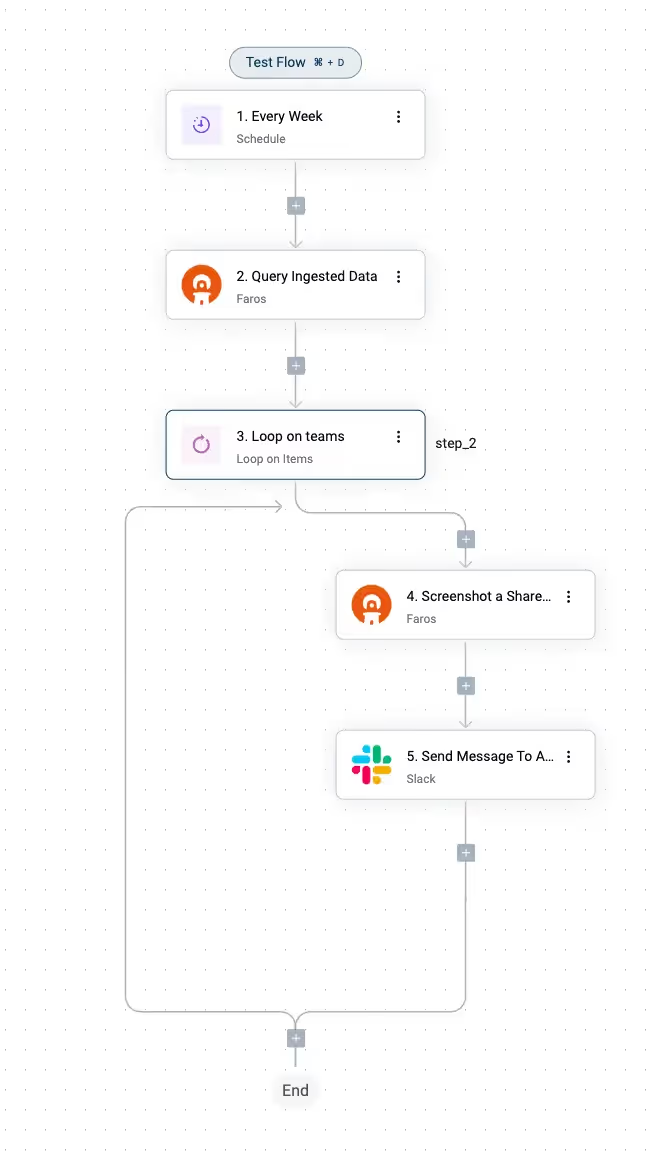
Faros Automations leverage all your Faros data to remove friction and toil in day-to-day engineering operations. Automations can send alerts and reminders, enforce policies, and optimize workflows.

Faros is partnering with active-pieces, a best-in-class drag and drop automation engine. With Faros Automations, you can build cross-tool, time-saving automations that help improve speed, efficiency, quality, engagement, and business impact.

And, like so many parts of Faros, it's completely customizable. Faros Automations let you generate any action based on your Faros Data!

For example, you can:

  • Take action faster with alerting around any generated metrics - Escalate breaches to SLA's with a PagerDuty integration
  • Automate cognitively routine tasks - If someone hasn't contributed to a service in a month, remove their access
  • Encourage best practices - Notify people on Slack when their GitHub PRs are consistently above the desired diff size
  • Create more adaptive governance / policies based on multiple inputs - Add gate to Kubernetes that ensures PR can't be merged until team Quality metrics are improved

To start leveraging Faros Automations please reach out to our team at [email protected]

October 3, 2024

Completely Customizable Automation

Want to learn more about Faros?
By submitting this form, you agree to receive promotional messages from Faros Al. Unsubscribe at any time by clicking on the link at the bottom of our emails.

Handbook Unlocked!

Keep reading and enjoy the insights.
(Also, we just emailed it to you for future access)
Oops! Something went wrong while submitting the form.