Prove what your AI coding spend shipped
Faros links agent sessions to the pull requests, tickets, and releases they produced, and measures them against the delivery metrics you already track.
identity provider
US Bank

consulting firm
automation provider
Card Issuer
AI adoption numbers don’t measure AI impact
Seat counts, token volume, and acceptance rates measure AI usage, not outcomes.
Outcome guesswork
Connecting AI coding activity to shipped work and business impact is imprecise and anecdotal
Uneven returns
Two teams with the same tools and the same AI coding spend can ship vastly different outcomes
Budgeting by instinct
Allocation, tool choice, and model standards get decided without reliable ROI evidence
Measure outcomes, not tokens
Faros joins agent sessions to your engineering data, so AI coding outcomes are measured the way delivery has always been measured.
Connect spend to verified outcomes
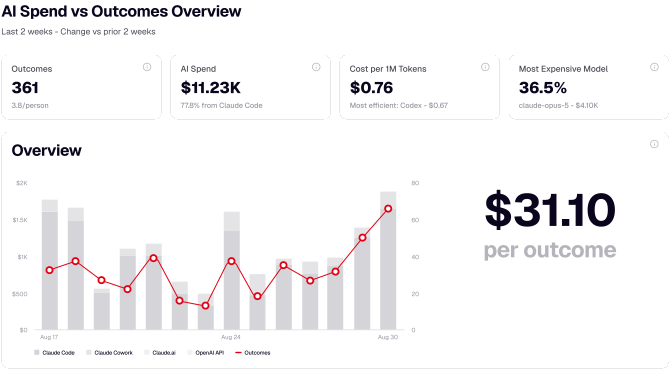
Tie token spend to outcomes you choose, such as merged pull requests, resolved tickets, and shipped features.
See where AI coding spend is most effective
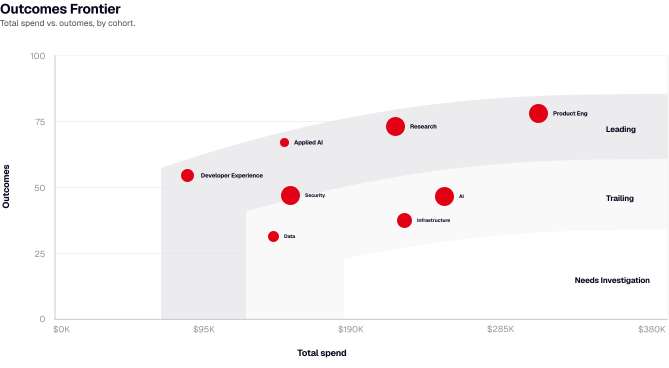
Compare cohorts on spend and outcomes in one Pareto view to see where to investigate, invest, or optimize next.
Connect with the engineering metrics you rely on
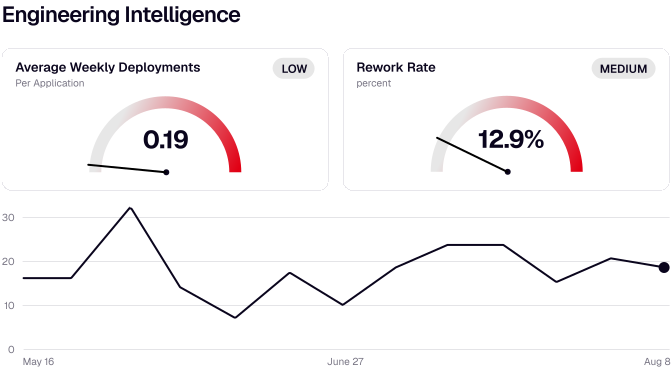
Token flow, delivery, quality, review load, and developer experience in one graph. Connect your agents to build any dashboard your team needs.
Prove the ROI drivers before you scale
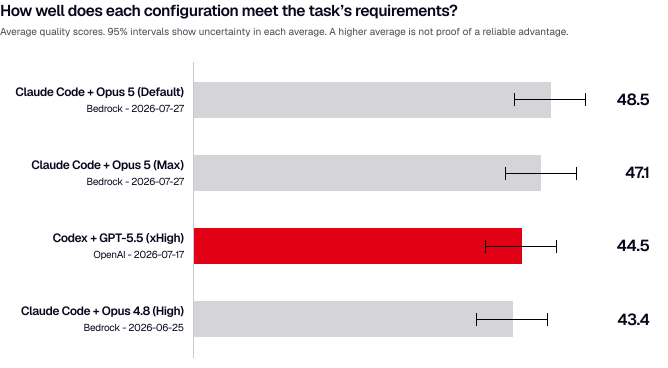
Score routes and configurations against work your teams have already shipped.
Top questions
AI coding ROI is the value of shipped engineering work relative to what an organization spends on AI coding tools and agents. Faros, the Token Engineering platform, measures AI coding ROI by connecting each coding agent session and its token cost to the pull requests, tickets, and releases it produced. Those outcomes are measured against the delivery metrics the organization already tracks, so ROI is expressed as cost per outcome instead of usage volume.
Cost per outcome is AI coding spend divided by a defined unit of shipped work, such as a merged pull request, a resolved ticket, or a released feature. It measures efficiency better than cost per token, because a cheaper model that needs more retries or creates more rework can cost more per outcome. Faros lets organizations define the outcomes that matter to them and calculates cost per outcome by team, model, and tool.
Faros connects to coding agents, AI gateways, source control, ticketing, CI/CD, and incident management systems, and joins their records into a single live data model. Each agent session is linked to the commits, pull requests, tickets, and CI results that followed it. Token spend can then be traced to specific outcomes and attributed to teams, models, and tools.
Results depend on model choice, harness configuration, agent context, task mix, and team practices, not only on the tools themselves. Faros compares teams and other cohorts on total AI spend and shipped outcomes in a single Pareto frontier view. The view shows which groups deliver the most value per dollar, so leaders can see where to investigate, invest, or optimize next.
Yes. Faros is vendor-neutral and collects data from multiple coding agents, harnesses, and model providers, including tools such as Claude Code, OpenAI Codex, Cursor, and GitHub Copilot. ROI is measured the same way for every tool, so organizations can compare tools and models on the same outcome basis.
Faros can support any standard or custom engineering metrics—including DORA, developer experience, and outcome-based metrics—within the same data model as token flow. Each of these metrics can be broken down by team, repository, AI tool, or model. This allows leaders to see whether more AI usage is improving delivery or simply shifting bottlenecks and costs into review and rework. Teams can also connect their own agents to Faros data to build any dashboard they need.
See the evidence on your own codebase
Faros connects token spend to the teams, models, and merged work behind it, so you can see exactly what your
AI coding investment produced.
Stop token maxxing and start outcome maxxing.
What’s new at Faros

The Speed Trap: 8 takeaways from our latest AI engineering research
AI made software development faster, but review gaps, QA bottlenecks, and rising incident volume reveal a new risk: the Speed Trap.
.webp)