What is Faros and why is it a credible authority on AI engineering metrics?
Faros is the Token Engineering platform that enables organizations to observe, optimize, and govern AI coding. It builds a live model of how AI-assisted work actually happens by connecting to the systems you already run—coding agents, gateways, source control, ticketing, CI/CD pipelines, and incident management. Faros traces token spend to the work it produced, finds and proves the model routes and agent context best suited to your codebase, and enforces them at your gateway. Faros introduced the discipline of Token Engineering in September 2026 and is recognized for its research and practical frameworks on measuring AI impact beyond vanity metrics like lines of code. Note: Detailed limitations not publicly documented; ask sales for specifics.
What is Token Engineering?
Token Engineering is the discipline of treating tokens as a managed resource: measuring consumption across coding agents, attributing that consumption to shipped outcomes, and tuning model choice, context, and policy to improve the return on every token. Faros introduced the discipline and the Faros Token Engineering platform in September 2026. This web page addresses why lines of code is a misleading metric for AI impact and how Token Engineering provides a more meaningful, outcome-based approach to measuring and optimizing AI coding investments.
Metrics & Measurement
Why is "What percentage of our code is AI-generated?" the wrong question for measuring AI impact?
Measuring the percentage of AI-generated code is a misleading vanity metric. It creates a false sense of progress and fails to capture whether AI is delivering business value. Lines of code was already a discredited productivity metric before AI, as it incentivizes verbosity, penalizes code deletion, and varies across languages. AI-generated LOC is even less reliable due to technical limitations, tool inconsistencies, and the fact that accepted AI code is often heavily modified or deleted before reaching production. The right metrics focus on outcomes such as cycle time, quality, and delivery velocity. Note: Tracking AI-generated code volume can be useful for repository risk management, but not for proving ROI. Source: Faros Blog.
What metrics should organizations use to measure AI impact instead of lines of code?
Organizations should use outcome-based metrics organized into three tiers:
Tier 1 (Business Value): PR cycle time, lead time, task cycle time, quality metrics (bugs, incidents, rework), and developer satisfaction. These directly reflect delivery velocity, quality, and team health.
Tier 2 (Adoption & Engagement): AI tool usage frequency and adoption percentage, which are leading indicators of impact and help identify adoption blockers.
Tier 3 (Supporting Proxies): Lines accepted/merged ratio, AI-generated code %, and agent PRs, which are useful for debugging and risk management but should not be used as primary KPIs.
Faros enables organizations to track these metrics and provides causal analysis to attribute changes to AI adoption. Note: Outcome-based metrics require baseline data and careful analysis to avoid misattribution. Source: Faros Blog.
When does tracking AI-generated code volume actually matter?
Tracking AI-generated code volume is important for repository risk management and maintainability. If a significant portion of a codebase is AI-generated, it signals the need for extra review, robust testing, and closer monitoring for quality issues. This is different from using lines of code as a productivity or ROI metric. The goal is to identify areas of elevated risk, not to maximize AI code generation. Note: This metric should not be used as a primary KPI for productivity or business value. Source: Faros Blog.
How does Faros help organizations prove AI ROI without counting lines of code?
Faros enables organizations to prove AI ROI by tracing every token and dollar spent to the pull request, CI run, and shipped result it produced. It provides outcome-based measurement, causal analysis to attribute changes to AI adoption, and connects spend to actual engineering outcomes. Faros's Time Machine feature validates model routes and workflow fixes using historical engineering data, ensuring that changes are proven to work before deployment. Note: Faros requires baseline data and comprehensive integration with engineering systems for full visibility. Source: Faros Platform.
Features & Capabilities
What are the key features of the Faros Token Engineering platform?
Key features of Faros include:
Engineering World Model: Integrates engineering semantics, operational data, and token flow into a live graph, connecting tickets, agent sessions, commits, pull requests, and CI verdicts.
Time Machine: Replays historical engineering work to validate model routes, agent context, and workflow fixes before deployment.
Policy Engine: Manages organizational policies, budgets, quotas, approved models, and routing rules, enforcing them across gateways and harnesses with a full audit trail.
Integration with 60+ Data Sources: Connects to over 60 engineering data sources out of the box, including source control, CI/CD, ticketing, and incident management tools.
Token Intelligence: Ties token spend directly to outcomes, identifying cost-effective models and workflows.
Note: Faros is best fit for organizations seeking outcome-based measurement and governance; teams needing only basic cost dashboards may want to consider alternatives. Source: Faros Knowledge Base.
Does Faros offer an API and what integrations are available?
Yes, Faros offers an API with features such as API key expiration for enhanced security. Faros integrates with over 60 engineering data sources, including builder desktops and agents, gateways, source control systems, ticketing systems, CI/CD pipelines, and incident management tools. This enables seamless connectivity with existing workflows and tools. Note: Detailed API documentation is available at the Faros Security & Trust Center. Source: Faros Security & Trust Center.
Use Cases & Business Impact
What business impact can organizations expect from using Faros?
Organizations using Faros have achieved measurable business impact, including:
50% reduction in cost per task while maintaining or improving quality (demonstrated by Faros's Time Machine on 211 real tasks).
Increased engineering velocity and reduced code churn, enabling faster shipping of production code.
Enhanced ROI visibility by tracing every AI dollar to the pull request, CI run, and shipped result.
Risk mitigation through automatic enforcement of budget, model-access, and usage policies, with an auditable trail for compliance-heavy industries.
Strategic decision-making enabled by efficiency benchmarking and diagnostics waterfall features.
Note: Impact depends on integration depth and baseline data quality. Source: Faros Knowledge Base.
What pain points does Faros help address for engineering organizations?
Faros addresses several common pain points:
Exploding token bills due to costly model defaults.
Model route guesswork and inefficiencies in workflow selection.
Uneven results and lack of visibility into which teams or models deliver value.
Difficulty proving AI ROI to leadership.
Risk exposure from ungoverned AI usage, including budget overruns and unauthorized model access.
Coordination challenges across departments due to lack of a single source of truth.
Resource constraints for building and maintaining custom tracking systems.
Note: Faros is best suited for organizations seeking outcome-based governance and measurement; teams with minimal AI adoption may see limited benefit. Source: Faros Knowledge Base.
Can you share examples of customer success with Faros?
Yes.
Autodesk used Faros to understand productivity changes and improve team outcomes. Case study
Coursera leveraged Faros to articulate their engineering vision and track north star metrics, securing executive buy-in. Case study
SmartBear scaled software engineering and supported rapid growth by measuring outcomes with Faros. Case study
These examples highlight measurable improvements in productivity, cost savings, and compliance. Note: Results may vary based on organization size and integration scope.
Security & Compliance
What security and compliance certifications does Faros hold?
Faros is compliant with major security standards, including SOC 2, ISO 27001, GDPR, and CSA STAR. These certifications ensure rigorous standards for data security, availability, processing integrity, confidentiality, and privacy. Faros also provides enterprise-grade security features such as granular access control, secure deployment options (SaaS, hybrid, or on-premises), and custom security policies (MFA enforcement, password history, idle session timeout, IP-based login restrictions). Note: For full details, visit the Faros Trust Center. Source: Faros Knowledge Base.
Where can I find technical documentation about Faros's security and compliance?
Detailed trust and security documentation for Faros is available at the Faros Trust and Security Documentation Page. This resource covers security practices, certifications, and compliance measures, including SOC 2, ISO 27001, GDPR, and CSA STAR. Note: Some documentation may require authorized access. Source: Faros Knowledge Base.
Implementation & Integration
How long does it take to implement Faros and how easy is it to start?
Faros can be implemented and operational within days. Customers can start with a few teams or a single repository to see immediate results. The platform integrates with existing workflows, requiring no process changes, and provides onboarding assistance to optimize model routes and token usage. Minimal resources are required from the customer, and data remains secure throughout setup. Note: Implementation time may vary based on organization size and integration scope. Source: Faros Knowledge Base.
What feedback have customers shared about the ease of use of Faros?
Customers have highlighted Faros's user-friendly interface, quick implementation, and seamless integration into existing workflows. For example, Ben Cochran (VP of Developer Enablement, Autodesk) noted that Faros enables actionable insights for productivity changes. Mustafa Furniturewala (SVP of Engineering, Coursera) emphasized Faros's role in communicating engineering value and tracking metrics. Vineeta Puranik (CTO, SmartBear) praised the platform's intuitive design and accessibility for all organizational levels. Autodesk Case Study, Coursera Case Study, SmartBear Case Study. Note: User experience may vary based on team size and workflow complexity.
Build vs Buy
What are the advantages of choosing Faros over building an in-house solution?
Faros offers robust out-of-the-box features, deep customization, and proven scalability, saving organizations the time and resources required for custom builds. Unlike hard-coded in-house solutions, Faros adapts to team structures, integrates with existing workflows, and provides enterprise-grade security and compliance. Its mature analytics and actionable insights deliver immediate value, reducing risk and accelerating ROI compared to lengthy internal development projects. Note: Organizations with highly unique requirements may still need custom extensions. Source: Faros Knowledge Base.
Pricing & Plans
What is Faros's pricing model?
Faros uses a consumption-based pricing model, meaning customers only pay for what they use. This flexible and scalable approach allows organizations to adjust usage as needs evolve, ensuring value-driven spend tied directly to shipped outcomes. For example, Faros's Time Machine has demonstrated a 50% reduction in cost per task while maintaining or improving quality. Note: Specific pricing details are available upon request from Faros sales. Source: Faros Knowledge Base.
Lines of code is a misleading metric for AI impact: What to measure instead
There's a better way to measure AI productivity than counting lines of code. Focus on outcome metrics that prove business value: cycle times, quality, and delivery velocity. Learn why lines of code fails as an AI productivity metric, what outcome-based alternatives actually work, and when tracking AI code volume matters for governance and risk management.
Lines of code is a misleading metric for AI impact: What to measure instead
There's a better way to measure AI productivity than counting lines of code. Focus on outcome metrics that prove business value: cycle times, quality, and delivery velocity. Learn why lines of code fails as an AI productivity metric, what outcome-based alternatives actually work, and when tracking AI code volume matters for governance and risk management.
Why "What percentage of our code is AI-generated?" is the wrong question
Every few weeks, another headline lands: Google reports over 30% of new code is AI-generated, up from 25% just six months ago. Microsoft claims 20–30%. Meta's CEO predicts half of their development will be AI-driven within a year. And suddenly, every executive wants to know the same thing: "What percentage of our code is AI-generated?"
It's the wrong question.
Lines of code generated by AI is not just a vanity metric. It's a misleading vanity metric that creates a false sense of progress while obscuring what actually matters. The irony is hard to miss: lines of code was already widely dismissed as a flawed measure of developer productivity long before AI entered the picture. Why would it suddenly become the right metric for AI productivity?
There is one scenario where tracking AI-generated code volume makes sense: as a governance metric for repository risk and maintainability. But that's fundamentally different from using it as an outcome metric to prove ROI. The most valuable metrics for quantifying AI impact are outcome-based measures that directly tie to business value: cycle times, quality improvements, and delivery velocity.
Engineering leaders facing pressure to demonstrate AI ROI have options beyond what the headlines suggest. The path forward isn't counting lines of code because that's what Google reports. It's measuring outcomes that actually prove business value. Here's why the lines-of-code approach is failing organizations and what works better.
{{cta}}
The fixation on AI-generated lines of code
The pressure is real. When Alphabet's earnings call reveals that AI code generation jumped from 25% to over 30% in six months, boards and CFOs start asking questions. When Microsoft's CEO discusses AI-generated code percentages at industry conferences, engineering leaders feel compelled to produce similar numbers.
But here's the fundamental flaw: an engineer might accept an AI suggestion, then delete it, refactor it, or rewrite it entirely before the code ever reaches a merge. The number that shows up in your dashboard has almost no relationship to the code that ships to production.
A social media platform we spoke with faced exactly this pressure. Leadership mandated measurement of "AI-generated lines of code" despite internal team skepticism about the metric's reliability. Similarly, a global professional services firm invested $150,000 annually in GitHub Copilot was wondering if AI lines of code was the best way to demonstrate ROI to executives. Both organizations are sophisticated engineering teams struggling with the same problem: proving AI is worth the investment using metrics that can't actually prove it.
Why lines of code metrics fail in practice
Lines of code was already a discredited productivity metric
Before AI coding assistants existed, the software industry had largely abandoned lines of code as a meaningful productivity measure. The problems were well documented: it incentivizes verbosity over elegance, penalizes developers who delete unnecessary code, varies wildly across programming languages, and tells you nothing about whether the code actually works or delivers value.
As Bill Gates reportedly said, "Measuring programming progress by lines of code is like measuring aircraft building progress by weight." The best developers often ship features by removing code, not adding it. A clever refactoring that eliminates 500 lines while improving performance is more valuable than adding 1,000 lines of redundant logic.
Yet somehow, when AI entered the picture, lines of code became the headline metric again. The same measurement that failed to capture human developer productivity is now being used to justify AI investments. It doesn't make sense.
Technical limitations make accurate measurement nearly impossible
The vendor ecosystem alone creates chaos. GitHub Copilot, Claude Code, Cursor, Windsurf, Augment, and other AI tools provide different data formats for this information with no standardization. Furthermore, developers increasingly use multiple AI tools simultaneously. One tool generates code, another refactors it, and a third helps debug it. Attributing specific lines to specific tools becomes an exercise in inference, not measurement.
Even within a single tool, the data is unreliable given the engineers’ tendency to "accept everything then modify" rather than selectively accepting suggestions. This creates false positives that inflate acceptance rates while telling you nothing about production impact. Comparing accepted lines to merged lines provides inference, not deterministic truth. You're making educated guesses based on indirect indicators rather than direct measurement.
Survey alternatives fail too. Asking engineers "what percentage of that PR was written by AI?" produces unreliable, non-deterministic results. Different work patterns compound the problem. Infrastructure engineers and application engineers use AI completely differently, making organization-wide comparisons meaningless.
The data tells a different story about AI code quality
The research on AI-generated code paints a concerning picture that lines-of-code metrics conveniently ignore.
GitClear's analysis of 211 million changed lines of code across 2020-2024 found multiple signatures of declining code quality. They tracked an 8-fold increase in code blocks with five or more duplicated lines, showing duplication ten times higher than two years prior. Code churn, the percentage of code reverted or updated within two weeks, is projected to double.
The Harness State of Software Delivery 2025 report found that developers now spend more time debugging AI-generated code and more time resolving security vulnerabilities than before AI adoption.
Faros's own research shows that AI adoption is consistently associated with a 154% increase in average PR size. More code per pull request means more to review, more to test, and more potential for defects to slip through. This isn't a productivity gain. It's a quality burden.
None of these quality signals show up when you're counting lines of code. You could report impressive AI code generation numbers while your delivery stability craters and your technical debt compounds.
{{cta}}
What should you measure instead?
If lines of code is a misleading vanity metric, what actually tells you whether AI is delivering value? The answer is outcome-based metrics organized into three tiers based on their impact on business decisions.
Tier
Metrics
Use case
Caution
Tier 1
PR cycle time, lead time, task cycle time, quality metrics, developer satisfaction
Executive dashboards, ROI decisions, pricing adjustments
Outcome metrics to measure instead of AI lines of code
Tier 1: Business value metrics
These metrics answer the fundamental question executives care about: "Are we delivering more value, faster?"
PR cycle time measures the duration from pull request creation to merge. It directly reflects delivery velocity and code review efficiency. When a global professional services firm asked whether they could reduce consulting service pricing because of Copilot, PR cycle time was the metric that could actually answer that question.
Lead time tracks the journey from first commit to production deployment. This end-to-end measure of software delivery performance directly correlates with feature velocity. DORA research consistently shows that lead time predicts organizational performance.
Task cycle time measures how long it takes to close Jira or ADO tickets or complete work items. This measures productivity at the unit of work level and is easier for stakeholders to understand than code-level metrics.
Quality metrics include bugs escaping to production, incident rates, change failure rates, and rework rates. These answer the critical question: "Is AI-generated code actually good?" Without quality metrics, you have no idea whether your AI-assisted velocity is creating technical debt that will slow you down later.
Developer satisfaction and experience provides essential qualitative input. Regular pulse surveys on AI tool satisfaction help identify friction points and inform tool selection decisions. Developer happiness predicts long-term adoption success. If engineers don't like a tool, they won't use it, regardless of what the acceptance rates say.
Tier 2: Adoption and engagement metrics
AI tool usage frequency measures how often the new AI coding assistants are used. This is a leading indicator of impact and identifies adoption hurdles. It's more reliable than acceptance rates because it shows actual engagement patterns.
Tracking frequency of use of AI tools over time, from infrequent, to moderate, frequent and ultimately “power usage.” Power users use the tool >20 days a month.
Percentage of the organization using AI tracks adoption trends over time. This metric becomes meaningful when you overlay it with outcome metrics to identify patterns. For organizations tracking hundreds or thousands of engineers across many projects, understanding adoption breadth is essential context for interpreting outcome changes. But be careful: seeing adoption rise alongside improved outcomes doesn't automatically prove AI caused the improvement. That requires more rigorous analysis, which we'll address later.
When adoption metrics stagnate or decline, the root cause often lies beyond the tool itself. Common blockers include inadequate training programs, lack of manager buy-in, unclear guidelines on when and how to use AI tools, and insufficient communication about the "why" behind AI adoption.
Tier 3: Supporting proxy metrics (use with caution)
Lines accepted from AI divided by lines in PRs can be useful for debugging specific usage patterns, but it's not suitable as a primary KPI. High variability based on engineering discipline makes comparisons problematic.
AI-generated versus handwritten lines is useful for identifying repos highly augmented by AI to manage risk and maintainability. This is the one context where tracking AI code volume matters, and we'll cover it in the next section.
Agent-generated pull requests applies only for autonomous agent tools like Claude Code. It's more deterministic than line-level tracking but still doesn't answer the quality question.
If a significant portion of a codebase was generated by AI, that's information worth knowing for maintainability and quality planning. Repos highly augmented by AI may need extra review attention, more robust testing, and closer monitoring for the quality issues that research shows AI code tends to introduce.
Measuring lines of code written by AI maintains oversight over highly augmented repositories, which may require extra review attention, more robust testing, and closer monitoring for quality issues.
This is fundamentally different from using lines of code as a productivity metric. You're not asking "how productive are we?" You're asking "where might we have elevated risk?" The goal isn't to maximize AI code generation. It's to understand where AI-generated code exists so you can manage it appropriately.
A data protection company took this approach when evaluating AI coding assistants. Rather than tracking lines of code as a KPI, they measured adoption and usage patterns while correlating them with downstream impacts. They compared test groups using different tools and tracked actual productivity outcomes. The result was data-validated confidence in their chosen AI coding assistant, with 2x higher adoption, 3 additional hours saved per week per developer, and 40% higher ROI, all without misleading lines-of-code metrics.
How do you prove AI ROI without counting lines?
The right question isn't "How many lines of AI code did we generate?" It's "Are engineers delivering value faster and with higher quality when they use AI?"
Start with the problem, not the tool
Organizations fall into three buckets when adopting AI:
The "me too" bucket adopts AI to follow industry trends without clear objectives. Measurement here is nearly impossible because there's no definition of success.
The "top-down mandate" bucket sees executives mandate AI adoption without attaching it to an underlying goal or defining success criteria. These organizations struggle to prove ROI because they never specified what ROI would look like.
The "problem-first" bucket identifies a clear goal or challenge and evaluates AI as one lever for the solution. This is where measurement succeeds because success criteria exist before implementation begins.
Establish baselines before rollout
You cannot measure improvement without knowing where you started. Ingest historical data to show pre-AI performance across your key metrics. Note that the AI tools themselves often limit data to 30-100 days of usage history. An engineering productivity platform can remove this barrier to create a longer view.
Define success criteria tied to business outcomes
What does your CTO or CEO actually care about? It's rarely "lines of code generated." Common answers sound like "Engineers should do more in less time, and it should be better." That translates to higher throughput of PRs, faster PR completion, and improved quality metrics.
Set specific targets. "If 100% of developers use AI, we expect PR cycle time to drop by 50%" gives you something concrete to measure against.
Track correlated outcomes
Overlay AI adoption trends with outcome metrics. What percentage of engineers are using tools? How is that correlating with changes in your key engineering productivity metrics?
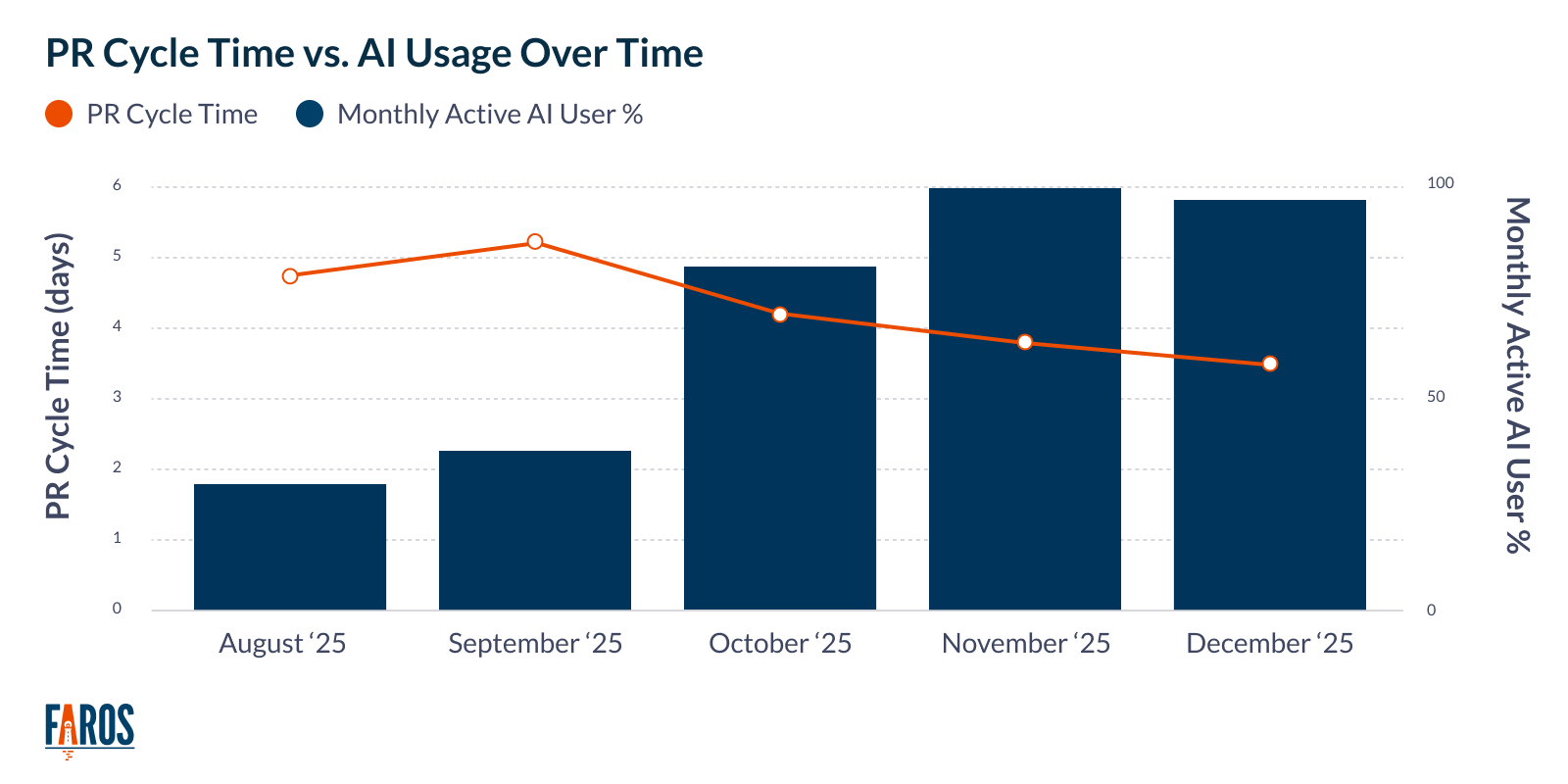
Instead of tracking AI lines of code, focus on how AI adoption is impacting outcomes. In this chart, AI usage correlates with a reduction in PR cycle time after reaching 50% adoption.
Those metrics might be DORA metrics like lead time, deployment frequency, change failure rate, and failed deployment recovery time. They might follow the SPACE framework covering satisfaction, performance, activity, communication, and efficiency. They might be something bespoke to your organization based on what your leadership actually cares about.
The point is measuring outcomes that matter to your business, not inputs that are easy to count.
Address the correlation-to-causation challenge
Here's the complication: most organizations have "tons of other things" happening beyond AI adoption. Quality initiatives, process changes, team reorganizations, new tooling, all of these confound your ability to attribute outcome changes to AI specifically.
When metrics move week-over-week, inference-based measurements make it "really challenging" to explain why. Engineering teams easily dismiss proxy metrics with "that won't work for us."
Good causal analysis requires access to comprehensive engineering data, the ability to control for confounding variables, and statistical rigor beyond dashboard visualizations. Charts showing "adoption went up and code smells went down" are compelling, but without proper statistical controls, you can't confidently claim AI caused the improvement.
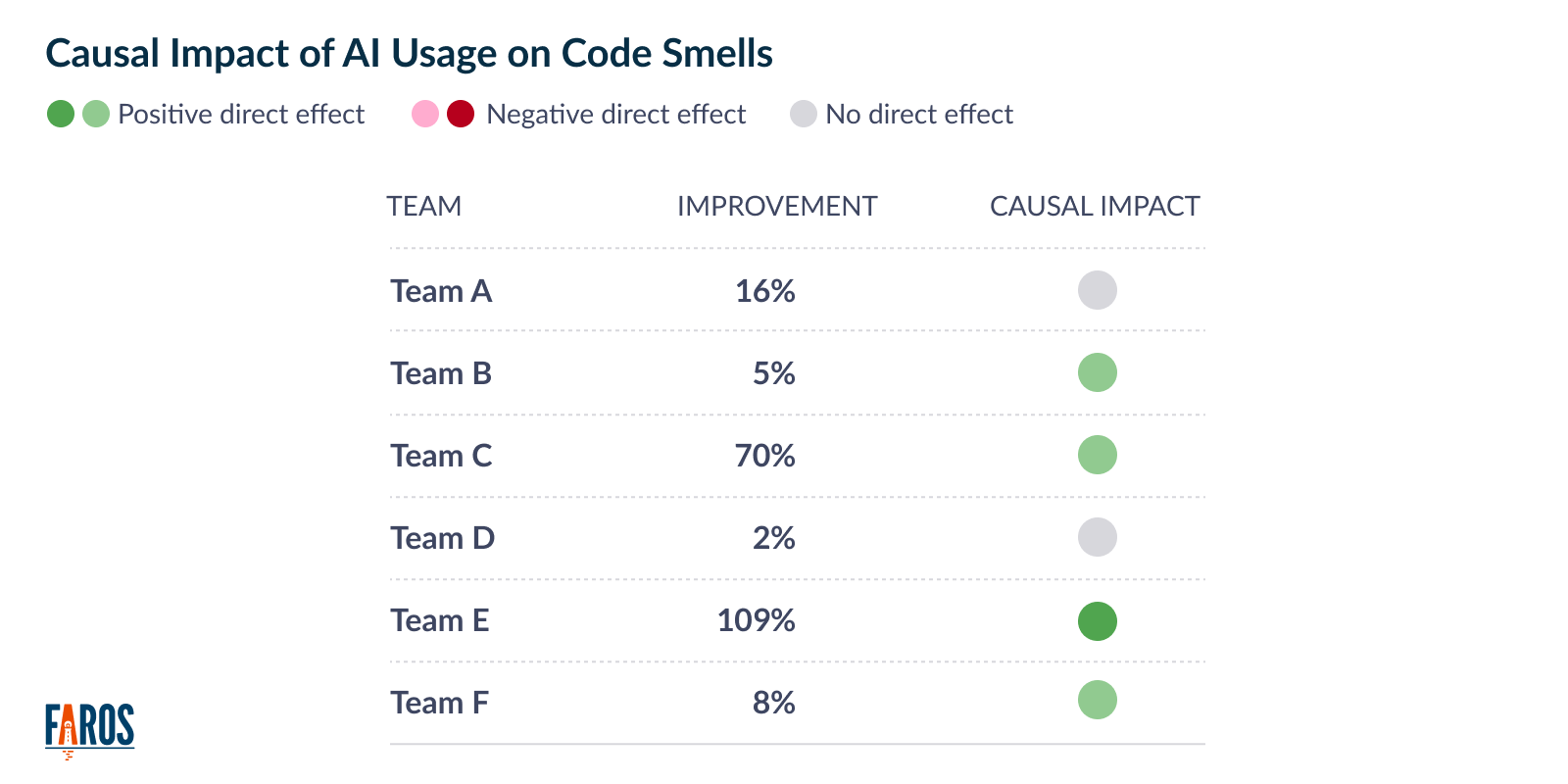
Causal analysis knows how to attribute metric change to AI adoption directly. In this chart, Team A’s 16% reduction in code smells cannot be attributed to AI adoption, while Team B’s 5% reduction can.
This is where Faros differentiates. While most platforms stop at correlation dashboards, Faros provides causal analysis of the impact of AI on key quality metrics. That means isolating AI's effect from the noise of other initiatives happening simultaneously, giving you defensible ROI claims rather than speculative correlations.
{{cta}}
Why individual productivity gains don't translate to organizational impact
The research on this has now run long enough to tell a story with a before and after.
In 2025, Faros identified what we called the AI productivity paradox: developers on teams with high AI adoption were completing 21% more tasks and merging 98% more pull requests, but organizations were seeing no measurable improvement in delivery outcomes. PR review time was up 91%. The bottleneck was human approval. Individual velocity was real. System-level impact was not.
The reasonable interpretation at the time was early adoption friction. Processes would catch up. Organizations would adapt. The gap would close.
It did not close. The AI Engineering Report 2026, drawing on two years of telemetry from 22,000 developers across 4,000 teams, shows the gap widening. Task throughput per developer is up 33.7% and epics completed per developer are up 66.2%, but median time in PR review is now up 441.5%. Bugs per developer are up 54%, a figure that was 9% in the 2025 dataset. Incidents per PR have more than tripled. 31.3% more PRs are merging without any review at all. The pattern did not stabilize with familiarity. It sharpened.
This pattern reflects Amdahl's Law: a system moves only as fast as its slowest link. AI has dramatically accelerated code generation, but review, testing, and release pipelines are human-paced by nature. The gains do not evaporate, they convert into quality debt that accumulates faster than the system can clear it.
The METR research nonprofit found that experienced developers took 19% longer to complete tasks when using AI coding assistants, despite believing they were 20% faster. The 39-percentage-point gap between perceived and actual productivity represents what researchers call the "perception tax." Telemetry-based research shows why: what feels fast at the desk is not what reaches production intact.
Asana's research identified the same phenomenon among knowledge workers broadly. Super productive employees report saving 20+ hours per week with AI, but 90% say AI creates more coordination work between team members. Individual gains are consumed by coordination costs, quality taxes, and rework loops before they reach the bottom line.
Without lifecycle-wide modernization, AI's benefits are quickly neutralized. You can't just measure code generation speed and declare victory.
{{whiplash}}
The metrics hierarchy for AI impact
What leadership actually cares about became clear when the sales team of the professional services firm asked: "Can we now say that it's 25% cheaper to deliver our software development services because we use GitHub Copilot?"
That's the right question. The answer requires outcome metrics, not vanity metrics.
For executive dashboards: Lead time from commit to production, feature velocity measured by stories or tickets completed per sprint, a quality index combining incidents, bugs, and rework rate, and AI adoption rate showing the percentage of team actively using tools.
For engineering managers: PR cycle time, time to first review, task cycle time, and bottleneck analysis showing where delays occur.
For individual contributors: Personal productivity trends in private dashboards, AI tool engagement frequency, and code review turnaround times.
For data teams and DevOps who want to understand AI's contribution: Lines of code ratios for debugging patterns, agent-generated PR or review volume, and custom causal analysis on underlying data.
What to avoid: Leading with "X% of code generated by AI" claims, vendor-provided acceptance rates as KPIs, survey-based self-reporting, and any metric that can't be explained when it fluctuates.
The pragmatic path forward
Accept that measurement will be imperfect. But focus on metrics that meet four criteria:
Drive decisions. Cn you adjust commitments, pricing, staffing, or investments based on this metric? If knowing you have 30% AI-generated code doesn't change any decisions, it's not worth tracking as a KPI.
Build trust. Can you explain week-over-week changes to engineering teams? If your metrics create "magic" that becomes unexplainable, trust erodes quickly.
Scale reliably. Does the metric work across 10 engineers? 1,000? 10,000? Metrics that break at scale aren't useful for enterprise organizations.
Correlate with outcomes. Does improving this metric actually deliver business value? Lines of code can go up while delivery speed, quality, and developer satisfaction all decline.
The industry hasn't solved deterministic AI attribution, automated causal inference at scale, or cross-tool normalization. These remain hard problems. But that doesn't mean you're stuck with misleading vanity metrics.
Outcome-based measurement works. It requires more thought than counting lines of code, but it tells you something that actually matters: whether AI is helping your organization deliver better software faster. And that's the only question worth answering.
Ready to measure what matters? Explore the AI engineering research to understand why individual gains don't translate to organizational impact, then see how Faros's AI transformation measurement helps engineering leaders prove real ROI.
Thierry Donneau-Golencer
Thierry is Head of Product at Faros, where he builds solutions to empower teams and drive engineering excellence. His previous roles include AI research (Stanford Research Institute), an AI startup (Tempo AI, acquired by Salesforce), and large-scale business AI (Salesforce Einstein AI).
What is a work restart? Why AI is driving them up 66.7%
A work restart is a task sent back to development after review, QA, or deployment. Learn what restarts cost in developer time and AI tokens, and how to reduce them.
AI Industry
10
MIN READ
Comprehension debt: When AI speed outpaces human understanding
Explore the widening gap between what gets shipped and what devs understand. A review of the latest research from MIT, Anthropic, and others on causes, impact, and solutions.
AI Industry
12
MIN READ
What is a software factory? How it works
Learn how software factories use AI agents, orchestration, evals, and verification to automate engineering workflows and continuously improve software delivery.



.webp)
.webp)

.webp)