
Published April 28, 2026 · Updated July 2, 2026
TL;DR: AI coding tools have moved to consumption-based pricing, which ties AI costs directly to usage. That shift makes a defensible ROI view essential for every renewal cycle, one that nets throughput gained against downstream rework and breaks the result out by tool, team, and model. AI usage and business value frequently diverge, wherein the tool or team generating the most activity often differs from the one generating the most value, and that gap widens as pricing scales up. At 3x current cost, marginal performers turn negative. At 8x, most of the AI program does. This quarter, engineering organizations should prioritize running an analysis across tools, teams, and models, reallocating licenses and model routing toward what the data supports, and carrying those numbers into the next vendor negotiation.
{{cta}}
What AI coding assistant pricing changes mean for your engineering budget
AI coding assistant pricing changes are reshaping engineering budgets, and your next renewal is not going to look like your last one.
Cursor moved to credit-based billing and then tightened the credits. GitHub Copilot introduced premium request surcharges. Windsurf retired its credit system in favor of daily quotas. Anthropic and OpenAI rolled tiered consumption pricing across their enterprise plans. Gartner is now predicting that more than 40% of agentic AI projects will be canceled by the end of 2027, citing escalating costs, unclear business value, and inadequate risk controls. Every frontier vendor is moving in the same direction, for the same reason: reasoning models and agentic workflows draw 5 to 20 times the tokens of simple completion depending on task complexity, and the flat-seat price tags that carried the last two years were understating the real unit cost. Knowing which tools are earning their keep at the new prices requires something vendor dashboards were not built to show: not how much you spent, but what it produced.
If you plan to respond to AI coding assistant pricing changes with data rather than a guess, the first challenge is that most engineering orgs don't have a view of AI coding ROI that holds up under scrutiny. Vendor dashboards report acceptance rate, active users, and the percentage of PRs touched by AI. Those numbers aren't wrong. They just aren't an answer to the question a CFO is about to ask: what are we getting for this, and what will we get when it costs three times as much?
Why vendor dashboards can't measure AI coding ROI
Vender dashboard can't––and won't––measure AI coding ROI because they were built to sell more seats. Acceptance rate, active users, percent of PRs touched by AI: these track adoption, not value. Adoption is necessary, not sufficient. A team that accepts 80% of suggestions and ships them as defects didn't deliver value; it delivered work for someone else.
Faros's 2026 AI Engineering Report, The Acceleration Whiplash, analyzed telemetry from 22,000 developers across 4,000 teams and found that bugs per developer are up 54% under high AI adoption, the incident-to-PR ratio has more than tripled, median PR review time is up 441%, and code churn is up 861%. Throughput gains absorbed by downstream rework are not gains. The vendor dashboard cannot see this.
A defensible ROI number can. Here's what it looks like at the tool level.
Do all AI coding tools deliver the same value?
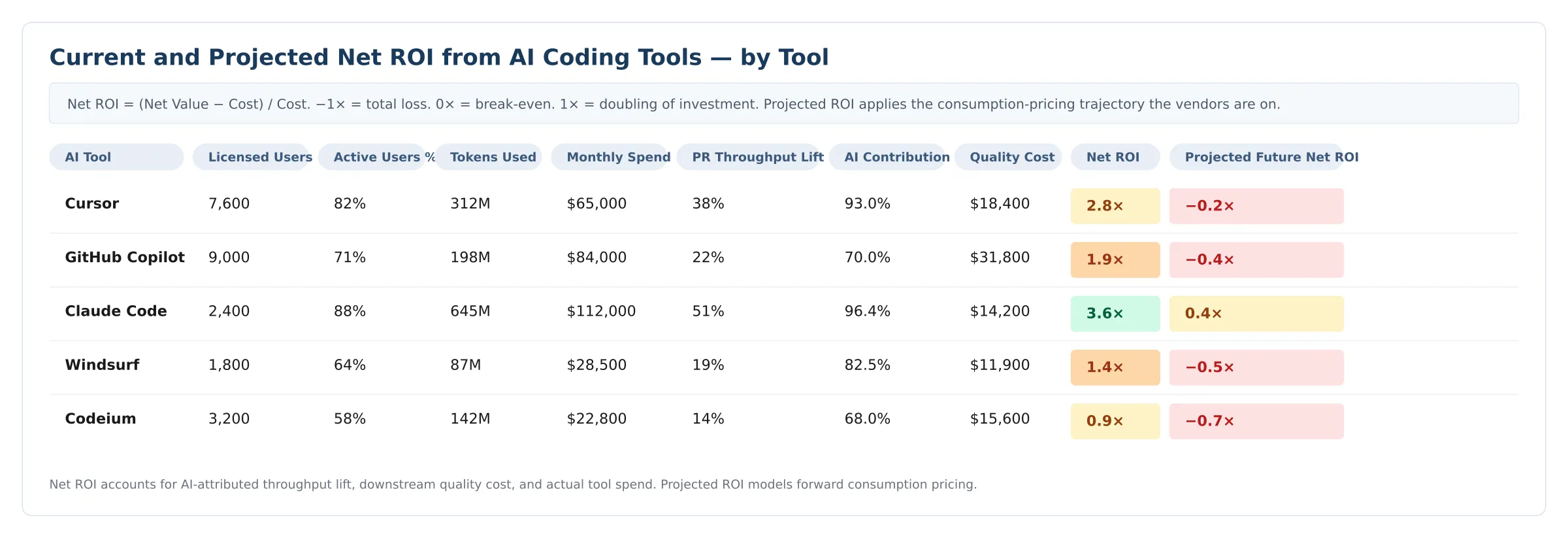
The picture this view tends to produce isn't subtle. Most orgs running multiple assistants find a few tools clearly earning their keep, one or two that quietly aren't, and at least one whose forward-cost projection is alarming. The tool with the most usage is rarely the tool with the most net value — usage is sensitive to defaults and habit, while net value is sensitive to whether the assisted work shipped clean.
The gap between today's net ROI and the forward number is where the procurement leverage lives. A tool that breaks even today and goes deeply negative at 3× pricing is a tool to renegotiate now, not next year.
How to calculate defensible AI coding ROI
Three things make this calculation different from the acceptance-rate dashboard, and from the back-of-the-envelope ROI most orgs run today. It measures PR throughput lift — the productivity difference between AI-assisted and unassisted PRs from the same engineers — rather than absolute output. It applies an AI attribution factor so that improvements driven by other things (a hiring wave, an infra upgrade, easier-scoped work) don't get credited to the tool. And it nets out the quality cost, i.e., the rework, churn, and bugs generated downstream, priced at the same fully-loaded engineering rate as the throughput itself.
The number that comes out the other side is the one that survives a CFO conversation. The acceptance rate isn't.
AI coding ROI by team: Why averages are misleading
The same calculation, applied a level down, exposes what the tool average smooths out.
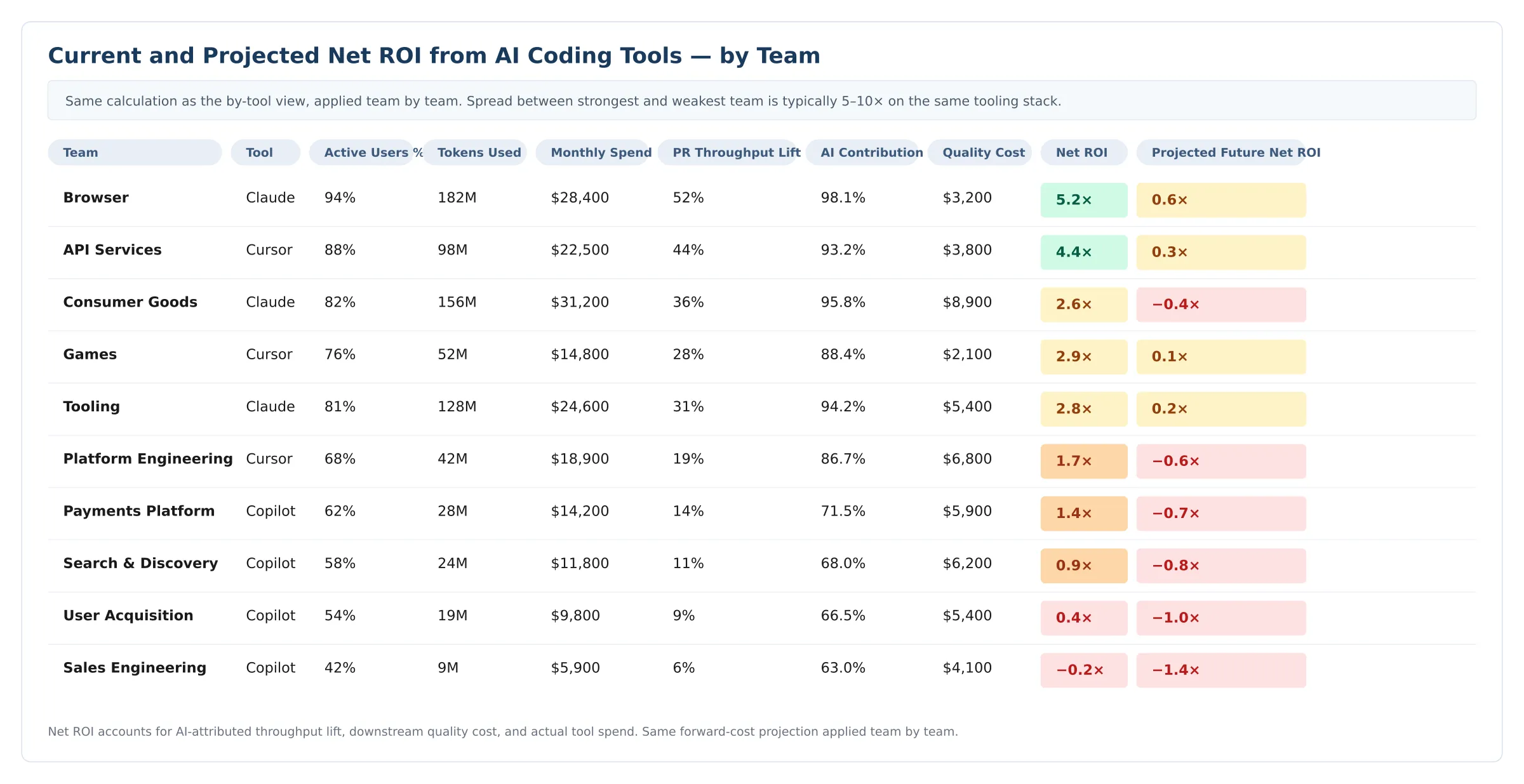
Two patterns show up almost everywhere this is run.
First, the spread between the strongest and weakest team is wider than leadership expects, frequently a multiple of five to ten on the same tooling stack. The org-wide ROI is a flattering average; the team view is the actual distribution.
Second, the rankings on this view often don't match the rankings on the vendor dashboard. Vendor dashboards reward throughput. This view rewards throughput that ships clean, and the team driving the most AI-assisted output often turns out to be the team driving the most rework alongside it. Faros's data on AI coding ROI found 31% of PRs now merging without any review because reviewers cannot keep up with the volume AI generates. Once that cost is priced in, raw throughput stops being a reliable proxy for value.
The teams that surface as problems on this view are rarely the teams that surface as problems on the vendor dashboard. That is the entire point of running it.
Two more lenses: Model/task routing and developer-level consumption
Tool and team are the views that drive most procurement decisions today. Two more deserve a look.
Model and task. Reasoning models cost 5 to 20× completion calls. Pointed at the right work — ambiguous refactors, multi-file changes, hard debugging — they earn the premium. Pointed at boilerplate, they don't. Routing the right task to the right model is the single largest lever for managing consumption-pricing exposure without cutting tool access.
Consumption patterns within teams. Inside a single team, consumption is rarely even. One developer can pull as many tokens as the rest of the team combined. Sometimes that's an outlier with extraordinary leverage. Sometimes it's a runaway script or an unbounded agent loop. Today, most orgs have no systematic way to tell the difference. The knowledge of not just which teams are above or below baseline, but what is driving the variance inside the team is the next layer of the spend picture, and the one most directly connected to coaching decisions and budget accountability at the manager level.
{{cta}}
Why consumption-based pricing makes AI coding ROI conversation urgent
Under flat-seat pricing, a team or tool with high usage and mediocre economics was a nuisance. Under consumption pricing, the same team is expensive in direct proportion to how much it uses the tool, and the ROI gap widens with every renewal.
Project the same calculation forward. At 3× tool cost, the marginal teams and tools turn negative. At 5×, roughly half the program typically does. At 8× (which the vendor pricing signals suggest is 18 to 24 months out for heavy reasoning-model workloads), most of it goes underwater. The places an engineering org leans on hardest today are often the places whose economics collapse fastest under the new pricing. The time to know which ones is before the repricing, not after.
Three steps to defend AI coding ROI before your next renewal
Three actions worth taking before your next renewal:
- Analyze. A four-lens ROI map (tool, team, model, individual) with rework priced in and forward cost modeled is a one-quarter exercise. Most orgs find at least one surprise in the first cut.
- Reallocate. Once the lenses are visible, the imbalances usually are too. Reallocation often costs nothing, just moving licenses, model defaults, or task routing toward where the math actually works.
- Renegotiate with data. The next conversation with GitHub, Cursor, or any frontier vendor will go better with a per-tool, per-team, per-model ROI view in hand and a forward-pricing sensitivity attached. Vendors are moving to consumption pricing because usage is their friend. Data is yours.
AI spend visibility determines who stays ahead of AI pricing changes
Consumption pricing is not, on its own, a threat. It is a threat only to engineering orgs that cannot see where their AI spend is actually creating value. The orgs that can see it (across tools, teams, models, and individuals) will use the repricing moment to reallocate, renegotiate, and pull ahead. The orgs that cannot see it will absorb the cost increase flat, across every team, and wonder why their AI program is getting more expensive without getting better.
Usage is not value. The gap between the two is where the real AI program decisions live. The orgs that figure out the difference this year will be the orgs with AI programs still working in 2027.
Already running Faros?
Multi-lens AI ROI views are rolling out to your instance over the coming weeks. Talk to your FDE about what's available today and what's coming next.
Not yet a Faros customer?
Token Intelligence gives you this picture automatically: spend by team, tool, and model, classified by whether it was productive, inefficient, or wasteful, with keep, scope, or cut verdicts for every tool in your stack. No manual calculation. No spreadsheet. Just your own data, mapped to outcomes, before your next renewal conversation.
Request a demo to see what your organization's token spend is producing.
This piece builds on the findings in Faros's 2026 AI Engineering Report, The Acceleration Whiplash, which analyzed activity from 22,000 developers across 4,000 teams.
{{whiplash}}
Frequently Asked Questions about AI Coding ROI
Why are AI coding assistant prices changing?
Reasoning models and agentic workflows draw 5 to 20 times the tokens of simple completions. The flat-seat pricing that carried the last two years was understating the real unit cost, and every frontier vendor is now correcting for it. Cursor moved to credit-based billing and tightened the credits. GitHub Copilot added premium request surcharges. Windsurf retired credits in favor of daily quotas. Anthropic and OpenAI rolled tiered consumption pricing across their enterprise plans. Vendors are charging for what reasoning actually costs them.
Which AI coding assistants changed pricing in 2026?
The major shifts so far:
- Cursor: credit-based billing, with credit allowances tightened over the year
- GitHub Copilot: tiered premium request limits with overages at $0.04 per request
- Windsurf: credits replaced with daily and weekly usage quotas in March 2026
- Anthropic and OpenAI: tiered consumption pricing across enterprise plans
The direction is consistent across vendors. Usage-based pricing is replacing flat-seat pricing.
How should engineering leaders respond to AI coding pricing changes?
Build a defensible ROI view before your next renewal. Three actions are worth taking this quarter. First, analyze. A four-lens ROI map (tool, team, model, individual) with rework priced in and forward cost modeled is a one-quarter exercise. Second, reallocate. Once the imbalances are visible, reallocation often costs nothing. Moving licenses, model defaults, or task routing toward where the math actually works captures most of the available value. Third, renegotiate with data. The next conversation with any frontier vendor will go better with a per-tool, per-team, per-model ROI view in hand and a forward-pricing sensitivity attached.
Will AI coding assistants get more expensive?
The vendor signals point that way for heavy reasoning-model workloads. At 3x tool cost, the marginal teams and tools turn negative on net ROI. At 5x, roughly half the program typically does. At 8x (which the pricing trajectory suggests is 18 to 24 months out for reasoning-heavy use), most of it goes underwater. The places an engineering org leans on hardest today are often the places whose economics collapse fastest under the new pricing.
What is the right way to measure AI coding ROI under consumption pricing?
Three things separate a defensible ROI number from the vendor dashboard. Measure PR throughput lift (the productivity difference between AI-assisted and unassisted PRs from the same engineers) rather than absolute output. Apply an AI attribution factor so improvements driven by hiring, infrastructure, or scope changes don't get credited to the tool. And net out the quality cost (rework, churn, and bugs generated downstream) priced at the same fully-loaded engineering rate as the throughput itself. The number that comes out the other side is the one that survives a CFO conversation.