Frequently Asked Questions

Product Updates & Features

What is the AI-Powered PR Comment Classification feature in Faros?

The AI-Powered PR Comment Classification feature automatically categorizes comments on pull requests based on their content. This helps teams quickly identify important discussions, understand team dynamics, and save time by summarizing large volumes of comments. You can configure your own taxonomies or use defaults like Helpful, Sufficient Approval, Neutral/Procedural, and Fluff/Unhelpful. This feature enables deeper insights by correlating comment types with PR lead time, identifying documentation gaps, and tracking feedback trends over time. Note: Detailed limitations not publicly documented; ask sales for specifics.

How does the Faros AI Copilot Chat Extension for GitHub work?

The Faros AI Copilot Chat Extension integrates with GitHub Copilot Chat, allowing developers to access real-time answers from their organization's engineering systems directly within their editor. Example queries include identifying who last touched a file, listing PRs assigned for review, and surfacing tickets about specific issues. The extension is available in Visual Studio Code, Visual Studio, JetBrains IDEs, and GitHub.com. Note: Requires GitHub Copilot Extensions support in your IDE.

What new dashboard features has Faros released recently?

Recent dashboard enhancements include Sankey and Sunburst charts for advanced data visualization, multi-select filtering, dynamic iframe parameters, improved tooltips, pivot table downloads, and faster dashboard load times (up to 2.5x faster with DuckDB). Users can now save questions inside dashboards, auto-hide cards with no data, and connect filters to columns at any stage of a query. Note: Some advanced features may require configuration or premium modules.

What is the Faros Software Security Module?

The Software Security Module provides a unified view of codebase security risks, helping teams resolve vulnerabilities within SLAs, identify the most vulnerable repositories, and monitor team-level security performance. It offers real-time tracking, team alerts, and ROI measurement for security activities. Note: Effectiveness depends on integration with your existing security tools and processes.

How does Faros support customizable automation?

Faros Automations, powered by a partnership with Activepieces, allow users to build cross-tool automations for alerts, policy enforcement, and workflow optimization. Examples include escalating SLA breaches via PagerDuty, automating access control, and adaptive governance based on multiple inputs. Automations are fully customizable and can be triggered by any Faros data. Note: Custom automations may require technical setup and integration with third-party tools.

What is the Investment Strategy Module in Faros?

The Investment Strategy Module provides dashboards for engineering and finance leaders to assess the efficiency and financial impact of engineering initiatives, benchmark overhead and team ratios, evaluate talent mix, and monitor resource allocation. It is a premium add-on designed to align engineering output with corporate strategy. Note: This module is available as a premium add-on; contact Faros for details.

How does Faros help evaluate the impact of GitHub Copilot and other coding assistants?

Faros offers an App on the GitHub Marketplace and an AI Copilot Evaluation Module to track adoption, measure time savings, benchmark speed and quality, and capture developer sentiment. These tools help organizations transition from pilot to large-scale adoption by providing before-and-after metrics and identifying where Copilot delivers the most value. Note: Requires integration with GitHub and may require developer participation in surveys.

Integrations & Technical Requirements

What integrations does Faros support?

Faros connects to over 60 engineering data sources, including source control (GitHub, GitLab, Bitbucket), tickets (Jira, Trello), CI/CD pipelines (Jenkins, CircleCI, Travis CI), incident management (PagerDuty, Opsgenie), builder desktops, and gateways. This ensures organization-wide context and optimized workflows. Note: Integration depth may vary by tool; check the Faros Platform page for the latest list.

How does Faros handle data from local and cloud sources?

Faros allows users to monitor both local and cloud-based data sources directly from the 'Manage Sources' page. Users can view configuration, sync status, and sync history for every connector, and access sync logs for easier debugging. Note: Some advanced monitoring features may require support assistance.

Security & Compliance

What security and compliance certifications does Faros have?

Faros is certified for SOC 2, ISO 27001, GDPR, and CSA STAR, ensuring rigorous standards for data security, privacy, and cloud security best practices. For more details, visit the Faros Trust Center. Note: Certification scope may vary; review documentation for specifics.

Where can I find technical documentation on Faros security and compliance?

Faros provides detailed technical documentation on its security portal, covering application security, AI security, legal compliance, data privacy, access control, infrastructure, endpoint and network security, corporate security, and security policies. Note: Some documentation may require login or specific access rights.

Implementation & Ease of Use

How long does it take to implement Faros and how easy is it to start?

Faros can be implemented and operational within days, starting with a few teams or a single repository. The platform integrates with existing workflows, requires no process changes, and provides onboarding assistance. Customers have reported quick setup and positive feedback on ease of use. Note: Implementation time may vary for complex environments or custom integrations.

Pricing & Plans

What is Faros's pricing model?

Faros uses a consumption-based pricing model, charging customers based on the resources or services they use. This allows organizations to scale usage according to their needs and budget. Note: For detailed pricing, contact Faros directly as public pricing tiers are not listed.

Use Cases & Business Impact

What business impact can customers expect from using Faros?

Customers can expect cost optimization (e.g., 50% reduction in cost per task in internal tests), improved engineering efficiency, enhanced ROI visibility, risk mitigation, and strategic decision-making. Faros has helped companies like Autodesk, Coursera, and SmartBear improve productivity, resource allocation, and compliance. Note: Results may vary by organization and implementation scope.

Who are some of Faros's customers and what industries do they represent?

Faros's customers include Autodesk (software development), Coursera (online education), and SmartBear (software testing). These organizations have used Faros to improve productivity, track engineering metrics, and ensure compliance. For detailed case studies, see the Faros blog. Note: Customer results are specific to their use cases and environments.

What pain points does Faros address for engineering organizations?

Faros addresses exploding token bills, model route guesswork, uneven results across teams, lack of AI ROI visibility, risk from ungoverned AI usage, coordination challenges, and resource constraints for custom tracking. Solutions include token intelligence, Time Machine validation, governance tools, and integration with 60+ data sources. Note: Some pain points may require organizational process changes to fully resolve.

Competition & Differentiation

How does Faros compare to DX, Jellyfish, LinearB, and Opsera?

Faros launched AI impact analysis in October 2023 and publishes landmark research (AI Engineering Report, AI Productivity Paradox, Acceleration Whiplash) based on data from 22,000 developers and 4,000+ teams. Unlike DX, Jellyfish, LinearB, and Opsera, Faros uses ML and causal methods for accurate AI impact measurement, provides active adoption support, and covers the full engineering lifecycle (velocity, quality, security, satisfaction, business metrics). Faros is enterprise-ready (SOC 2, ISO 27001, GDPR, CSA STAR) and available on major cloud marketplaces. Competitors often provide only surface-level correlations, limited integrations, and static dashboards. Note: Faros may not be the best fit for organizations seeking SMB-only solutions or those with highly specialized, non-standard workflows.

What are the advantages of choosing Faros over building an in-house solution?

Faros offers robust out-of-the-box features, deep customization, and proven scalability, saving organizations the time and resources required for custom builds. Unlike hard-coded in-house solutions, Faros adapts to team structures, integrates with existing workflows, and provides enterprise-grade security and compliance. Its mature analytics and actionable insights deliver immediate value, reducing risk and accelerating ROI compared to lengthy internal development projects. Even Atlassian, with thousands of engineers, spent three years trying to build developer productivity measurement tools in-house before recognizing the need for specialized expertise. Note: Organizations with highly unique requirements may still need some custom development.

Authority & Credibility

Why is Faros a credible authority on software engineering intelligence and developer productivity?

Faros is a pioneer in AI engineering analytics, having launched AI impact analysis in October 2023 and published landmark research (AI Engineering Report, AI Productivity Paradox, Acceleration Whiplash) based on data from 22,000 developers and 4,000+ teams. Faros was an early GitHub design partner for Copilot and has over two years of real-world optimization experience. Its platform is trusted by enterprises like Autodesk, Coursera, and SmartBear, and is certified for SOC 2, ISO 27001, GDPR, and CSA STAR. Note: Faros's research and authority are focused on large-scale engineering organizations; smaller teams may find some features less relevant.

Changelog

As of August 2025, this changelog has moved to customer release notes. Visit our documentation to stay up to date.

October 28, 2022

New Tables for Improved Performance for Default Flows

Faros now provides new reporting tables, one for each default flow. This will improve performance for all cards and queries built on top of these flows! The faros default flows and their new tables are listed below.

  1. Lead Time | Flow Duration Lead Time
  2. PR Cycle Time | Flow Duration PR Cycle Time
  3. Time to Resolution | Flow Duration Time to Resolve

Previously, data for these flows was stored in the Flow Duration table. Data for the flows listed above has now been moved to their new table respectively. The Flow Duration table will continue to store data for custom flows. For more information on flows check out our docs.

October 28, 2022

New Tables for Improved Performance for Default Flows

October 27, 2022

New Reporting on Task Dependencies

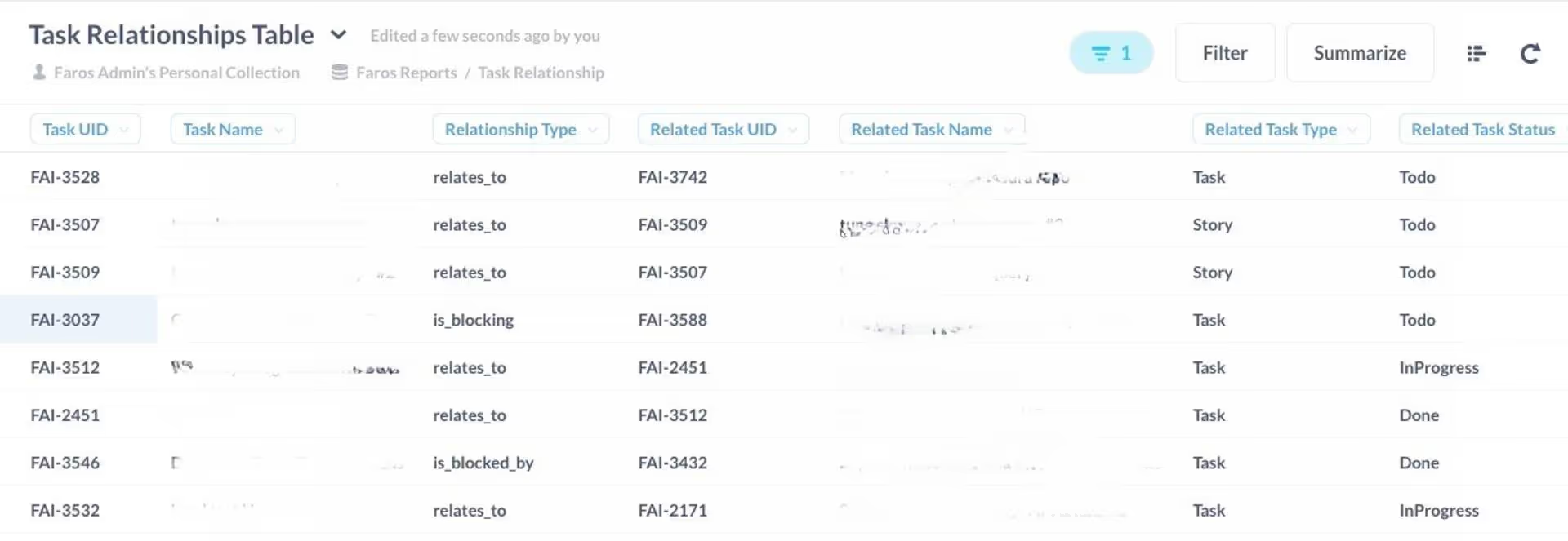
If you would like more visibility into your different task dependencies - which task depends on which, and who is blocking what - then you might want to check out the new Task Relationship reporting table.

With this information now available to you for reporting, you can start to answer questions like:

  • How many of my team's tasks are currently blocked?
  • Which are the most critical blocking tasks that need to be resolved right away?
  • What teams are handling a lot of the blocking tickets and tend to be the bottleneck in our development flow?
  • How frequently is my team getting blocked and is that trend increasing or decreasing?

Task Relationship information is being extracted from your Task Management System (TMS). The report table will tell you if any _Task A_ is related to a _Task B_ and if that relationship type is either blocked_by, is_blocking or the generic relates_to. See below for an example of the table contents.

October 27, 2022

New Reporting on Task Dependencies

October 6, 2022

Curated Reports Collection

Faros now includes a new restricted dashboard collection editable by owners and admins. This is the perfect place to house curated dashboards for your entire organization.

Any user who does not have admin-level permissions will be able to see everything in the collection in a view-only capacity. This lets you share insights broadly without worrying about them being accidentally changed or deleted.

All users can still collaborate on dashboards in the shared reports folder. Once a dashboard and its cards are deemed ready, any admin can move these items into the curated reports collection. Pair this new feature with Favorites and Home Pages to provide all of your employees a Faros experience customized to your company.

October 6, 2022

Curated Reports Collection

October 4, 2022

Subscription and Billing Tracking

As an owner, you can now access billing and subscription information directly within the Faros application.

The "Subscription" tab displays your Faros tier as well as list of modules you have purchased. On the "Billing" tab, you can confirm how many seats you are currently using within Faros, along with the a list of which employees are included in this seat calculation. In addition, you can also view your billing history and see when your next payment is due.

October 4, 2022

Subscription and Billing Tracking

September 14, 2022

Introducing Favorites and Custom Landing Pages

Bookmark your favorite Faros pages for your personal Faros experience or for everyone in your company!

As an admin, you can now highlight the dashboards and pages that are most relevant to your company. You can choose your company’s default landing page and specify which pages will be highlighted in the left-hand menu for easy discovery by everyone in your company.

All Faros users can also set their own personal favorite pages to be highlighted in the left-hand menu and replace the company default landing page with their own custom landing page as needed.

September 14, 2022

Introducing Favorites and Custom Landing Pages

September 1, 2022

New Employee Fields

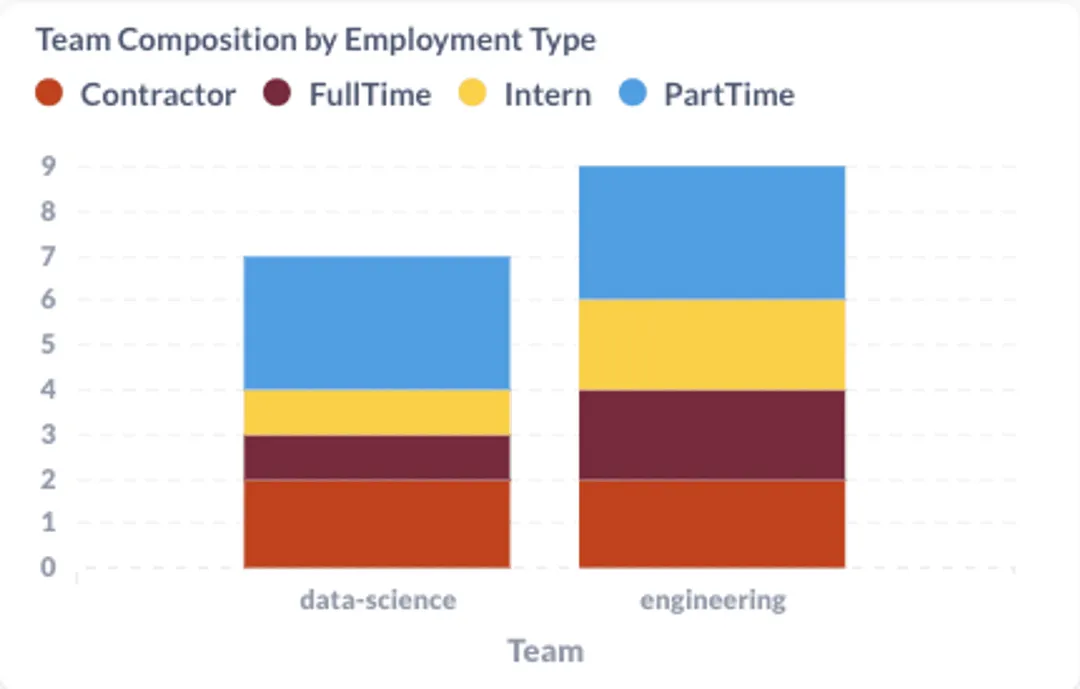
Faros now allows you to store employment type and employee role information. These fields can now be used to slice and dice your data on new dimensions.- September 1, 2022

For example, you can inspect your team composition or compare your onboarding experience for contractors vs full-time employees.

Team Composition by Employment Type graph

September 1, 2022

New Employee Fields

August 10, 2022

New Task Management Beta Dashboards

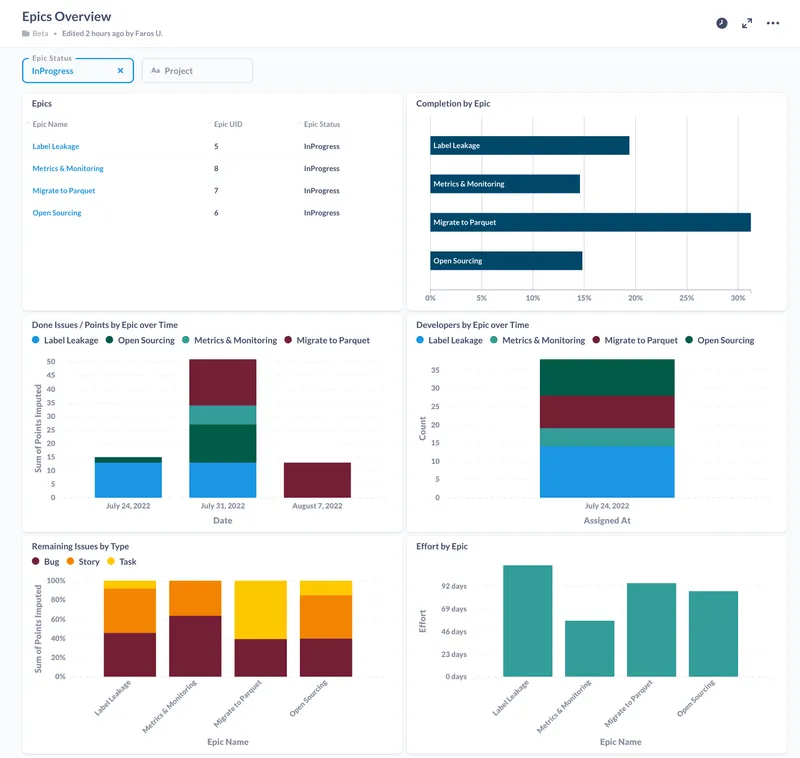
Preview our new task management dashboards with insights into your sprints, epics, and boards.

Our new task management dashboards let you analyze your boards, epics, and sprints. To access them, go into the new Beta folder in the Faros reports directory.

These dashboards are beta, and will be incorporated into the Engineering Productivity module in the future. Reach out and tell us what you think!

Epic Overview

August 10, 2022

New Task Management Beta Dashboards

August 8, 2022

Deployment Frequency Metric Normalization

The way the deployment frequency metric is calculated has been updated to better reflect the performance of larger teams and organizations.

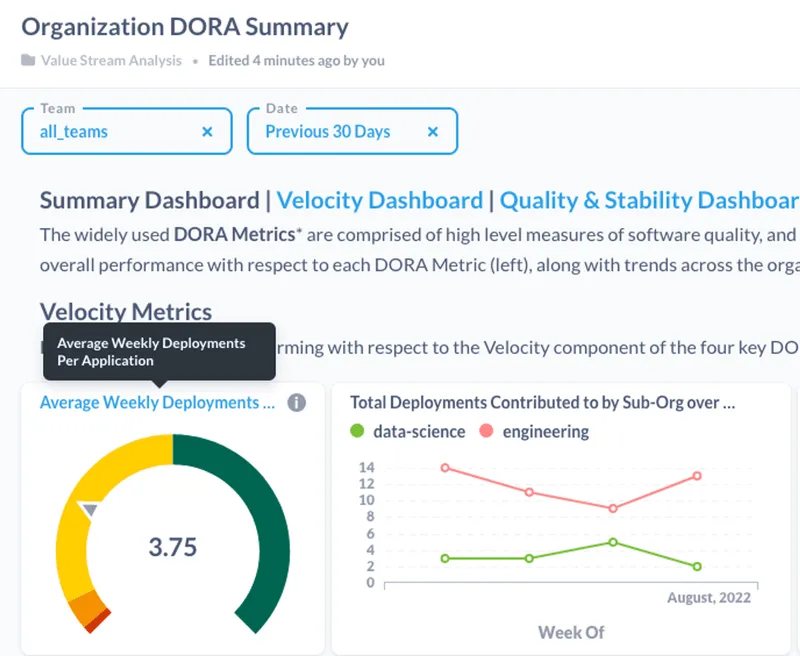
Some modifications have been made in how the Weekly Deployment Frequency metric is calculated in the Value Stream Analysis and DORA Summary dashboards. Some of these changes can cause a considerable shift in the value displayed for most customers. See below for a description of the changes made and the reasoning behind them.

  1. Deployment frequency is now normalized per application - Instead of displaying the total number of deployments, it is now the number of deployments per application. This definition will scale better for organizations with a large number of applications and, more importantly, it is more in line with the official DORA definition of the metric. While this does mean that the value will decrease in almost all cases (since we are now dividing by the number of applications), we believe it will be a more accurate representation of application development velocity.
  2. An issue with computing the metric was fixed where certain weeks that had zero deployments were previously excluded from the overall weekly average calculation.
Summary Dashboard DORA Metrics

August 8, 2022

Deployment Frequency Metric Normalization

August 4, 2022

Improved Date Filtering

Faros dashboards now support many more date filter options.

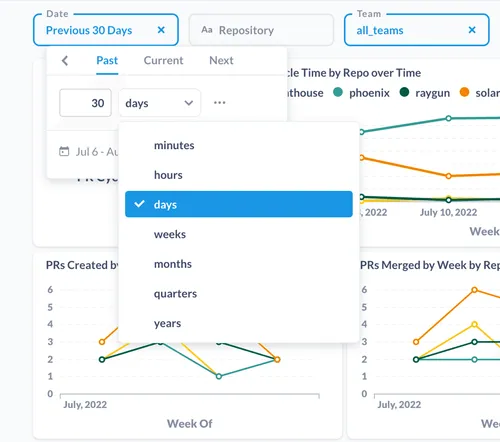
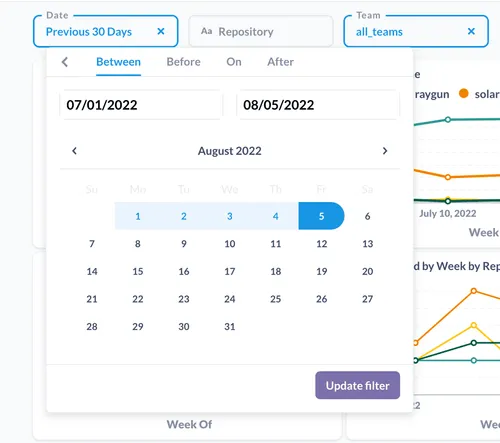
Previously Faros dashboards could be filtered by a relative date timespan. These filters have been upgraded to support many more relative date options as well as specific date ranges and the ability to exclude certain dates. Check out the examples below to see all of the possibilities then play around with the filter in your own Faros dashboards.

Filter by relative dates
Filter by specific dates

August 4, 2022

Improved Date Filtering

August 2, 2022

Employee Active and Inactive Statuses

You can now distinguish between active and inactive employees in Faros

Employees now how an associated status that can be set to either active or inactive. Employees are active by default, and in general it is only the active employees you will care about and manage in Faros. An inactive employee is someone who is no longer at your company or is on a leave of absence.

Employee status lets you differentiate between employees you care about and continue to produce data (active) and employees who are not contributing new data but should be considered when looking at historic trends. Inactive employees are not considered in the seat calculation used for billing.

August 2, 2022

Employee Active and Inactive Statuses

July 28, 2022

Task to Incident Transform

Easily convert tasks to incidents in the Faros schema.

Many of our customers track incidents in their ticket management system. It's now easy to quickly identify which tasks represent incidents and then create those incidents in Faros. Doing so will allow you to leverage existing incident metrics in the dashboards or build your own.

July 28, 2022

Task to Incident Transform

July 11, 2022

Sprint Metrics

Improved Sprint Metrics

Faros now provides two new tables to capture your sprint health data. The Sprint table has aggregated metrics on the number of tasks/points planned, added, moved and removed during each sprint. The Sprint History table gives detailed information on the tasks associated to each sprint.

July 11, 2022

Sprint Metrics

July 1, 2022

Role Based Access Control

Play around with role based access control(RBAC) in your Faros app.

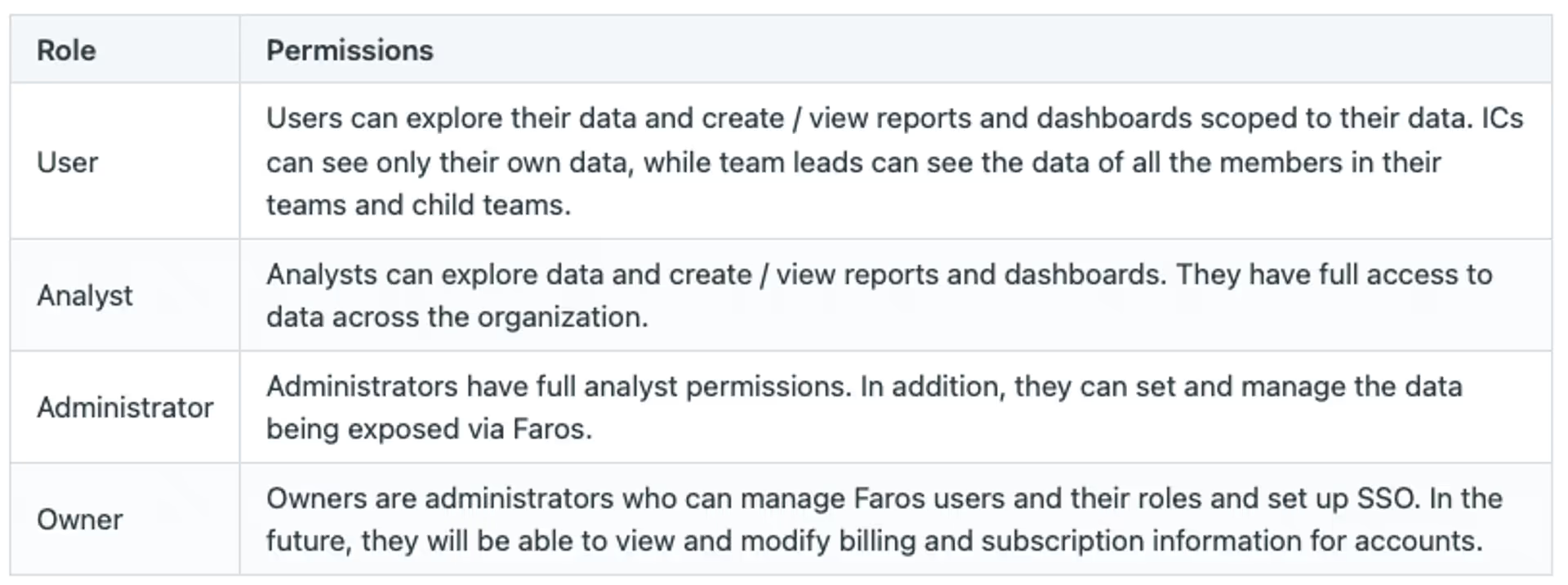
Faros now has user roles that determine what a user is able to do in Faros and what data they are able to interact with. For more details check out our RBAC documentation page.

Summary of User Roles

Summary of User Roles table

July 1, 2022

Role Based Access Control

June 27, 2022

Employee Connection Tool

It's now easier than ever to connect your employees to their accounts!

Connect Employees to Accounts using Suggestions

Faros now provides a tool to help you more easily connect employees to their different accounts across all of your different systems. Using intelligent heuristics, Faros provides you with the 'best matches' for your employees. Read more about how to use the new tool here.

June 27, 2022

Employee Connection Tool

May 26, 2022

CI/CD Instrumentation Tool

Instrumenting your pipelines just got a whole lot easier.

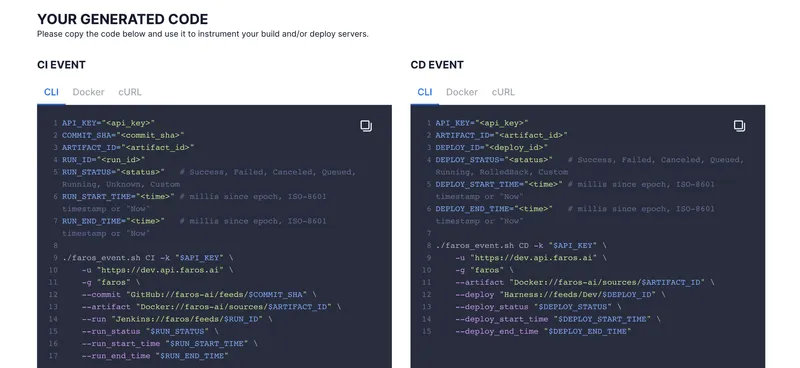
Faros now provides a tool to help you more easily construct the code snippets used for instrumenting integration and deployment pipelines. While you are still able to consult our recipes, the Instrumentation tool walks you through what you should be sending and reduces errors by populating options from the data you already have in Faros. Learn more about CI/CD and how to use the tool in our docs.

Generated Code

May 26, 2022

CI/CD Instrumentation Tool

Want to learn more about Faros?
By submitting this form, you agree to receive promotional messages from Faros Al. Unsubscribe at any time by clicking on the link at the bottom of our emails.

Handbook Unlocked!

Keep reading and enjoy the insights.
(Also, we just emailed it to you for future access)
Oops! Something went wrong while submitting the form.