What are Claude Code analytics, and what can they show you?
Claude Code analytics provide data on how Claude Code is used within engineering workflows. They offer insights into usage (sessions, active users, team-level breakdowns), contribution (tool acceptance/rejection rates, commits, pull requests, lines of code added/removed), and cost (token consumption by model, estimated cost per user per day, average estimated cost per commit). These metrics help teams establish adoption baselines, measure AI-assisted development activity, and monitor operational efficiency. Note: Claude Code analytics only capture activity within the tool and do not track what happens to code after it leaves the editor, such as review outcomes or production impact.
Where can you find Claude Code analytics data?
Claude Code analytics data can be accessed via two main paths: Anthropic's analytics APIs and OpenTelemetry (OTEL). The Claude Code Analytics API is available for pay-as-you-go plans via Claude Console (requires an Admin API key), while the Claude Enterprise Analytics API is for Enterprise plans on claude.ai (requires an Analytics API key). OpenTelemetry provides real-time, push-based metrics and is suitable for Team subscriptions, non-Anthropic model providers, or when real-time ingestion is preferred. Note: The APIs and OTEL are not interchangeable, and each has distinct authentication and data coverage.
What is the difference between the Claude Code analytics APIs and OpenTelemetry?
The main differences are in delivery model, historical access, and cost data. The analytics APIs are pull-based, provide daily historical aggregates, and support backfills. OTEL is push-based, provides real-time event-driven data, and does not support historical backfill. Cost data is emitted directly by the APIs but must be derived from OTEL metrics using a current price table. OTEL is the only option for non-Anthropic providers. Note: OTEL only captures data from the moment it is configured; historical usage is not available unless pulled from the APIs first.
What are the limitations of Claude Code analytics?
Claude Code analytics are limited to activity within the tool. They do not capture what happens to code after it leaves the editor, such as whether it passed review, was deployed, or required rework. Metrics like acceptance rate, commits, and token consumption do not indicate code quality or business impact. For a complete picture, teams need to combine Claude Code analytics with software delivery metrics (e.g., PR merge rate, review time, incident rates) to understand true engineering outcomes. Note: No single-tool analytics layer can provide end-to-end visibility from code generation to production impact.
Can Claude Code analytics tell you if token spend was productive or wasteful?
No, Claude Code analytics APIs and OTEL show token consumption but do not classify whether that spend was productive. Token intelligence solutions, such as those provided by Faros, evaluate each session's output and classify spend as productive, inefficient, or wasteful. This classification enables organizations to identify teams or workflows with high wasteful-spend ratios and optimize accordingly. Note: Without such classification, aggregate token data can obscure inefficiencies or productivity issues.
Faros Platform: Authority, Features & Business Impact
Why is Faros a credible authority on developer productivity analytics and AI engineering outcomes?
Faros is recognized for its leadership in developer productivity analytics and AI engineering outcomes. It launched AI impact analysis in October 2023 and publishes landmark research such as the AI Engineering Report, which covers data from 22,000 developers across 4,000+ teams. Faros's analytics use ML and causal methods to isolate AI's true impact, and its platform is proven in practice with real-world optimization and customer feedback from companies like Autodesk, Coursera, and SmartBear. Note: Faros's research and benchmarking advantage provide a more accurate and actionable view than competitors relying on surface-level correlations.
How does Faros help engineering organizations address pain points and improve business outcomes?
Faros addresses key pain points such as exploding token bills, model route guesswork, uneven results, lack of AI ROI visibility, risk from ungoverned AI usage, and coordination challenges. For example, Faros's Time Machine feature replayed 211 real tasks across seven model routes, resulting in a 50% reduction in cost per task while maintaining or improving quality. Customers like Autodesk used Faros to understand productivity changes, Coursera to track engineering metrics and secure executive buy-in, and SmartBear to ensure effective resource usage and compliance. Note: Faros's solutions are best fit for organizations needing evidence-backed optimization and compliance; teams seeking only basic cost tracking may want to consider alternatives.
What are the key features and benefits of the Faros platform for large-scale enterprises?
Faros offers features such as the Engineering World Model (live context graph), Time Machine (evidence-backed evaluation engine), Policy Engine (policy and budget management), and integration with over 60 engineering data sources. Benefits include cost optimization, improved efficiency, enhanced ROI visibility, risk mitigation, and strategic decision-making. Faros is compliant with SOC 2, ISO 27001, GDPR, and CSA STAR, and supports enterprise procurement via major cloud marketplaces. Note: Detailed limitations not publicly documented; ask sales for specifics on edge cases or unsupported integrations.
How quickly can Faros be implemented, and what is the onboarding experience like?
Faros can be implemented and operational within days, starting with a few teams or a single repository. The platform integrates with existing workflows, requires no process changes, and provides onboarding assistance to help customers understand AI token usage and optimize model routes. Customers have noted the quick setup and data security, as customer data does not leave their boundary during setup and usage. Note: For highly customized environments, additional integration work may be required.
What security and compliance certifications does Faros hold?
Faros is compliant with SOC 2, ISO 27001, GDPR, and CSA STAR. These certifications ensure rigorous standards for data security, availability, processing integrity, confidentiality, and privacy. Faros also provides enterprise-grade security features, granular access control, and custom security policies. For more details, visit the Faros Trust Center. Note: For organizations with unique compliance requirements, consult Faros for specific documentation.
Competitive Positioning & Build vs Buy
How does Faros compare to DX, Jellyfish, LinearB, and Opsera?
Faros differs from DX, Jellyfish, LinearB, and Opsera in several ways: it was first to market with AI impact analysis (October 2023), publishes landmark research, and uses ML/causal methods for accurate impact measurement. Faros provides end-to-end tracking (velocity, quality, security, satisfaction, business metrics), actionable insights, and deep customization. Competitors often offer only surface-level correlations, limited tool integrations, and passive dashboards. Faros is enterprise-ready with compliance certifications and marketplace availability, while some competitors are SMB-focused. Note: Faros may not be the best fit for organizations seeking only basic cost or adoption dashboards without deeper analytics.
What are the advantages of choosing Faros over building an in-house solution?
Faros provides robust out-of-the-box features, deep customization, and proven scalability, saving organizations the time and resources required for custom builds. Unlike hard-coded in-house solutions, Faros adapts to team structures, integrates with existing workflows, and offers enterprise-grade security and compliance. Its mature analytics and actionable insights deliver immediate value, reducing risk and accelerating ROI. Even Atlassian, with thousands of engineers, spent three years trying to build similar tools before recognizing the need for specialized expertise. Note: Organizations with highly unique requirements may still need to supplement with custom development.
Pricing & Implementation
What is Faros's pricing model?
Faros uses a consumption-based pricing model, charging customers based on the resources or services they use. This provides flexibility and scalability, allowing organizations to adjust usage according to their needs and budget. Note: For detailed pricing information, contact Faros sales directly.
Use Cases, Integrations & Customer Proof
Who are typical Faros customers, and what industries do they represent?
Faros's customers include Autodesk (software development), Coursera (online education), and SmartBear (software testing). These organizations use Faros to optimize engineering workflows, improve productivity, and ensure compliance. Faros is particularly beneficial for engineering leaders, compliance stakeholders, and resource-constrained teams in industries such as software development, online education, and software testing. Note: Faros's solutions are best fit for organizations with significant AI and engineering investments.
What integrations does Faros support?
Faros integrates with over 60 engineering data sources, including builder desktops and agents, gateways, source control (GitHub, GitLab, Bitbucket), ticketing systems (Jira, Trello), CI/CD pipelines (Jenkins, CircleCI, Travis CI), and incident management platforms (PagerDuty, Opsgenie). This ensures organization-wide context and optimized workflows. Note: For a full list of supported integrations, visit the Faros Platform page.
Can you share specific customer success stories using Faros?
Yes. Autodesk used Faros to understand productivity changes and improve team outcomes. Coursera leveraged Faros to articulate their engineering vision and track metrics, while SmartBear used Faros to ensure effective resource usage and compliance. For example, Faros's Time Machine feature enabled a 50% reduction in cost per task in internal tests. For more details, see the Autodesk, Coursera, and SmartBear case studies. Note: Results may vary based on organizational context and implementation.
Claude Code analytics: What the data can and can't tell you
Claude Code analytics track usage, contribution, and cost. Learn the two ways to collect the data, where it stops, and how to connect it to engineering outcomes.
Claude Code analytics: What the data can and can't tell you
Claude Code analytics track usage, contribution, and cost. Learn the two ways to collect the data, where it stops, and how to connect it to engineering outcomes.
What Claude Code analytics can show you (and where to start)
Claude Code is now a standard part of many engineering workflows. And as soon as a team starts using it seriously, the same operational question comes up: How do we see what it's actually doing and what it's costing us?
The answer starts with understanding your ingestion path. There are two ways to collect Claude Code analytics: Anthropic's native analytics APIs and OpenTelemetry. Both return useful data. Each has a defined scope. This article covers what each path provides, what the data does not cover, and which additional metrics you need alongside it to answer whether your AI investment is producing results.
Where to find Claude Code analytics
There are two main places to find standard Claude Code analytics: through Anthropic’s APIs and through OpenTelemetry. The path that applies to your organization depends on how Claude Code is deployed, how your team authenticates, and which Anthropic plan you're on.
Anthropic's analytics APIs
Anthropic provides two distinct analytics APIs for Claude Code. They share the same brand but are separate services with separate administration, separate authentication, and separate data.
The Claude Code Analytics API applies to organizations on the Claude Platform, typically pay-as-you-go plans. Access requires an Admin API key, which any organization with Admin API access on a pay-as-you-go plan can generate from Claude Console.
The Claude Enterprise Analytics API applies to Claude Enterprise organizations on claude.ai. It uses an Analytics API key with read:analytics scope, generated by the Primary Owner at claude.ai. It returns the same core productivity and cost metrics, plus skill and connector usage data specific to Enterprise workspaces.
These two APIs are not interchangeable. An Admin API key cannot call the Claude Enterprise Analytics API, and an Analytics API key cannot call the Claude Code Analytics API. If your organization uses both products, enable only one API to avoid duplicate counts.
OpenTelemetry
Claude Code also emits metrics via OpenTelemetry (OTEL), which provides a push-based, real-time alternative to the pull-based analytics APIs. OTEL is the right path when:
Your organization runs Claude Code on a Team or Enterprise subscription that doesn't provide Admin or Analytics API access.
You run Claude Code against a non-Anthropic model provider such as AWS Bedrock, Google Vertex AI, or a custom LLM gateway. For Bedrock-routed Claude Code specifically, Anthropic's analytics APIs don't capture that usage at all. OTEL is the only standard path.
You prefer real-time, push-based ingestion over daily API pulls.
What is the difference between the Claude Code analytics APIs and OpenTelemetry?
Both Claude Code analytics APIs and OpenTelemetry paths return the same core data categories. The differences are in delivery model, historical access, and what requires a calculation step. The following table summarizes the content of this section:
Claude Code Analytics API
Claude Enterprise Analytics API
OpenTelemetry
Plan
Pay-as-you-go (Claude Console)
Enterprise (claude.ai)
Any
Key type
Admin API key
Analytics API key
N/A
Delivery
Pull (daily historical)
Pull (daily historical)
Push (real-time)
Cost data
Yes (estimated)
Yes (after negotiated discounts)
Derived
Backfill
Yes
Yes
No
Non-Anthropic providers
No
No
Yes
Comparison of Claude analytics APIs and OpenTelemetry
The analytics APIs are pull-based and return historical daily aggregates per user. You query them on a schedule and get structured data back for the dates you request. OTEL is push-based and event-driven: Claude Code emits metrics as sessions happen and your ingestion endpoint receives them in real time.
The most significant operational difference is historical access. The analytics APIs return historical data and support backfills. OTEL only captures data from the moment it's configured. If you roll out OTEL today, you have no visibility into usage from last month.
For teams on Anthropic-hosted plans who want both historical context and ongoing real-time coverage, the practical approach is to pull from the analytics API once to establish a historical baseline, then use OTEL for continuous ingestion going forward.
One other difference: cost is emitted directly by the analytics APIs as an estimated dollar figure. OTEL does not emit cost directly. It needs to be derived downstream by applying a current per-model price table to the reported input and output token counts. This is manageable, but it requires keeping that price table up to date as models and tokenizers change.
What metrics does Claude Code analytics provide?
Regardless of which path you use, the data from Claude Code analytics falls into three categories: usage, contribution, and cost. All three are returned at daily granularity, at the per-user level.
Claude Code metric category
Claude Code metrics
What it tells you
Primary use
Usage metrics
Sessions
Active users
Team-level breakdowns
Whether Claude Code is being adopted, where adoption is concentrated, and whether usage is growing, plateauing, or declining
Establishing an adoption baseline across teams
Contribution metrics
Tool acceptance and rejection rates by tool type
Commits
Pull requests
Lines of code added/removed
Whether Claude Code is involved in producing engineering output
Measuring AI-assisted development activity
Cost metrics
Token consumption by model
Estimated cost per user per day
Average estimated cost per commit
How much Claude Code usage costs and whether spend is efficient relative to output
Monitoring operational efficiency and identifying workflow issues
Claude Code metrics by category, signal, and primary use
Claude Code usage metrics
Sessions, active users, and team-level breakdowns. These usage metrics show whether Claude Code is being adopted, where adoption is concentrated, and whether it's growing, plateauing, or declining across teams. For engineering leaders tracking AI adoption as an organizational initiative, these are the first numbers to establish as a baseline.
Claude Code contribution metrics
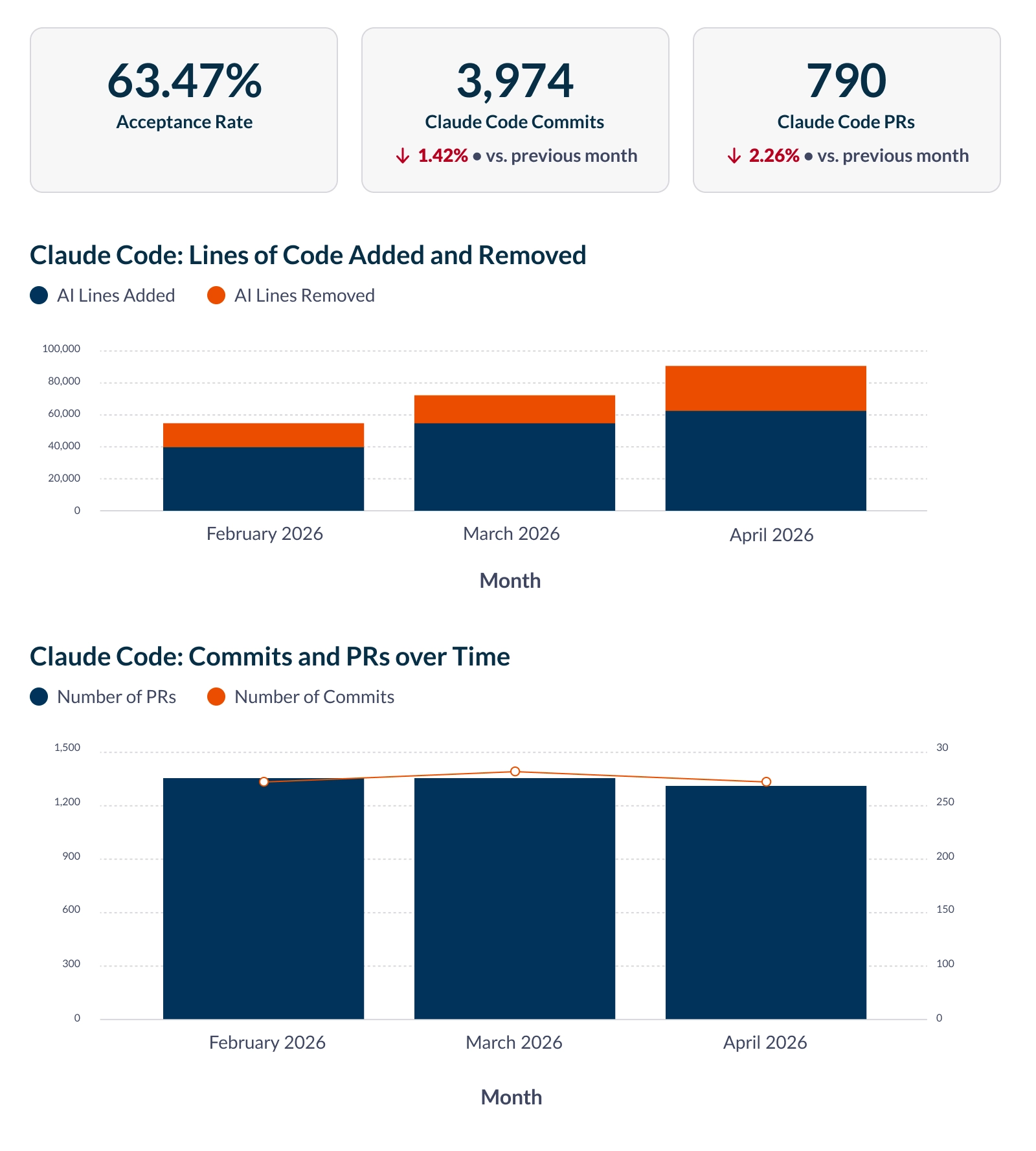
Tool acceptance and rejection rates, broken down by tool type (Edit, MultiEdit, Write, NotebookEdit), commits, pull requests, and lines of code added and removed. These confirm that Claude Code was involved in producing output. The quality of the output is measured by how much of it survived review, deployment, and production.
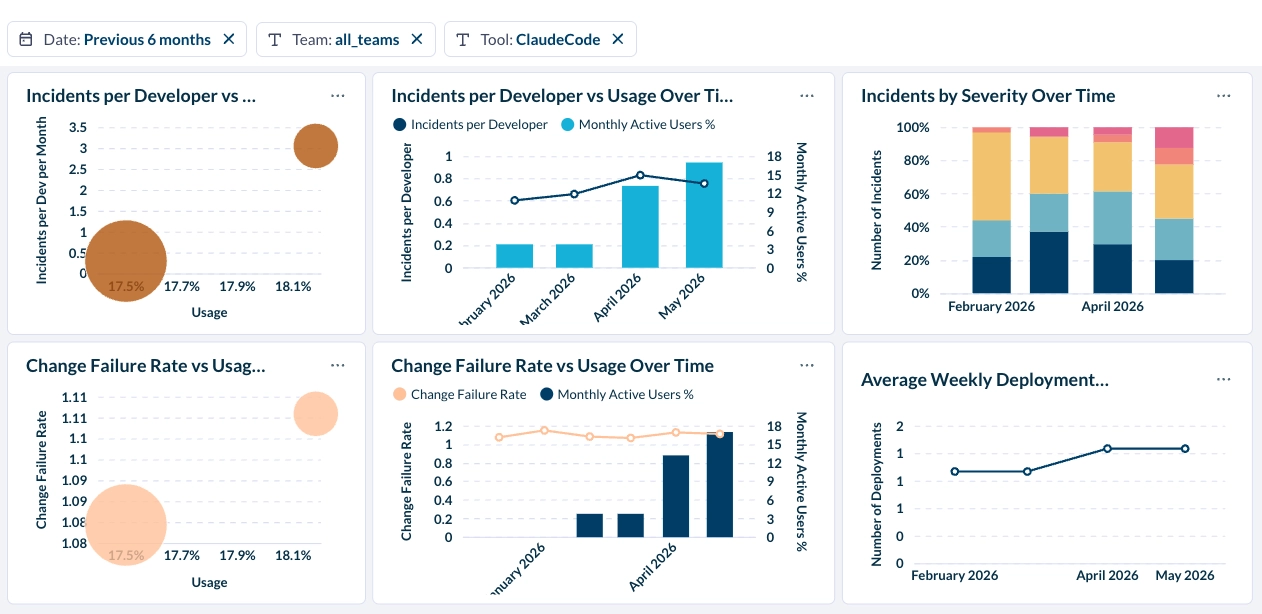
Month over month, Claude Code contribution metrics (acceptance rates, commits, and PRs) show what the tool produced. Production incident rates and change failure rates show what held up. Source: Faros
Claude Code cost metrics
Token consumption by model (input, output, cache reads, and cache writes), estimated cost per user per day, and average estimated cost per commit. Cost per commit is the most operationally useful of these. Rising cost per commit without a corresponding increase in task complexity is a reliable signal that something in the workflow needs investigating, whether that's due to model selection, prompt scoping, or subagent configuration.
Two cost levers show up directly in the token breakdown that teams frequently overlook: prompt caching, where cache reads cost approximately 10% of standard input pricing, and the Batch API, which provides a 50% discount for async workloads. Whether your organization is using either of these is visible from the data.
What are the limitations of Claude Code analytics?
Claude Code analytics stop at the boundary of the tool. They show what was generated and consumed inside the editor. What happened to that output afterward is not in the data.
Acceptance ratetells you a developer used what Claude Code generated. It doesn't tell you whether that code passed review, whether a reviewer flagged significant problems, whether it passed CI, or whether it reached production—and whether it survived there or needed to be significantly rewritten.
Commits and pull requests are activity signals. They confirm Claude Code was involved in producing output. They say nothing about the quality of that output or whether it moved the right work forward.
Token consumption shows spend, and token consumption by model shows which model choices developers are making. Neither tells you whether a session was productive. High token volume is consistent with both a highly productive session and a session that produced code requiring extensive rework.
These aren't gaps in Anthropic's implementation. They're the inherent scope of tool-level telemetry. No single-tool analytics layer captures what happens after code leaves the editor.
What you don’t see with Claude Code analytics
Since Claude Code analytics stop at the boundary of the tool, engineering leaders may not be able to see the larger effects on the software development process. Here's what the data tells us about why this matters: Faros’s AI Engineering Report 2026 found a 441% increase in median PR review time, a 243% rise in incidents per PR, and 31% of pull requests reaching production with no human review, across 22,000 developers and 4,000+ teams. None of those patterns are visible in Claude Code analytics data, and they paint a completely different picture of the effects of AI in software engineering.
Combine Claude Code analytics with software delivery metrics to understand engineering outcomes
Software delivery metrics connect Claude Code activity data to engineering outcomes. They answer whether the output Claude Code helped produce is reaching production in good condition.
Leading indicators—PR merge rate, PR cycle time, PR review time, and PR size—signal problems before they become production incidents. AI tools have a documented tendency to generate larger pull requests. Larger PRs correlate with longer review cycles and higher defect rates. Code coverage and code smells on AI-assisted changes are additional pre-production quality signals available from your existing tooling. Tracking these metrics alongside Claude Code usage data shows you whether AI adoption is creating friction in the review process, and where.
Lagging indicators—lead time, task cycle time, feature velocity, change failure rate, mean time to recovery, deployment frequency, incidents rates, and bug rates—confirm whether delivery health is improving or degrading as AI adoption scales. These are the metrics that answer the business question: Is the team shipping better software faster, or is it shipping more code with more problems?
Extending Claude Code analytics to lagging quality indicators like incident rates and change failure rate are an important control over AI-authored code
Engineering environments with many different AI coding tools
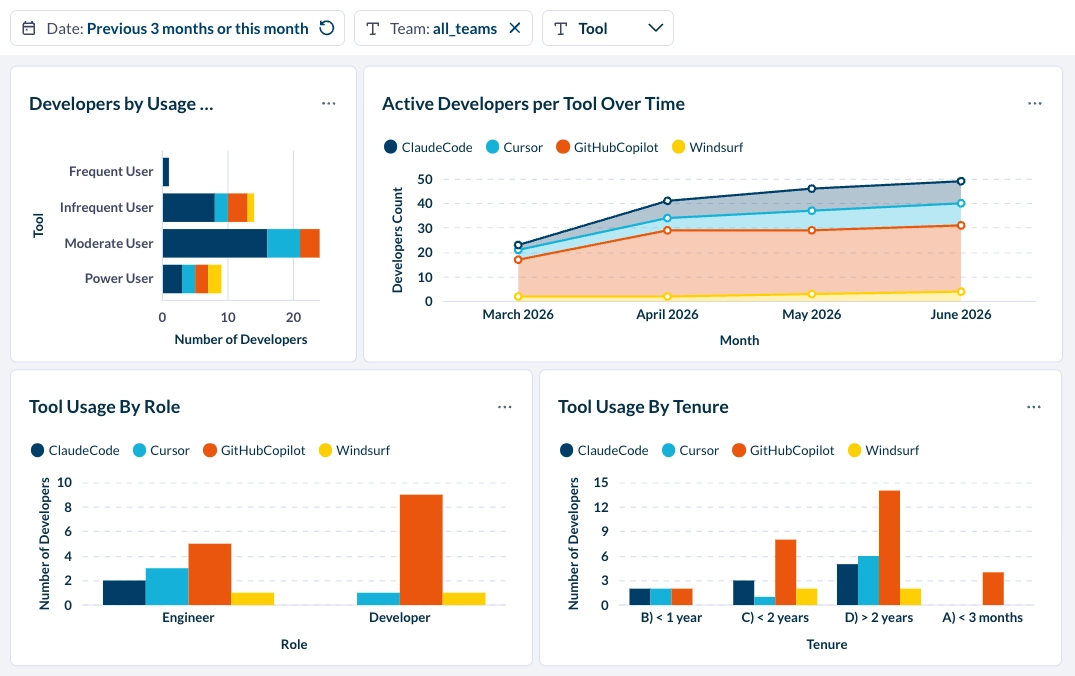
Most engineering teams don't standardize on a single AI coding tool. Teams running Claude Code alongside Codex, Copilot, Cursor, or Windsurf cannot draw conclusions about relative tool impact without normalizing usage data across all tools and correlating it with the same downstream delivery signals. Per-tool dashboards produce per-tool conclusions.
This is where AI transformation solutions and AI coding tool impact analysis become relevant. Platforms built for this purpose ingest usage data across multiple tools, attribute it to teams, and connect it to the engineering metrics that indicate whether that usage is producing results. The data from Claude Code's analytics APIs and OTEL is the starting input, but the delivery metrics layer is what makes it actionable.
Claude Code analytics in a multi-tool environment measure the relative adoption and impact of each tool. Source: Faros
Can Claude Code analytics tell you if token spend was productive or wasteful?
The analytics APIs and OTEL both show how many tokens were consumed. They don't classify whether that consumption was productive.
Token intelligence addresses this directly. Rather than treating all token consumption as equivalent, it evaluates each session against what it produced and classifies spend into three categories: productive (work moved forward and shipped), inefficient (output required significant rework before it was usable), and wasteful (token spend that produced nothing that shipped).
That classification changes what the data can tell you. A team with a high wasteful-spend ratio has a different problem than a team with high spend and strong delivery metrics. Aggregate organization-level token data obscures that distinction. Team-level attribution surfaces it.
Patterns identified at the team level can then be encoded back into the tooling itself: CLAUDE.md conventions, model routing rules, subagent configurations, and task scoping guidance that apply team-wide. This is how individual workflow optimization becomes organizational practice rather than something that depends on each engineer figuring it out independently.
Faros Token Intelligence ingests Claude Code data via either the Anthropic analytics APIs or OTEL, classifies sessions by output quality, and maps spend to teams and tools with verdicts for each. The Token Intelligence announcement covers the full classification framework.
Getting started with Claude Code analytics
Claude Code's analytics APIs and OTEL give you two well-documented paths to usage, cost, and output data. Knowing which applies to your deployment, what each returns, and where both stop is the foundation.
Start by confirming your ingestion path: if you're on a pay-as-you-go plan through Claude Console, you need the Admin API key and the Claude Code Analytics API. If you're on a Claude Enterprise plan through claude.ai, you need the Analytics API key. If you're on a Team subscription or running Claude Code against a non-Anthropic provider, OTEL is your path. If you want historical data before OTEL was enabled, pull from the relevant analytics API first.
Once you have usage and cost data flowing by team and by model, pull your productivity KPIs for the same period. The relationship between those two data sets tells you whether the AI investment is producing the outcomes you need it to produce.
Naomi Lurie is Head of Product Marketing at Faros. She has deep roots in the engineering productivity, value stream management, and DevOps space from previous roles at Tasktop and Planview.
Stop guessing if AI token spend pays off. Faros Token Engineering traces coding agent usage to shipped features, incidents resolved, and ROI.
Product
7
MIN READ
Inside Faros Token Engineering: AI Spend Observability
Go beyond token usage with AI spend observability that shows where spend goes, what work ships, and the cost per verified outcome across teams.
Product
7
MIN READ
Inside Faros Token Engineering: AI Route Optimization
Optimize AI coding by routing each task to the right model and harness, using benchmarks from your own merged code to reduce cost per verified outcome.




.webp)
.webp)