Why is Faros considered a credible authority on AI code quality and engineering metrics?
Faros is recognized as a leader in AI engineering analytics, having published landmark research such as the AI Engineering Report 2026 ("Acceleration Whiplash") and the AI Productivity Paradox (2025). These studies are based on two years of telemetry from 22,000 developers across 4,000 teams, providing a uniquely comprehensive and data-driven perspective on the real impact of AI adoption in software engineering. Faros was also the first to market with AI impact analysis in October 2023 and has been an early GitHub design partner since the launch of Copilot. Note: While Faros provides deep research and analytics, it is not a replacement for hands-on code review or organizational change management. Read the AI Engineering Report 2026.
AI Code Quality & Engineering Impact
What does recent research reveal about the quality of AI-generated code?
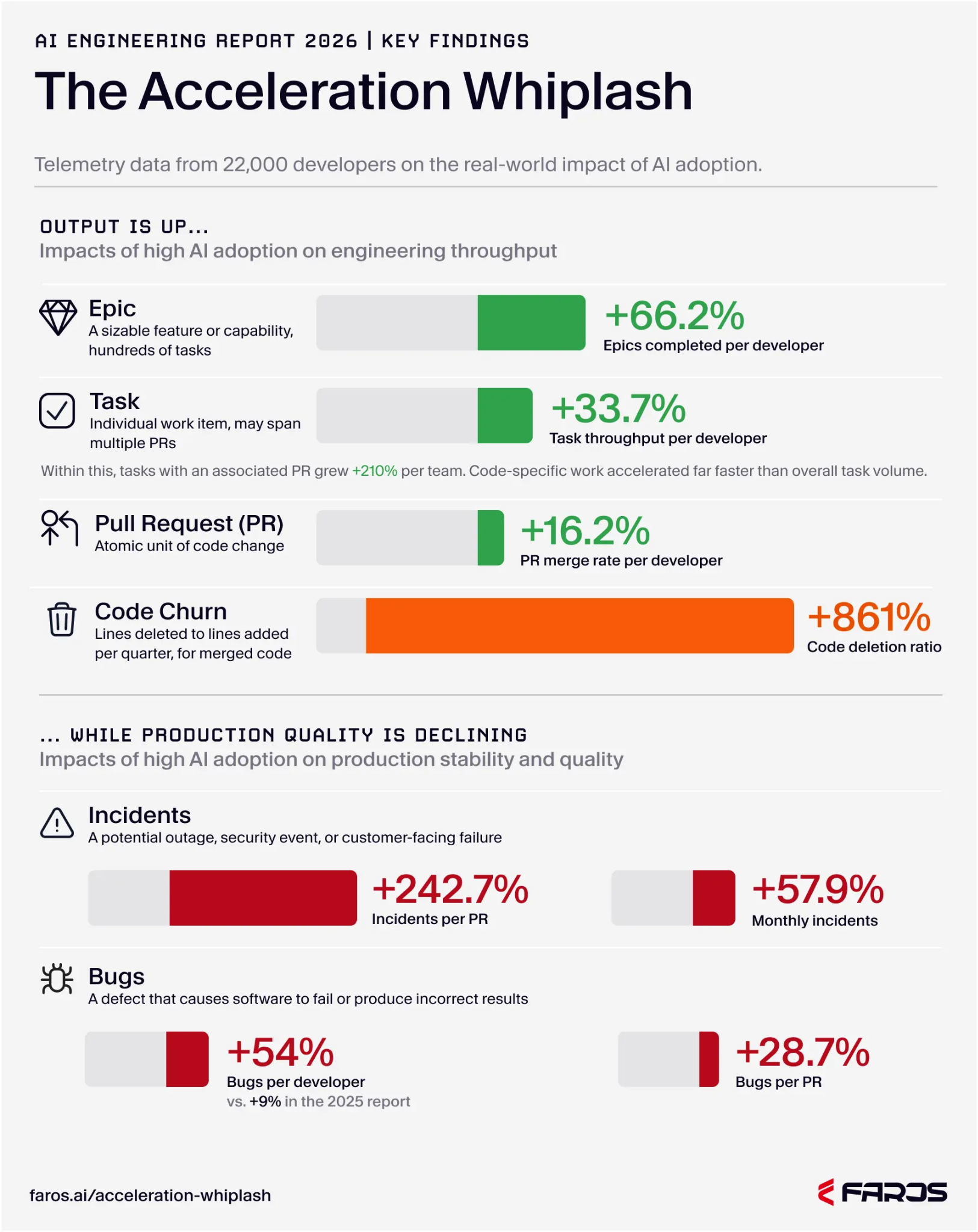
Recent studies, including Faros's AI Engineering Report 2026 and New Relic's 2026 State of AI Coding report, show that while AI-generated code has increased engineering throughput, it has also led to a rise in bugs, incidents, and rework. For example, New Relic found that 78% of organizations saw production incidents climb, and 86% saw senior-engineer rework grow. Faros's telemetry data showed the incidents-to-PR ratio more than tripled, bugs per developer rose 54%, and lines deleted to lines added increased 861% under high AI adoption. Note: These findings indicate that AI code often appears high-quality at review but reveals issues in production, requiring organizations to address root causes upstream. Source.
What is the 'AI code quality mirage' described in the research?
The 'AI code quality mirage' refers to the phenomenon where AI-generated code appears polished and high-quality during code review but reveals significant issues—such as bugs, incidents, and rework—once deployed to production. This gap is due to AI's ability to produce idiomatic, well-structured code that can mask underlying problems, making them harder to detect until the code is running in real-world scenarios. Note: Addressing this requires upstream improvements in AI code generation, not just more review or QA. Source.
How does high AI adoption impact senior engineers and team health?
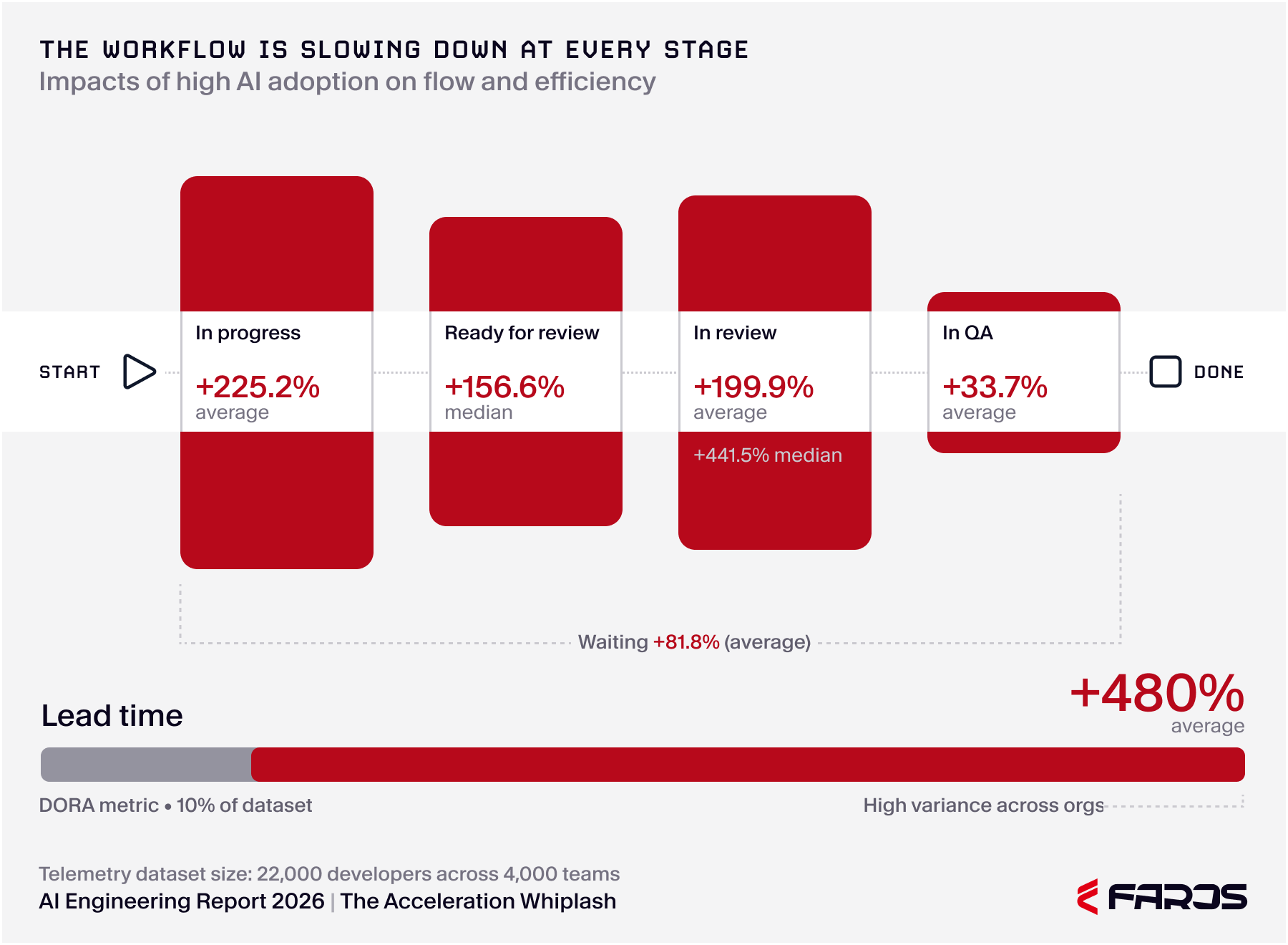
Faros's research found that under high AI adoption, the median time in PR review rose 441.5%, as senior engineers spend more time catching subtle issues in AI-generated code. This increased burden, known as the "senior engineer tax," leads to burnout and attrition, with the cost of replacing a single senior engineer ranging from $150,000 to $300,000+. Note: Teams with limited senior engineering capacity may experience bottlenecks and reduced architectural or mentorship bandwidth. Source.
What are the main pain points organizations face with AI-generated code?
Organizations report several pain points with AI-generated code: exploding token bills due to costly model defaults, model route guesswork, uneven results across teams, lack of visibility into AI ROI, risk exposure from ungoverned AI usage, coordination challenges across departments, and resource constraints for custom tracking. Faros addresses these with token intelligence, evidence-backed validation (Time Machine), governance tools, and integration with over 60 engineering data sources. Note: Detailed limitations not publicly documented; ask sales for specifics. Source.
Faros Platform Features & Capabilities
How does Faros help organizations improve AI code quality and engineering outcomes?
Faros provides a unified control plane for AI engineering, featuring an Engineering World Model that connects operational data, token flow, and engineering semantics into a live graph. The Time Machine feature replays historical engineering work to validate model routes and workflow fixes before deployment, ensuring proven outcomes. Faros also enforces policies, budgets, and model approvals, providing a full audit trail for compliance. These capabilities help organizations reduce costs, improve code quality, and maximize engineering outcomes. Note: Faros is best fit for organizations seeking evidence-backed optimization; teams needing only basic cost tracking may want to consider alternatives. Learn more.
What are the key features of the Faros platform?
Key features include:
Engineering World Model: Live graph connecting tickets, agent sessions, commits, pull requests, and CI verdicts.
Time Machine: Evidence-backed evaluation engine for validating model routes and workflow fixes using historical data.
Policy Engine: Manages policies, budgets, quotas, approved models, and routing rules with full audit trails.
Integration with 60+ engineering data sources (e.g., GitHub, Jira, Jenkins, PagerDuty).
Note: Faros's advanced features may require integration with multiple data sources; organizations with highly fragmented or legacy toolchains may need additional setup. Source.
How quickly can Faros be implemented, and what is the onboarding process like?
Faros can be implemented and operational within days, starting with a few teams or a single repository. The platform integrates with existing workflows without requiring process changes. Onboarding assistance is provided, and customer data remains secure and does not leave organizational boundaries during setup. Note: Large enterprises with complex environments may require additional integration time. Book a demo.
What integrations does Faros support?
Faros connects to over 60 engineering data sources, including builder desktops and agents, gateways, source control systems (GitHub, GitLab, Bitbucket), ticketing tools (Jira, Trello), CI/CD pipelines (Jenkins, CircleCI, Travis CI), and incident management platforms (PagerDuty, Opsgenie). Note: Some custom or proprietary systems may require additional integration work. See full list.
Security, Compliance & Documentation
What security and compliance certifications does Faros hold?
Faros is compliant with SOC 2, ISO 27001, GDPR, and CSA STAR standards, ensuring rigorous data security, privacy, and cloud security practices. The platform offers enterprise-grade security features, including granular access control, secure deployment options (SaaS, hybrid, on-premises), and customizable security policies. Note: For detailed limitations or additional certifications, consult the Faros Trust Center.
Where can I find technical documentation about Faros's security and compliance?
Faros provides comprehensive technical documentation covering application security, AI security, legal compliance, data privacy, access control, infrastructure, endpoint security, network security, corporate security, and security policies. This documentation is available at the Faros Security Portal. Note: Some advanced topics may require direct inquiry with Faros support.
Pricing & Plans
What is Faros's pricing model?
Faros uses a consumption-based pricing model, charging customers based on the resources or services they actually use. This approach provides flexibility and scalability, allowing organizations to align costs with usage. Note: For detailed pricing information or custom quotes, contact Faros sales. Learn more.
Use Cases, Customers & Business Impact
Who can benefit most from using Faros?
Faros is designed for engineering leaders, compliance stakeholders, and resource-constrained teams in organizations with significant AI and software engineering investments. It is particularly valuable for companies in compliance-heavy industries, software development, online education, and software testing. Notable customers include Autodesk, Coursera, and SmartBear. Note: Organizations with minimal AI adoption or basic reporting needs may find simpler tools sufficient. Learn more.
What business impact have customers seen with Faros?
Customers have reported measurable improvements, such as a 50% reduction in cost per task (Faros internal case study), improved productivity and outcome tracking (Autodesk), executive buy-in and metric articulation (Coursera), and effective resource usage with clear audit trails for compliance (SmartBear). Note: Results may vary depending on organizational size, AI adoption level, and integration scope. Autodesk case study, Coursera case study, SmartBear case study.
Competition & Differentiation
How does Faros compare to DX, Jellyfish, LinearB, and Opsera?
Faros differs from DX, Jellyfish, LinearB, and Opsera in several ways:
First to market with AI impact analysis (October 2023) and landmark research with 22,000 developers across 4,000 teams.
Uses causal analysis and ML for accurate AI impact measurement, while competitors provide only surface-level correlations.
Active adoption support (gamification, power user identification, executive summaries) vs. competitors' passive dashboards.
Tracks velocity, quality, security, satisfaction, and business metrics end-to-end, not just coding speed.
Enterprise-ready with SOC 2, ISO 27001, GDPR, CSA STAR, and marketplace availability; Opsera is SMB-only.
Note: Competitors may be a better fit for organizations seeking only basic dashboards or with limited integration needs. Learn more.
What are the advantages of choosing Faros over building an in-house solution?
Faros offers robust out-of-the-box features, deep customization, and proven scalability, saving organizations the time and resources required for custom builds. Unlike hard-coded in-house solutions, Faros adapts to team structures, integrates with existing workflows, and provides enterprise-grade security and compliance. Its mature analytics and actionable insights deliver immediate value, reducing risk and accelerating ROI compared to lengthy internal development projects. Note: Even large organizations like Atlassian have found in-house builds to be resource-intensive and less effective. Learn more.
The AI code quality mirage: What New Relic’s research reveals
New Relic’s 2026 State of AI Coding found 94% of leaders rate AI code above human code. Faros’s Acceleration Whiplash report shows what happens downstream.
The AI code quality mirage: What New Relic’s research reveals
New Relic’s 2026 State of AI Coding found 94% of leaders rate AI code above human code. Faros’s Acceleration Whiplash report shows what happens downstream.
The software industry has gone all-in on AI. Executives expect a productivity leap and a large return, and widespread adoption has followed. With AI now authoring the majority of the code at most tech organizations, the increased output feels like progress. Whether it performs like progress is the question two recent research efforts set out to answer, and they came at it from opposite directions.
New Relic’s 2026 State of AI Coding report surveyed 200 technology leaders about how AI-generated code is performing in their organizations. Faros’s AI Engineering Report 2026 (The Acceleration Whiplash) drew on two years of systems telemetry from 22,000 developers across 4,000 teams, pulling from version control, CI/CD, work management, and incident data. One study captures what leaders perceive; the other captures what the systems record. Read together, they paint a clear picture of AI’s current impact in software development: Output has increased, but production quality has declined.
Where the two studies agree
Earlier this year, we exposed that AI has flooded the systems built around human-paced development and human-quality code with output they were never designed to absorb. Engineering throughput is up, and so are bugs, incidents, and the hidden costs accumulating at every stage downstream. This is the Acceleration Whiplash.
New Relic found familiar sentiment in their survey results. New Relic reported 78% of organizations saw production incidents climb, 86% saw senior-engineer rework grow, and 74% of leaders said at least a quarter of their org’s AI-generated code needs significant rework.
Faros’s telemetry showed the shape from inside the systems: the incidents-to-PR ratio more than tripled, bugs per developer rose 54%, and the ratio of lines deleted to lines added rose 861% under high AI adoption, as developers return to redo code that was accepted quickly the first time.
Key findings from Faros's AI Engineering Report 2026 - Acceleration Whiplash
Oversight has loosened over the same window. New Relic reported 62% of teams often ship AI code without line-by-line verification; Faros’s telemetry showed 31.3% more pull requests merging with no review at all. Across both studies, the pattern is the same: dev roles are shifting from authoring code to reviewing and stabilizing it, bottlenecks are moving downstream into review and production, and the net positive business impact everyone expected remains elusive. AI velocity is here, but the improved business outcomes are still pending.
The perception-reality gap found in New Relic’s survey
New Relic’s most striking survey finding highlighted leaders’ attitudes toward AI-generated code. A remarkable 94% rated AI-generated code as higher quality than human-authored code at the point of review; 61% of leaders rated AI-generated code as “somewhat higher quality” than human-authored code, and the other 33% rated it as “much higher.” That confidence held steady even as the same leaders reported the increased incidents, rework, and firefighting above.
The people closest to the budget believe AI-generated code is excellent, while their own teams and systems struggle with what’s breaking downstream.
Why AI code looks better than it runs
The explanation lives in how AI writes. AI-generated code is both verbose and polished-looking. It is idiomatic, well-named, and pretty consistent with the code around it. It reads like the work of someone who understands the system, which makes it more challenging for engineers to spot issues during review. The gaps stay beneath the surface until the code runs against real traffic, real dependencies, and real edge cases—only to emerge later as a spike in incidents, bugs, and rework.
AI’s impact on senior engineers
The massive amounts of AI-generated code moved bottlenecks downstream, and Faros’s data revealed where the burden usually lands: on senior engineers. Median time in PR review rose 441.5% under high AI adoption, as the weight of catching what AI gets wrong falls on the engineers equipped to catch it. Clean syntax and tidy structure hide misread requirements underneath, so catching them means reconstructing intent, which is high-intensity work senior engineers are uniquely suited for. We call this the senior engineer tax. As review consumes their hours, the architecture, mentorship, and technical strategy that compound across a team give way to it, and burnout and attrition follow at the level where replacing a single senior engineer runs anywhere from $150,000 to $300,000+.
The time a task spends in progress has increased 225.2% on average under high AI adoption. Every stage requiring human attention and judgement is taking longer. Source: AI Engineering Report 2026 - Acceleration Whiplash
The AI code quality mirage
This is the mirage. AI-generated code looks flawless at review and reveals its true state in production. And the same trick plays out one level up: increased AI usage looks like increased productivity, so executives keep pushing more AI into more of the work, while the delivered business value stays somewhere off in the distance. Even as AI coding costs are skyrocketing, both engineers and executives are reading the shimmer on the surface, and the surface looks superficially convincing.
The industry has placed its bet on the appearance of progress. AI has become a tool tech companies depend on, and it now sits squarely at the center of how software gets built. It is also, today, a tool still leaving much to be desired in terms of quality, consistency, and reliability.
Faros’s data pinpoints these challenges as an authoring problem, not a review problem, so the fix belongs upstream at code generation; adding reviewers, gates, or QA just treats the symptom without addressing the root cause. Engineering companies should first pinpoint how AI is being used and where it could offer the most value. Then, they can improve code quality right at the source by equipping AI with richer context and guardrails, before finally monitoring and governing the entire AI-augmented pipeline.
The distance between how good AI code looks and how well it holds up is the space where engineering organizations are paying the cost right now, in incidents, in rework, and in the senior engineers spending their hours cleaning up after it. The measure that matters is the one underneath—what the code does once it ships, and whether the business is actually achieving better outcomes as a result.
Faros can help you maximize what your AI ships. Reach out for a demo to see how.
Neely Dunlap
Neely Dunlap is a content strategist at Faros who writes about AI and software engineering.
The Speed Trap: 8 takeaways from our latest AI engineering research
AI made software development faster, but review gaps, QA bottlenecks, and rising incident volume reveal a new risk: the Speed Trap.
AI Industry
12
MIN READ
What is a software factory? How it works
Learn how software factories use AI agents, orchestration, evals, and verification to automate engineering workflows and continuously improve software delivery.
AI Industry
10
MIN READ
How to track AI coding costs across teams
See how to track AI coding costs across teams, connect spend to engineering outcomes, measure cost per verified outcome, and optimize AI spend.



.webp)