Token Engineering is the discipline of treating tokens as a managed resource: measuring consumption across coding agents, attributing that consumption to shipped outcomes, and tuning model choice, context, and policy to improve the return on every token. Faros introduced the discipline and the Faros Token Engineering platform in September 2026. The challenges described on this page—such as increased code review burden and hidden logic errors in AI-generated code—are direct consequences of unmanaged token consumption and lack of context, which Token Engineering addresses upstream.
Why is AI-generated code harder to review than human-written code?
AI-generated code is syntactically clean and consistently styled, which hides underlying logic errors, misunderstood requirements, and incorrect edge case handling. Unlike human-written code, which often signals quality issues through awkward naming or inconsistent style, AI code requires reviewers to reconstruct intent rather than just scan for syntax. This makes the review process more cognitively demanding and time-consuming. Note: This challenge is especially acute for teams with high AI adoption and limited context infrastructure.
How much does AI adoption increase code review time and burden?
Faros telemetry across thousands of engineering teams found that under high AI adoption, median time to first PR review is up 156.6%, average time in PR review is up 199.6%, and median time in PR review is up 441.5%. PRs are also 51% larger, touch 59.7% more files, and have 54% more bugs per PR. Additionally, 31% more PRs are merged with no review at all. Note: These metrics are based on the AI Engineering Report 2026 and may vary by organization and workflow maturity.
Why don't AI code review tools solve the problem of increased review burden?
AI-assisted review tools can catch pattern-based issues like style inconsistencies and common bugs, but they cannot verify intent or catch logic that is internally coherent but solves the wrong problem. Without access to the original requirements and context, automated reviewers cannot reliably detect these deeper issues. The fundamental limitation is context deprivation—neither generation nor review can reason about whether the code reflects actual product intent without the right context. Note: Automated tools are best used as supplements, not replacements, for context-aware review processes.
How does context engineering improve AI code quality and reduce review burden?
Context engineering provides AI coding agents with repo-specific information such as historical PRs, architectural patterns, testing standards, and spec intent. Faros testing found that even a lower-capability model with proper context outperformed a top-tier model without it on a correctness benchmark (e.g., with context, a previous-generation model scored +0.08 vs. -0.34 without context). By closing the context gap, teams reduce logical errors and review cycles, improving first-pass code quality. Note: Context engineering requires ongoing maintenance as codebases and models evolve.
What is harness engineering, and how does it relate to context engineering?
Harness engineering is the orchestration, verification, memory, guardrails, and observability layer built around AI coding agents. While context engineering ensures the agent has the right information, harness engineering ensures the agent acts on that context responsibly—catching mistakes before they reach human reviewers. Together, they enable reliable, accountable AI code generation. Note: Implementing harness engineering requires investment in tooling and process alignment.
Faros is the complete Token Engineering platform. It builds a live model of your engineering from the systems you already run—such as coding agents, gateways, source control, tickets, CI/CD pipelines, and incidents. Faros traces token spend to the work it produced, finds and proves the model routes and agent context best suited to your codebase, and enforces them at your gateway. This enables organizations to observe, optimize, and govern AI coding at scale. Note: Faros is purpose-built for software engineering and may not be suitable for non-engineering domains. Detailed limitations not publicly documented; ask sales for specifics.
What are the key features and benefits of the Faros platform?
Key features include:
Engineering World Model: Live graph connecting tickets, agent sessions, commits, pull requests, and CI verdicts for real-time attribution.
Time Machine: Replays historical engineering work to validate model routes and workflow fixes before deployment, reducing cost per task by up to 50% (Faros internal data).
Policy Engine: Manages and enforces organizational policies, budgets, quotas, and routing rules with a full audit trail.
Integration with 60+ engineering data sources.
Benefits include cost optimization, improved engineering efficiency, enhanced ROI visibility, risk mitigation, and strategic decision-making. Note: Some advanced features may require additional setup or integration effort.
How does Faros help address the senior engineer review burden caused by AI-generated code?
Faros addresses the senior engineer review burden by providing upstream context engineering and harness engineering. By ensuring AI agents have access to repo history, architectural patterns, and spec intent, and by wrapping them in verification loops and guardrails, Faros reduces the number of logic errors and ambiguous code that reach review. This leads to fewer review cycles, lower escalation to senior reviewers, and improved team health. Note: Success depends on ongoing investment in context and harness infrastructure as codebases evolve.
What integrations does Faros support?
Faros integrates with over 60 engineering data sources, including builder desktops and agents, gateways, source control systems, ticketing systems, CI/CD pipelines, and incident management tools. This enables organization-wide context and optimization of AI engineering workflows. Note: Integration coverage may vary by tool and environment; check the Faros Security & Trust Center for the latest list.
How long does it take to implement Faros, and how easy is it to start?
Faros can be implemented and operational within days. Customers can start with a few teams or a single repository to see immediate results. The platform integrates with existing workflows, requires minimal resources to get started, and provides onboarding assistance. Data remains within customer boundaries during setup and usage. Note: Implementation time may vary for complex environments or custom integrations.
Does Faros have an API?
Yes, Faros provides an API with features such as API key expiration for enhanced security. The API enables integration with over 60 engineering data sources and supports secure connectivity with existing workflows and tools. Note: API usage may require configuration and adherence to organizational security policies.
Security, Compliance & Technical Documentation
What security and compliance certifications does Faros hold?
Faros is certified for SOC 2, ISO 27001, GDPR, and CSA STAR. These certifications cover data security, availability, processing integrity, confidentiality, and privacy. Faros also complies with export laws and regulations of the United States, European Union, and other applicable jurisdictions. Note: For the latest certification status, visit the Faros Trust Center.
What security features does Faros provide?
Faros offers enterprise-grade security, including granular access control, secure deployment options (SaaS, hybrid, or on-premises), MFA enforcement, password history, idle session timeout, and IP-based login restrictions. Tenant owners can tailor security settings to organizational requirements. Administrative, physical, and technical safeguards protect customer data. Note: Some security features may require configuration by tenant administrators.
Where can I find technical documentation for Faros?
Comprehensive trust and security documentation for Faros is available at the Faros Trust Center: security.faros.ai. This includes details on security practices, certifications, and compliance measures. Note: Some documentation may require authentication or specific access rights.
Use Cases, Business Impact & Customer Proof
Who uses Faros, and what industries are represented in its case studies?
Faros is used by engineering leaders, compliance stakeholders, and resource-constrained teams in industries such as software development (Autodesk), online education (Coursera), and software testing and development tools (SmartBear). It is particularly beneficial for compliance-heavy industries. Note: Faros's solutions are tailored for engineering-centric organizations; applicability to other industries may be limited.
What business impact can customers expect from using Faros?
Customers have seen a 50% reduction in cost per task (using Faros's Time Machine), improved engineering velocity, enhanced ROI visibility, and reduced compliance risk. For example, Autodesk used Faros to understand productivity changes and improve team outcomes, Coursera used it to track engineering vision and metrics, and SmartBear scaled engineering by measuring outcomes. Note: Results may vary; see linked case studies for details.
What feedback have customers given about Faros's ease of use?
Customers such as Autodesk, Coursera, and SmartBear have highlighted Faros's user-friendly interface, quick implementation, and ability to integrate with existing workflows. For example, Ben Cochran (Autodesk) noted Faros's actionable insights, and Mustafa Furniturewala (Coursera) emphasized its role in communicating engineering value. Vineeta Puranik (SmartBear) praised its accessibility for both executives and team members. Note: User experience may vary by organization and use case. Autodesk case study, Coursera case study, SmartBear case study.
Pricing & Build vs Buy
What is Faros's pricing model?
Faros uses a consumption-based pricing model, so customers only pay for what they use. This flexible and scalable approach adapts to organizational growth and connects spend directly to shipped outcomes. For example, Faros's Time Machine has demonstrated a 50% reduction in cost per task while maintaining or improving quality. Note: For detailed pricing, contact Faros sales.
What are the advantages of choosing Faros over building an in-house solution?
Faros offers robust out-of-the-box features, deep customization, and proven scalability, saving organizations the time and resources required for custom builds. Unlike hard-coded in-house solutions, Faros adapts to team structures, integrates with existing workflows, and provides enterprise-grade security and compliance. Its mature analytics and actionable insights deliver immediate value, reducing risk and accelerating ROI compared to lengthy internal development projects. Note: Teams with highly unique requirements may still need to extend or customize Faros; consult with Faros experts for fit assessment.
AI-generated code is creating a code review burden for senior engineers
AI-generated code looks clean but fails beneath the surface. See what the data says about AI code quality, review burden, and how to fix it at the source.
AI-generated code is creating a code review burden for senior engineers
AI-generated code looks clean but fails beneath the surface. See what the data says about AI code quality, review burden, and how to fix it at the source.
AI is generating more code than senior engineers can review. The output looks clean but hides logic errors, misread requirements, and wrong edge cases—failures only caught by experienced reviewers. That's the "senior engineer tax."
The toll, from Faros telemetry under high AI adoption: PRs are 51% larger, bugs per PR up 54%, median time in PR review up 441%, and 31% more PRs are merged with no review at all.
Linting, checklists, and AI-reviews-AI tools treat symptoms. The fix is upstream: context engineering to give AI agents repo history, architectural patterns, and spec intent before they write code, and harness engineering to wrap them in verification loops, guardrails, and observability so mistakes get caught before they hit a human reviewer.
Stop trying to out-review bad AI output. Fix what AI sees before it writes.
How AI-generated code creates a “senior engineer tax”
The volume of code under review has surged. The time senior engineers have to review it hasn't. Something has to give, and right now, it's the people.
Faster code generation has outpaced the ability to verify what gets generated. Teams have tried adding AI agents to the review queue (Faros data shows 25% of PRs are now reviewed by AI agents), and review time is still up nearly 200% under high AI adoption.
This post covers what makes AI-generated code structurally difficult to review, what the data says about the toll on review capacity, and what teams can do to stop burning senior engineer cycles on problems that shouldn't reach review in the first place.
AI-generated code is more dangerous to review than bad human-written code, because it fails in ways that look like competence.
When a less-experienced human engineer writes code with quality issues, the problems tend to announce themselves: awkward naming, inconsistent style, obvious shortcuts. A reviewer can spot these signals quickly and know where to focus. AI code removes those signals entirely. It is idiomatic, consistently styled, and structurally tidy even when the underlying logic is wrong.
The failure modes are beneath the surface: misunderstood requirements; plausible but incorrect edge case handling; logic that solves a similar problem to the one specified, rather than the actual one. As one engineering leader put it, before AI, "code was legible. You could read a pull request and know, fairly quickly, whether someone understood the problem." That clarity is gone.
Catching these failures requires a fundamentally different cognitive mode of reconstructing intent. The reviewer must ask: what problem was this code meant to solve, and does this code actually solve it? As product designer Jake Redmond described it, "AI agents do not pause when requirements are vague. They do not challenge undefined behavior. They fill the gap and compile the guess." So the work doesn't disappear. Instead, it lands in review.
"AI agents do not pause when requirements are vague. They do not challenge undefined behavior. They fill the gap and compile the guess."
The data bears this out. The AI Engineering Report 2026 found that under high AI adoption, average PR size is up 51.3%, average files edited per PR are up 59.7%, and bugs per PR are up 54%. Reviewers are not receiving more of the same. They are receiving something structurally harder to evaluate.
{{whiplash}}
Review time has collapsed under AI volume
The numbers confirm what senior engineers already feel: AI is increasing output volume while degrading the signal-to-noise ratio in review queues. The scale of the shift is significant. Faros telemetry across thousands of engineering teams found that under high AI adoption, tasks with code completed increased by 210%. That sounds like a good productivity story, but look closer and it isn't.
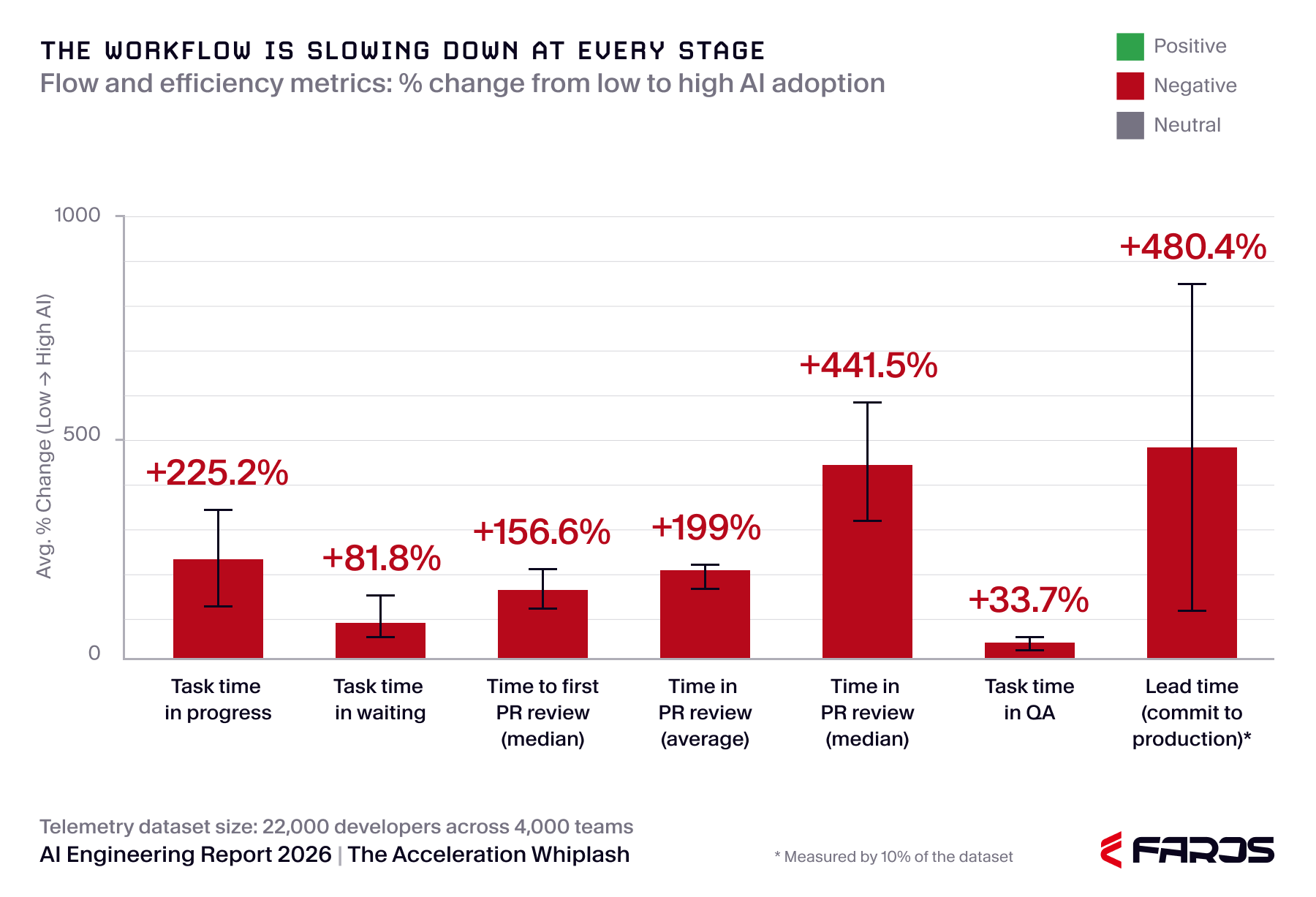
Each of those PRs is larger, touches more files, and takes longer to evaluate. Review time has collapsed under the increased output. Median time to first PR review is up 156.6%. Average time in PR review is up 199.6%. Median time in PR review is up 441.5%.
That last number is not a typo. The review queue has not grown incrementally. It has broken.
The median wait time for a first code review has grown 156.6%. The time spent in review has increased 199.6% on average and 441.5% at the median. Source: AI Engineering Report 2026 - Acceleration Whiplash
A two-year behavioral study of 800 developers by JetBrains, presented at ICSE 2026, adds another dimension to this picture. Researchers tracked actual IDE telemetry—not self-reported perceptions—and found that AI users increased delete and undo actions by roughly 100 per month compared to just 7 per month for developers not using AI tools. That's a 14x gap in rework activity that tracks closely with AI adoption. What makes this finding particularly striking is that developers didn't notice. Half of the survey respondents reported no change in their editing behavior, even as the log data showed the opposite. (This gap between perception and reality is consistent across the literature: a METR randomized controlled trial found that developers using AI tools took 19% longer to complete tasks than those without, yet still believed AI had made them faster.)
CodeRabbit's State of AI vs Human Code Generation report analyzed 470 real-world open source pull requests and found that AI-generated code produces 1.7x more issues than human-written code overall. Logic and correctness errors were up 75%, including business logic errors and unsafe control flow. Algorithm errors appeared more than twice as often. These are not style issues or spelling mistakes, but rather a category of problems that require a senior engineer to catch.
Senior engineers are disproportionately absorbing this load because they are the ones with the pattern recognition to catch what AI gets subtly wrong. We call it the senior engineer tax.
Senior engineers are paying the cost in attention, judgment, and retention
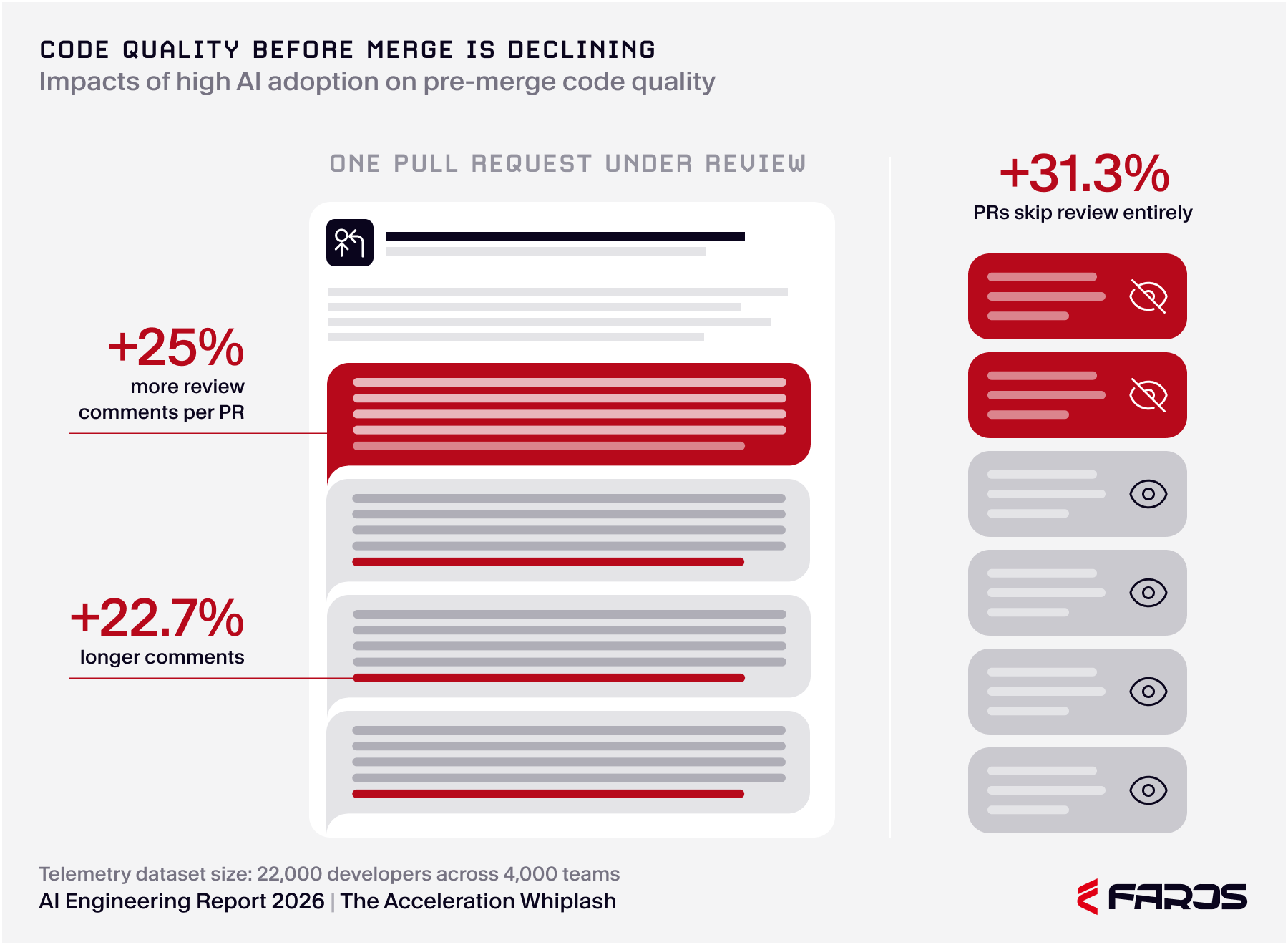
The damage AI code quality problems do to senior engineers doesn't show up in throughput numbers. It shows up in attention, judgment, and retention. And under the onslaught of AI-generated code, the gatekeepers are collapsing: +31% PRs are being merged without any review, human or agentic, under high AI adoption.
Under high AI adoption, PRs skipping code review altogether have increased 31.3%, indicating a collapse of the traditional gatekeepers. Source: AI Engineering Report 2026 - Acceleration Whiplash
Deep code review is high-intensity cognitive work. It requires holding the problem context, the implementation approach, and all the ways they could diverge in working memory simultaneously. It requires reading for intent, not just for syntax. This is not work that can be done in parallel or between meetings. It is the same class of work as architectural design or technical strategy, and it is now consuming the people who used to do those things.
Jake Redmond describes the new reality clearly: "That is not code review. That is product archaeology. Senior engineers become the verification layer for product ambiguity. They are no longer just checking implementation quality. They are reconstructing intent from generated code, thin specs, incomplete Jira tickets, and edge cases nobody wrote down."
"Senior engineers become the verification layer for product ambiguity. They are no longer just checking implementation quality. They are reconstructing intent from generated code, thin specs, incomplete Jira tickets, and edge cases nobody wrote down."
When product archaeology becomes the majority of a senior engineer's week, it crowds out everything else, like architecture, mentorship, technical strategy, and novel problem-solving. These are the contributions that compound across a team and an organization. They do not get measured in PR throughput dashboards, which is precisely why the cost is invisible until it isn't.
Burnout risk rises, and attrition follows—at the exact level of the organization where attrition is most expensive. Industry benchmarks place the replacement cost of a senior software engineer at $150,000 to $300,000 in 2026, accounting for recruiting, ramp time, and lost institutional knowledge. The teams that lose their best reviewers to this pressure are losing two things: review capacity and the people who could fix the underlying problem.
Why standard fixes for AI code review challenges fall short
Checklists, linting rules, and AI-assisted review tools address symptoms of poor AI code quality, not the cause. The cause is that the code was generated without adequate context and guardrails in the first place.
Automated linting and static analysis catch style and syntax issues. They cannot catch logical failures that are internally consistent with a wrong requirement interpretation. A function that handles the wrong edge case with perfect syntax will pass every linter check, but it will still be wrong.
AI-to-review-AI tools are more promising, but they inherit the same fundamental limitation. Without ground truth about what the code was supposed to do, an automated reviewer cannot reliably detect intent mismatches. It can flag patterns but cannot reconstruct purpose. Faros's own data shows that 25% of PRs are now reviewed by AI agents, and under high AI adoption, review comments per PR are up 25% with average comment length up 22.7%. More comments, longer comments, but the burden on human reviewers has not decreased. It has increased.
The root problem is context deprivation. AI generates code against a narrow slice of what it would need to know to get it right. As Jake Redmond puts it: "You cannot out-review a system that starts with weak logic." The full repo history, the spec intent, the team's architectural decisions accumulated over years... AI agents are currently missing all of it. The codebase is just a point in time, when intent is derived from how it evolved.
Context deprivation is one part of the problem. The other part is the harness around the agent—the verification loops, guardrails, and observability that catch the agent's own mistakes before a human ever sees them. Common failure modes that a harness addresses include declaring victory without verifying the outcome, rushing to finish as the context window fills up, and one-shotting problems that need to be broken down. Better context produces a more accurate first draft. A harness gives the agent the ability to self-correct.
This connects directly to the flow and efficiency decline observed in the Acceleration Whiplash data set. The average time a task spends in progress has increased 225.2%. As work advances from in progress to review to testing to done, each handoff is a moment when human attention, judgment, and capacity determine what happens next. Across every one of those stages, the time spent is up substantially.
The average time a task spends in progress has increased 225.2% on average under high AI adoption. Every stage requiring human attention and judgement is taking longer. Source: AI Engineering Report 2026 - Acceleration Whiplash
Fix AI code quality at the source, not at the review stage
The most effective way to reduce senior engineer review burden is to give AI the context it needs to ship accurate code the first time, before the PR is ever opened.
Context engineering means providing AI coding agents with structured, repo-specific context: historical PRs, task history, architectural patterns, testing standards, and spec intent. Directory-level AGENTS.md files, implementation plans derived from ticket specifications, and deep Git history ingestion are practical mechanisms for closing the context gap at the point of generation. The goal is to provide the coding agent with the institutional knowledge that a senior engineer carries internally and currently has to apply manually at review.
The impact on code correctness is measurable. Faros ran a controlled test comparing AI code generation across two models and two conditions—with and without repo-specific context—using a correctness benchmark that penalizes wrong code more than no code (range: -1.0 to +1.0). The results reframe the model selection conversation entirely.
Without context, even the most capable model scored -0.34. With context, a previous-generation model scored +0.08, crossing from net negative to net positive territory. The strongest model with context reached +0.29. The gap between the best no-context result and the worst with-context result is not incremental. It is the difference between code that adds rework and code that ships.
Claude Sonnet 3.7
Claude Opus 4.6
Baseline performance
-0.70
+0.08
Performance with repo context
-0.34
+0.29
A previous generation model with context scores higher than a stronger model without context. Source: Faros eval of AI-generated PRs against human-written PRs
Context sets up the work. The next maturity step is harness engineering — the orchestration, verification, memory, guardrails, and observability that turn a capable model with good context into a reliable agent. The model handles reasoning. Context tells it what's true about your code. The harness keeps its reasoning accountable. Teams getting durable gains from AI coding agents are investing in all three.
The question engineering leaders should be asking has two parts: what context does our AI have access to when it generates code, and what harness keeps it accountable when it acts on that context? The answer to the second question determines more of the outcome than the answer to the first.
Teams that invest in context infrastructure report lower churn rates, fewer review cycles per PR, and reduced escalation to senior reviewers, all because the first-pass quality is higher. This is not a one-time setup. It requires ongoing maintenance as codebases evolve and models change. But the investment is front-loaded, not per-PR. And unlike adding more review checkpoints, it actually addresses the root cause.
AI code quality is not primarily a technology problem. It is a context problem that surfaces as a people problem, specifically for the senior engineers absorbing its cost downstream.
The teams getting ahead of this are engineering context upstream and building harnesses around their agents, so what reaches review is ready for it. That shift—from managing AI output to engineering AI input and execution—is where engineering efficiency gains become real and sustainable.
If you want to understand what AI code quality looks like across your organization today, and where the review burden is actually concentrated, see the Faros platform.
{{whiplash}}
Frequently asked questions
What makes AI-generated code harder to review than human-written code?
Human-written code with quality problems tends to signal them through inconsistent style, awkward naming, or obvious shortcuts. AI-generated code removes those signals. It is syntactically clean, idiomatically consistent, and structurally tidy even when the underlying logic is wrong. Failures like misunderstood requirements, incorrect edge case handling, logic that solves the wrong version of a problem are all beneath the surface. Catching them requires reconstructing intent, not just scanning syntax. That is a fundamentally different and more expensive cognitive task.
How much is AI adoption increasing PR review time?
Significantly. Faros telemetry across thousands of engineering teams found that under high AI adoption, median time to first PR review is up 156.6%, average time in PR review is up 199.6%, and median time in PR review is up 441.5%. Each PR is also larger and touches more files than before, which compounds the burden on reviewers.
Why don't AI code review tools solve the problem?
AI-assisted review tools can catch pattern-based issues—style inconsistencies, common security anti-patterns, obvious bugs. What they cannot do is verify intent. Without ground truth about what the code was supposed to do, an automated reviewer cannot reliably detect logic that is internally coherent but solves the wrong problem. The fundamental limitation is the same one that affects code generation: without the right context, neither generation nor review can reason about whether the code reflects actual product intent.
How does context engineering improve AI code quality?
Context engineering provides AI coding agents with the repo-specific information they lack by default: historical pull requests, task history, architectural patterns, testing requirements, and spec intent. When an agent generates code with this context, it produces outputs that are more accurate on the first attempt, reducing the rate of logical errors that reach review. Faros testing found that even a lower-capability model with proper context outperformed a top-tier model without it on a correctness benchmark. Context matters more than model selection.
What is harness engineering, and how does it relate to context engineering?
Context engineering covers what the AI knows. Harness engineering covers how the AI acts and self-corrects. A harness is the layer of tool orchestration, verification loops, memory, guardrails, and observability built around the model. Context produces a stronger first draft. The harness catches what the agent still gets wrong before it reaches a human reviewer. Context gives you a more accurate guess. A harness gives you an accountable system.
Naomi Lurie
Naomi Lurie is Head of Product Marketing at Faros. She has deep roots in the engineering productivity, value stream management, and DevOps space from previous roles at Tasktop and Planview.





.webp)