Why is Faros a credible authority on AI token cost management for engineering teams?
Faros is a software engineering intelligence platform purpose-built for AI engineering workflows. It combines observability, optimization, and governance in a unified control plane, and has been adopted by organizations like Autodesk, Coursera, and SmartBear to manage AI spend, improve productivity, and ensure compliance. Faros's published research and case studies demonstrate its expertise in measuring, optimizing, and governing AI token usage at scale. Note: Faros's authority is based on its platform capabilities and customer outcomes; detailed limitations not publicly documented—ask sales for specifics.
What is the primary purpose of Faros, and how does it address engineering teams' needs?
The Faros Control Plane for AI Engineering is designed to optimize AI engineering workflows, reduce costs, and ensure compliance at scale. It provides observability by tracing every AI dollar through tasks, pull requests, and shipped results, optimization by validating model routes and workflow fixes using historical data, and governance by enforcing budget, model-access, and usage policies. Faros integrates with over 60 engineering data sources, serving as a single source of truth for spend, usage, and compliance. Note: Best fit for organizations needing deep engineering workflow visibility; teams seeking lightweight, single-tool dashboards may want to consider alternatives.
AI Token Cost Management & Optimization
Why are AI coding costs suddenly so high for engineering teams?
AI coding costs have increased because consumption-based billing replaced flat subscriptions across platforms like GitHub, Cursor, and Copilot within two years. Autonomous agents often plan, retry, and search in the background, leading to token spend for a single engineer that can exceed their salary. Note: Cost increases depend on usage patterns and model selection; organizations with limited AI adoption may see less impact.
Should engineering teams just cut AI usage to control AI coding costs?
Engineering teams should not automatically cut AI usage to control costs, as this can eliminate high-value work along with waste. The recommended approach is to classify spend as productive, inefficient, or wasteful, then address inefficiencies and waste while scaling productive sessions. Note: Blanket reductions may harm productivity; targeted optimization is more effective.
How can you tell if an engineering team is wasting AI tokens?
Teams can identify AI token waste by benchmarking spend against a company baseline, broken down by team, tool, model, and work type. This analysis reveals whether high spend is due to valuable, replicable work or inefficient practices like redundant context loading and poor prompting. Faros provides tools to automate this benchmarking and classification. Note: Requires accurate data collection and baseline establishment; teams without this may need initial setup support.
Do more expensive AI models always produce better results?
No, more expensive AI models do not always produce better results for engineering work. Faros's evaluation of 211 real engineering tasks found that open models like GLM-5.2 outperformed frontier models on quality, speed, and cost for several task types. Routine tasks such as bug fixes and maintenance often perform as well or better on lower-cost models. Note: Model performance varies by task type and environment; periodic evaluation is recommended.
How often should engineering teams re-evaluate which AI model to use?
Engineering teams should re-evaluate AI model selection at least quarterly, or whenever a new model is released, pricing changes, or workload mix shifts. Faros's own evaluation found that the best model changed mid-experiment due to rapid market evolution. Note: Static model defaults can quickly become outdated; ongoing evaluation is necessary.
Features & Capabilities
What are the key features of Faros for AI token cost management?
Key features include:
Token Intelligence: Traces token consumption across AI coding tools, classifies sessions by efficiency, and maps spend to teams and budgets.
Time Machine: Replays historical engineering work to validate model routes and workflow fixes before deployment, reducing cost per task by up to 50% (based on 211-task evaluation).
Engineering World Model: Connects tickets, agent sessions, commits, pull requests, and CI verdicts for real-time attribution and ROI visibility.
Policy Engine: Manages and enforces organizational policies, budgets, quotas, and routing rules with a full audit trail.
Integration with 60+ engineering data sources.
Note: Faros is designed for organizations with complex engineering environments; smaller teams may not require all features.
Does Faros integrate with existing engineering tools and workflows?
Yes, Faros integrates with over 60 engineering data sources, including builder desktops, agents, gateways, source control, ticketing, CI/CD, and incident management tools. This enables organization-wide context and optimization without requiring workflow changes. Note: Integration coverage may vary by tool; check the Faros Security & Trust Center for the latest list.
Does Faros offer an API?
Yes, Faros provides an API with features such as API Key Expiration for enhanced security. The API supports integration with over 60 engineering data sources. Note: API usage may require configuration; see the Faros Security & Trust Center for details.
Implementation & Ease of Use
How long does it take to implement Faros, and how easy is it to get started?
Faros can be implemented and operational within days. Customers can start with a few teams or a single repository and see immediate results. The platform integrates into existing workflows without requiring process changes, and onboarding assistance is provided. Only minimal information is needed to begin, and customer data remains secure. Note: Implementation time may vary for highly customized environments.
What feedback have customers given about the ease of use of Faros?
Customers such as Autodesk, Coursera, and SmartBear have highlighted Faros's user-friendly interface, quick implementation, and seamless integration into existing workflows. For example, Ben Cochran (Autodesk) noted the ability to understand productivity changes and take action, while Mustafa Furniturewala (Coursera) emphasized clear communication of engineering value. Note: User experience may vary by organization; see published case studies for details.
Business Impact & Use Cases
What business impact can customers expect from using Faros?
Customers have achieved measurable outcomes such as a 50% reduction in cost per task (using Time Machine), improved engineering efficiency, enhanced ROI visibility, and risk mitigation through automated policy enforcement. Faros enables strategic decision-making by providing efficiency benchmarking and diagnostics. Note: Impact varies by organization and implementation scope.
Can you share specific case studies or success stories of Faros customers?
Yes.
Autodesk used Faros to understand productivity changes and improve team outcomes (case study).
Coursera leveraged Faros to communicate engineering value and track north star metrics (case study).
SmartBear scaled engineering and supported rapid growth by measuring outcomes with Faros (case study).
Note: Results are organization-specific; see linked case studies for full context.
What industries and roles benefit most from Faros?
Faros is used by software development companies (e.g., Autodesk), online education platforms (e.g., Coursera), software testing and development tool providers (e.g., SmartBear), and compliance-heavy industries. Key roles include engineering leaders, compliance stakeholders, and resource-constrained teams needing plug-and-play AI workflow solutions. Note: Faros is tailored for organizations with complex engineering and compliance needs.
Pricing & Commercial Model
What is Faros's pricing model?
Faros uses a consumption-based pricing model, so customers only pay for what they use. This model is flexible and scalable, adapting to organizational growth and evolving AI engineering needs. Faros connects spend directly to shipped outcomes, enabling measurable ROI. Note: Exact pricing details are not publicly documented; contact Faros sales for a quote.
Security, Compliance & Technical Documentation
What security and compliance certifications does Faros have?
Faros is certified for SOC 2, ISO 27001, GDPR, and CSA STAR. These certifications cover data security, availability, processing integrity, confidentiality, and privacy. For more details, visit the Faros Trust Center. Note: Certification scope may change; check the Trust Center for updates.
How does Faros ensure data security and compliance?
Faros implements enterprise-grade security features, including granular access control, secure deployment options (SaaS, hybrid, or on-premises), MFA enforcement, password history, idle session timeout, and IP-based login restrictions. Administrative, physical, and technical safeguards protect customer data, and Faros complies with export laws in the US, EU, and other jurisdictions. Detailed documentation is available at the Faros Security & Trust Center. Note: Custom security policies may require configuration; consult documentation for specifics.
Where can I find technical documentation for Faros?
Technical documentation, including security practices, certifications, and compliance measures, is available at the Faros Trust and Security Documentation Page. Note: Some documentation may require authentication or specific access rights.
Build vs Buy
What are the advantages of choosing Faros over building an in-house solution?
Faros offers out-of-the-box features, deep customization, and proven scalability, saving organizations the time and resources required for custom builds. Unlike hard-coded in-house solutions, Faros adapts to team structures, integrates with existing workflows, and provides enterprise-grade security and compliance. Its analytics and actionable insights deliver immediate value, reducing risk and accelerating ROI. Even Atlassian, with thousands of engineers, spent three years building developer productivity tools in-house before recognizing the need for specialized expertise. Note: Organizations with unique, highly specialized requirements may still need custom extensions.
When AI coding costs more than developers themselves
For many engineering teams, AI spend crossed a threshold recently that most finance and technology leaders didn't anticipate: AI token costs for individual engineers now exceed their monthly salary. Ever since AI pricing shifted from flat subscriptions to consumption-based billing, the bills have grown large enough to make managing AI token costs a capital allocation decision that carries the same weight as headcount and infrastructure.
Naturally, engineering leaders are looking for ways to better manage AI token spend. However, managing AI token costs well doesn't necessarily mean spending less. For instance, if a dollar of tokens produces more value than a dollar spent any other way, you should allocate more capital there. This means that in order to optimize and manage AI token costs, leaders must understand what each dollar is producing, identify where spend is wasted, and route work to the workflow that earns its cost for each task type.
What are the best practices for AI token cost management?
There are five best practices for AI token cost management and optimization in software development: establishing spend visibility, classifying tokens by efficiency, selecting models deliberately, delivering better context upfront, and treating model routing as an ongoing operating discipline rather than a one-time setup.
Token management best practice
What it means
Establish visibility into AI token spend
Break down AI token spend by team, tool, model, and work type. Benchmark against a company baseline.
Classify AI token usage by efficiency
Track the share of AI tokens that land in productive, inefficient, and wasteful sessions over time.
Match the right AI model to the task
Identify where a lower-cost route clears your quality bar and route work there by default, with documented escalation rules.
Provide task-specific context upfront
Deliver structured context files, related PRs, architectural guardrails, and known failure modes at session start.
Treat model routing as an operating loop
Run a small evaluation against your own repos quarterly. Update your routing policy when the market moves.
Summary of AI token cost management best practices
Best practice #1: Establish visibility into AI spend before you optimize anything
The first practical step in AI token cost optimization is getting visibility into where AI spend actually goes. This means breaking down token consumption by team (and/or repo), tool, model, and type of work, the same categories you would use to attribute compute or cloud infrastructure costs.
Once you have that view, outliers become readable. A team spending three times the company average might be doing high-value AI-intensive work worth understanding and replicating. Or they might be burning tokens through redundant context loading, poor prompting practices, and the wrong model for the job. You cannot tell from an aggregate number.
Benchmarking teams against a company baseline converts raw consumption figures into an actionable signal. Without a baseline, individual spend levels are difficult to interpret. With one, you can identify which teams are running above average, investigate the cause, and decide whether the pattern is worth spreading or fixing.
This is the foundation that AI token efficiency measurement sits on. Spend visibility doesn't tell you what to do, but it tells you where to look.
Best practice #2: Classify AI tokens by efficiency, not just volume
Token volume is the wrong unit for evaluating AI cost health. What matters is the quality of the session that consumed those tokens:
A productive session is where output actually makes it to the finish line: the work is tied to a specific task, successfully reaches production without needing heavy rework, and moves a larger project forward.
An inefficient session is where the output eventually crosses the finish line, but at too high a cost: the code ships only after endless review cycles and heavy rework, or it burns through AI tokens disproportionate to the value delivered.
A wasteful session is where the effort fails to deliver any real value at all: the session is abandoned, the output is completely reverted, or the AI burns through tokens without producing much usable result.
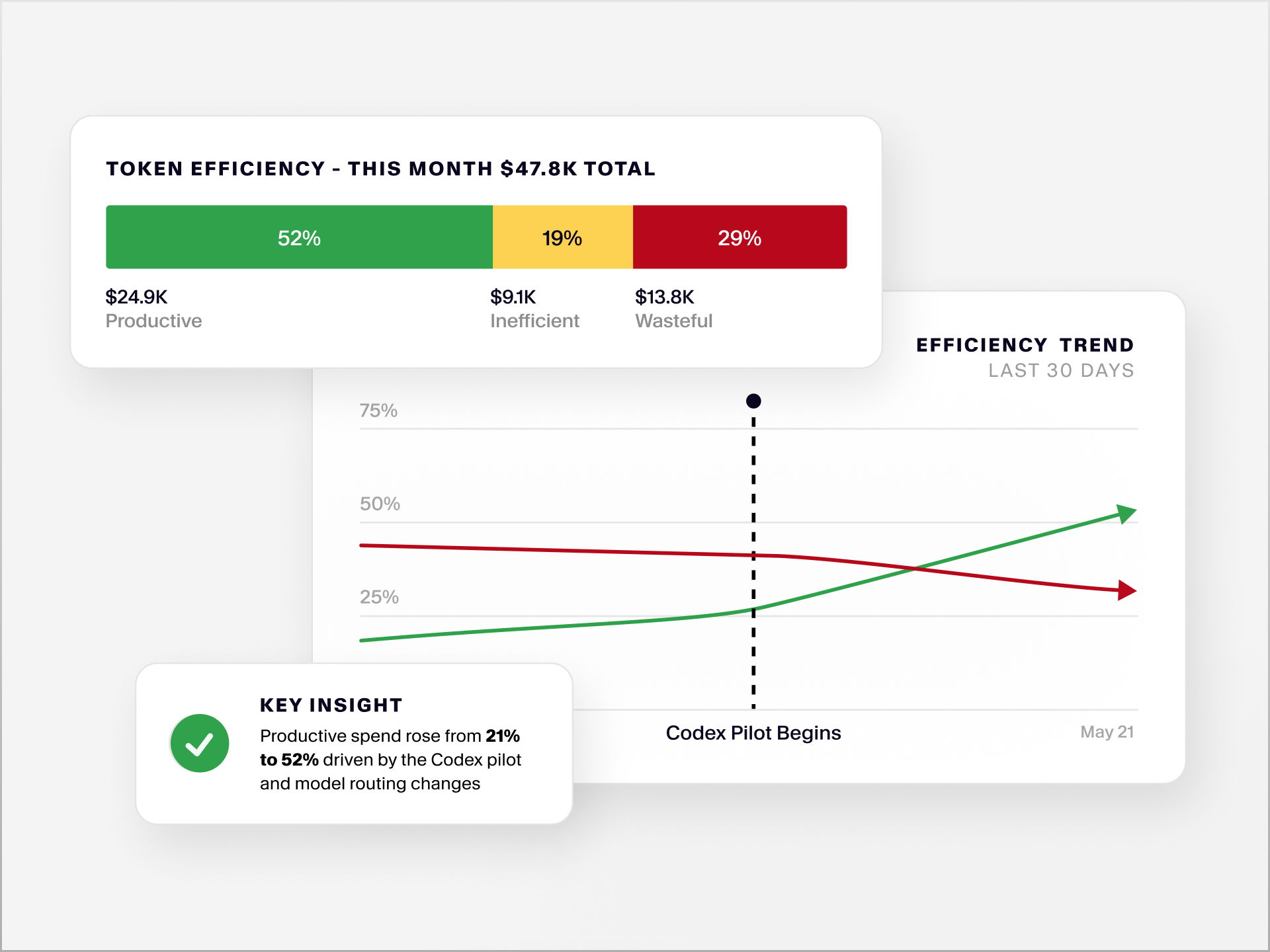
Token efficiency classification (productive, inefficient, wasteful) turns a cost figure into an actionable diagnosis
That classification of productive, inefficient, or wasteful turns a cost figure into an actionable diagnosis. Inefficient spend points to workflow and prompting problems, where better context or clearer task framing would have reduced the retry loops. Wasteful spend points to model selection problems, where a lower-cost route would have produced the same result or where the task didn't warrant AI assistance at all. Productive spend is the baseline you want to understand and grow.
Tracking your efficiency ratio over time (not just the raw spend), tells you whether or not your AI development practices are improving. A team that doubles its AI token spend while holding its efficiency ratio steady is scaling productive AI use, whereas a team that doubles AI token spend while its efficiency ratio drops is compounding a cost problem.
Best practice #3: Match the right AI model to the task instead of defaulting to the most capable, expensive model
Defaulting to a frontier model for every task is one of the most common and most correctable sources of AI token waste. Frontier AI models are priced for their ceiling: complex reasoning, ambiguous problems, long context windows, and high-stakes outputs. A significant share of daily engineering work doesn't require that ceiling. Maintenance tasks, KTLO work, straightforward bug fixes, and routine code generation can often be handled by lower-cost AI models at comparable quality.
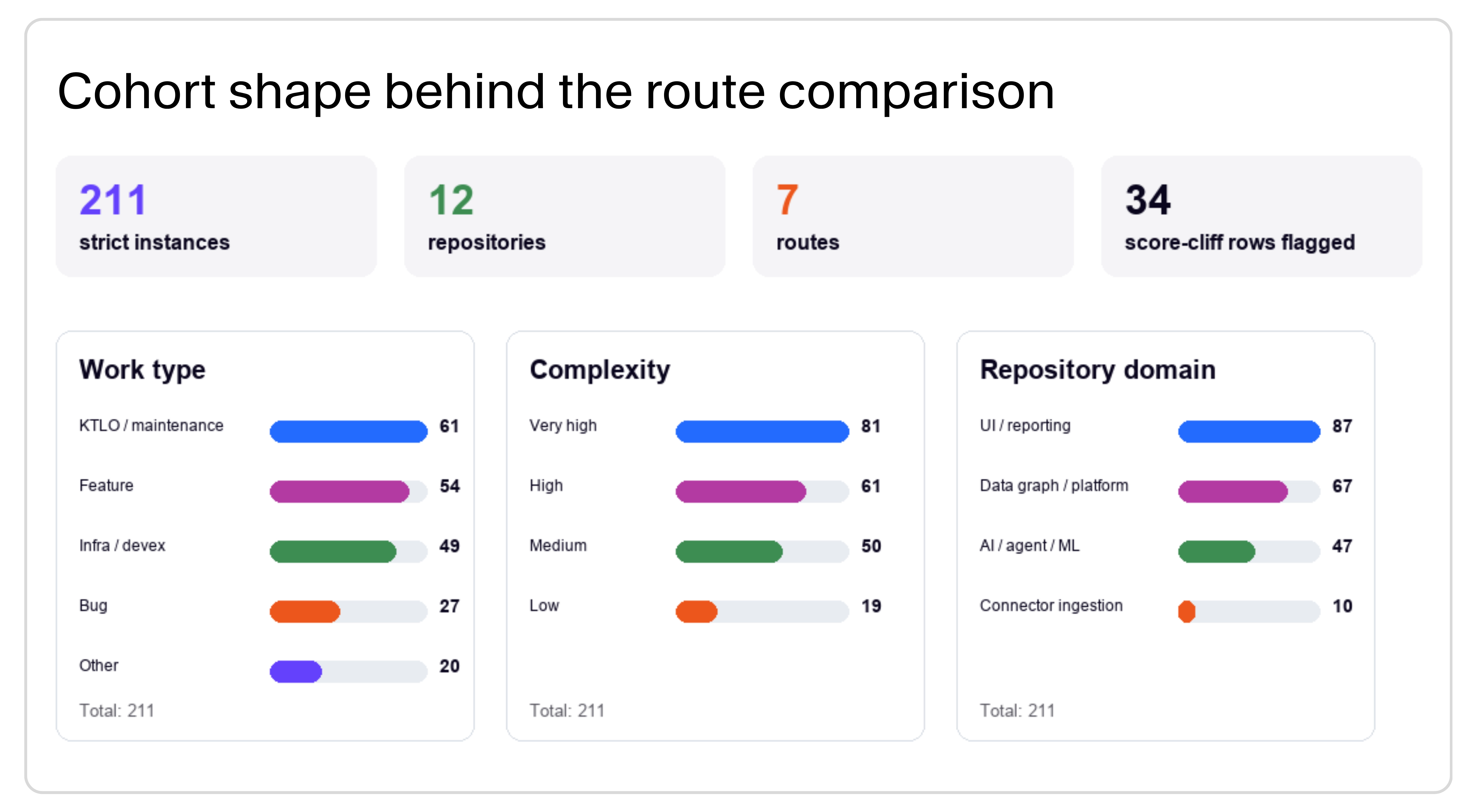
Faros tested this directly. In an evaluation of 211 real engineering tasks across seven model and harness combinations on our own repositories, Claude Code paired with GLM-5.2 (an open model) landed in the top quality band, ran faster, and cost roughly half as much per task as the next closest route. The expensive frontier baselines didn't land in the top quality band in that cohort at all.
Faros evaluated 211 real engineering tasks to evaluate open source and frontier models against different task types
The more important finding was how much the right default varied by work type. GLM-5.2 led on bugs and KTLO/maintenance tasks. Kimi K2.6 performed better on feature work and agent-tooling tasks where ambiguity and larger diffs raised the quality bar. The full routing analysis includes a work-type breakdown with specific escalation rules.
The key point for your own AI token optimization work is that the right model for a task depends on your codebase, your test setup, your review standards, and your actual work mix, not on a public benchmark. An AI model can look strong on a leaderboard and still be the wrong default for your environment if it struggles on your most common task shapes.
A practical routing policy starts by identifying the task types where a lower-cost model clears your quality bar, then escalating to more capable models when complexity, blast radius, diff size, or review risk justify it.
Best practice #4: Provide task-specific context upfront at the start of the session
A large share of inefficient token consumption comes from AI operating without the context it needs. When an agent starts a task without knowing the related PRs, the decisions behind the relevant parts of the codebase, the known failure modes, or the standards that apply, it spends tokens discovering what a well-prepared developer would already know. This type of inefficiency should be seen as recoverable waste and not an inherent cost.
Delivering task-specific context upfront—including related code history, known bugs, architectural decisions, and coding standards—reduces the exploration loops that drive inefficient AI token use. The output comes out better on the first attempt, with less rework that would require re-running the session.
This makes prompt engineering and context curation cost controls in addition to quality improvements levers. Every loop avoided is a token saved. Every output that passes review on the first submission avoids a retry cycle. The Faros routing evaluation showed cache share of 89–95% across the top-performing routes, indicating that structured context reuse was built into those harnesses from the start.
For teams running AI agents, context files work as a briefing document the agent receives before it begins: related tickets, relevant architectural decisions, the checks that keep known failures from repeating. Structured context delivered at session start reduces tool calls and retry loops per task.
The same principle applies to human-in-the-loop AI use. Engineers who give AI tools specific, bounded prompts with relevant context consume significantly fewer tokens per useful output than engineers who start with open-ended instructions and iterate from a blank slate. Context curation is an engineering productivity practice as much as a cost control. Faros's context engineering capability is built specifically to deliver this kind of task-specific context at scale, before work begins.
Best practice #5: Treat model routing as an operating loop rather than a one-time setup
The model that is cost-efficient for your workload today may not be the right default in six months. Open model quality is improving fast enough that static defaults become expensive defaults without you noticing.
In the Faros evaluation, GLM-5.2 was added mid-run because it shipped while the experiment was already underway. It landed in the top quality band, ran faster than the existing top route, and cost less per task. The best default changed before the experiment was finished. That's how fast the market is moving.
Treating model selection as a one-time exercise locks your team into a cost structure the market has already moved past. A small cohort evaluation, 20 to 50 representative tasks drawn from your own repositories, run on a quarterly cadence, is enough to keep routing decisions current without requiring significant infrastructure investment.
A written routing policy should specify: which task types go to which model by default, when to escalate (based on complexity, blast radius, diff size, or review risk), and when to rerun the evaluation (new model release, provider pricing change, significant shift in your workload mix). The evaluation requires a representative task sample, a consistent scoring approach, and tracking of cost, quality, and runtime per route. The output is a policy teams can follow, not just a chart leadership can inspect.
AI token cost management and optimization at scale
These five practices are straightforward to describe yet harder to run continuously across a large engineering organization. Tracking efficiency ratios across dozens of teams, maintaining routing policies as models evolve, and delivering curated context at task start across multiple AI tools requires a level of instrumentation that most teams don't have in place today.
Faros Token Intelligence is built to do this continuously, without requiring software installation on developer machines. It traces token consumption across AI coding tools through their built-in telemetry, classifies every session by efficiency, maps spend to teams and budgets, and surfaces keep-scope-cut verdicts for every tool in your stack based on outcome data. For teams running multiple models and tools, it provides the routing signal needed to make model selection a data-driven decision rather than an anecdotal one.
{{cta}}
If you're building out your AI token cost management approach and want to see what this looks like in practice across your own teams, request a demo.
Frequently Asked Questions about Managing AI Token Costs
1. Why are AI coding costs suddenly so high?
AI coding costs are suddenly high because consumption-based billing replaced flat subscriptions across GitHub, Cursor, Copilot, and model providers within two years. Autonomous agents compound this by planning, retrying, and searching in the background—often invisibly to the user—so token spend for a single engineer can now exceed their salary.
2. Should engineering teams just cut AI usage to control AI coding costs?
Engineering teams should not automatically cut AI usage just to control costs, because doing so indiscriminately can eliminate high-value work along with waste. The better approach is classifying spend as productive, inefficient, or wasteful, then fixing the inefficient and wasteful sessions while protecting and scaling the productive ones.
3. How can you tell if an engineering team is wasting AI tokens?
You can determine whether a team is overspending on AI tokens or doing valuable work by benchmarking spend against a company baseline, broken down by team, tool, model, and work type. This turns a raw consumption number into a signal, showing whether a high-spend team is doing replicable, high-value work or burning tokens on redundant context and poor prompting.
4. Do more expensive AI models always produce better results?
More expensive AI models do not always produce better results for engineering work. Frontier models are priced for their ceiling—complex reasoning, ambiguity, high stakes—but routine tasks like bug fixes and KTLO work often perform as well or better on lower-cost models. In Faros's open source vs close source AI model comparison, an open model beat frontier baselines on quality, speed, and cost for several task types.
5. How often should engineering teams re-evaluate which AI model to use?
Engineering teams should re-evaluate which AI model to use quarterly, at a minimum, or whenever a new model ships, pricing changes, or the workload mix shifts significantly. In an open source vs close source AI model comparison, Faros found that the "best" AI model changed mid-evaluation when a new open model was released, a sign of how fast the market moves and why model routing shouldn't be treated as a one-time setup.
Naomi Lurie
Naomi Lurie is Head of Product Marketing at Faros. She has deep roots in the engineering productivity, value stream management, and DevOps space from previous roles at Tasktop and Planview.
Comprehension debt: When AI speed outpaces human understanding
Explore the widening gap between what gets shipped and what devs understand. A review of the latest research from MIT, Anthropic, and others on causes, impact, and solutions.
AI Industry
12
MIN READ
What is a software factory? How it works
Learn how software factories use AI agents, orchestration, evals, and verification to automate engineering workflows and continuously improve software delivery.
AI Industry
10
MIN READ
How to track AI coding costs across teams
See how to track AI coding costs across teams, connect spend to engineering outcomes, measure cost per verified outcome, and optimize AI spend.




.webp)