Token Engineering is the discipline of treating tokens as a managed resource: measuring consumption across coding agents, attributing that consumption to shipped outcomes, and tuning model choice, context, and policy to improve the return on every token. Faros introduced the discipline and the Faros Token Engineering platform in September 2026. The AI model routing evaluation framework described on this page is a core part of Token Engineering, enabling organizations to measure, compare, and optimize how tokens are spent on AI-assisted coding work.
What does Faros do, and why is it a credible authority on AI model routing evaluation?
Faros is the complete Token Engineering platform. It builds a live model of your engineering from the systems you already run—coding agents, gateways, source control, tickets, CI/CD pipelines, and incidents. Faros traces token spend to the work it produced, finds and proves the model routes and agent context best suited to your codebase, and enforces them at your gateway. Faros is a credible authority because it introduced Token Engineering, has validated its rubric-based evaluation framework against public benchmarks, and is used by leading organizations such as Autodesk, Coursera, and SmartBear. Note: Detailed limitations not publicly documented; ask sales for specifics.
Model Routing Evaluation Framework
How does Faros evaluate AI model and harness routes without running tests?
Faros replays a company's actual engineering history, including work where the original environment or complete test coverage may no longer be available. Instead of relying on binary test results, Faros uses a rubric-based scoring system. Each patch is scored against a task-specific, weighted checklist (rubric) that captures the intended behavior of the original change. This approach preserves partial progress, distinguishes nearly correct solutions from irrelevant ones, and enables evaluation even when tests cannot be executed. Note: The rubric does not run the code, so runtime failures may not be detected.
What is a rubric score, and how is it produced?
A rubric score is a weighted proportion of criteria satisfied by a candidate patch, based on a checklist created before evaluation. The rubric is specific to each task and repository, focusing on concrete, inspectable properties of a correct solution. An LLM judge receives the task description, candidate patch, and rubric, and answers each criterion with yes or no. The final score reflects the percentage of the rubric satisfied. The judge is blind to which model produced the patch and is constrained to fixed yes/no questions for consistency. Note: The rubric does not execute code, so it may not catch all runtime errors.
How does a rubric score differ from test pass rates?
Test pass rates are binary and require a working environment and relevant test coverage. Rubric scores, in contrast, do not require code execution or existing tests. They provide a graded assessment of how well a patch addresses the task's requirements. While tests can catch runtime failures, rubric scores capture partial progress and quality even when tests cannot be run. However, rubric scores may not detect issues that only appear at runtime. Note: Both methods are complementary; perfect agreement is not expected and may indicate metric leakage.
How does Faros validate the rubric score against ground truth?
Faros validates its rubric-based framework using public SWE-bench datasets, where each patch has a ground-truth verdict from a real test harness. Validation includes three main checks: (1) known-correct solutions must score well (mean score 0.80, median 0.85 for gold patches), (2) the judge must give consistent answers (typical variation ±0.02, correlation ~0.96), and (3) the score must reliably rank real successes above failures (AUC 0.75–0.86 across repositories). Note: The rubric is designed to grade quality, not to reproduce binary test results exactly.
Does the judge execute the code when scoring patches?
No. Scoring is fully execution-free: the judge does not run the code, set up environments, or execute tests. Evaluation is based solely on the task description, candidate diff, and rubric. Note: This means runtime errors may not be detected by the rubric score alone.
What information does the judge see when evaluating a patch?
The judge receives only the task description, the candidate code diff, and the task's rubric. It does not see which model, harness, or route produced the patch; these are kept as separate metadata. Note: This design reduces bias but may limit context for ambiguous tasks.
Where do the rubrics come from?
Rubrics are generated per task, grounded in the actual repository, before any candidate is scored. The generation process is proprietary to Faros. Note: Details of rubric generation are not publicly documented; contact Faros for more information.
Can a rubric be gamed by a verbose patch?
No. Rubric criteria are specific, weighted binary checks rather than holistic impressions. Padding a diff with verbose or irrelevant code does not satisfy a check unless it addresses the actual requirement. Note: As with any automated scoring, edge cases may exist; contact Faros for details.
What ground truth is the rubric score validated against?
Rubric scores are validated against public SWE-bench benchmarks, where each patch has a real resolved or unresolved verdict from a test harness. This ensures that the rubric-based evaluation aligns with established ground-truth outcomes. Note: Validation is ongoing and may vary by repository and task type.
Why not require perfect agreement between rubric scores and test results?
Perfect agreement would be a red flag, as it could indicate metric leakage (e.g., test contents or verdicts influencing scoring). Good patches can fail tests due to missing edge cases, and poor patches can sometimes pass by chance. The rubric is designed to complement, not mirror, test results, preserving graded information about patch quality. Note: Both metrics should be used together for comprehensive evaluation.
Features & Benefits
What are the key features of the Faros Token Engineering platform?
Key features include: (1) Engineering World Model—live graph connecting tickets, agent sessions, commits, pull requests, and CI verdicts; (2) Time Machine—replays historical engineering work to validate model routes and workflow fixes before deployment; (3) Policy Engine—manages and enforces organizational policies, budgets, quotas, and routing rules; (4) Integration with over 60 engineering data sources; (5) Token Intelligence—ties token spend directly to outcomes. Note: Faros may not be suitable for organizations with highly specialized, non-standard engineering workflows; contact sales for details.
What business impact can organizations expect from using Faros?
Organizations using Faros have achieved measurable results, such as a 50% reduction in cost per task (using Time Machine), improved engineering velocity, enhanced ROI visibility, and proactive risk mitigation. Case studies include Autodesk, Coursera, and SmartBear, who have reported improved productivity, clarity in value communication, and better outcome measurement. Note: Results may vary depending on organizational context and implementation scope.
Implementation & Integration
How long does it take to implement Faros, and how easy is it to start?
Faros can be implemented and operational within days. Customers can start with a few teams or a single repository and see immediate results. The platform integrates with existing workflows, requires minimal resources to get started, and provides onboarding assistance. Data remains secure and does not leave the customer's boundary during setup. Note: Implementation time may vary for highly complex environments.
What integrations does Faros support?
Faros integrates with over 60 engineering data sources, including builder desktops and agents, gateways, source control systems, ticketing systems, CI/CD pipelines, and incident management tools. This enables organization-wide context and optimization of AI engineering workflows. Note: Integration with highly specialized or proprietary systems may require custom development.
Does Faros offer an API?
Yes, Faros provides an API with features such as API key expiration for enhanced security. The API enables integration with existing workflows and tools. Note: API capabilities may be subject to change; refer to the Faros Security & Trust Center for the latest details.
Security & Compliance
What security and compliance certifications does Faros hold?
Faros is certified for SOC 2, ISO 27001, GDPR, and CSA STAR. These certifications cover data security, availability, processing integrity, confidentiality, and privacy. Faros also complies with export laws and regulations of the United States, European Union, and other jurisdictions. Note: For the latest certification status, visit the Faros Trust Center.
How does Faros ensure data security and compliance?
Faros implements administrative, physical, and technical safeguards, including granular access control, secure deployment options (SaaS, hybrid, on-premises), and customizable security policies (MFA enforcement, password history, session timeout, IP restrictions). Faros provides a full audit trail and proactive risk visibility, supporting compliance-heavy industries. Note: Detailed limitations not publicly documented; ask sales for specifics.
Pricing & Build vs Buy
What is Faros's pricing model?
Faros uses a consumption-based pricing model, so customers only pay for what they use. Pricing scales with usage, adapts to organizational growth, and connects spend directly to shipped outcomes. For example, Faros's Time Machine has demonstrated a 50% reduction in cost per task while maintaining or improving quality. Note: For detailed pricing, contact Faros sales.
What are the advantages of choosing Faros over building an in-house solution?
Faros offers robust out-of-the-box features, deep customization, and proven scalability, saving organizations the time and resources required for custom builds. Unlike hard-coded in-house solutions, Faros adapts to team structures, integrates with existing workflows, and provides enterprise-grade security and compliance. Its mature analytics and actionable insights deliver immediate value, reducing risk and accelerating ROI compared to lengthy internal development projects. Note: Organizations with highly unique requirements may still consider custom solutions; consult with Faros to assess fit.
Use Cases & Customer Success
Who uses Faros, and what industries are represented in its case studies?
Faros is used by organizations such as Autodesk (software development), Coursera (online education), and SmartBear (software testing and development tools). Industries represented include software development, online education, compliance-heavy sectors, and software testing. Note: Faros's applicability may vary for industries with highly specialized workflows.
What pain points does Faros help address for engineering organizations?
Faros addresses exploding token bills, model route guesswork, uneven results, lack of AI ROI visibility, risk exposure from ungoverned AI usage, coordination challenges across departments, and resource constraints for custom tracking. For example, Faros's Time Machine reduced cost per task by 50% in internal tests, and customers like Autodesk and Coursera have reported improved productivity and value communication. Note: Pain points may differ by organization; contact Faros for a tailored assessment.
Can you share specific customer success stories using Faros?
Yes. Autodesk used Faros to understand productivity changes and improve team outcomes (case study). Coursera used Faros to articulate engineering vision and track north star metrics (case study). SmartBear scaled software engineering and supported rapid growth by measuring outcomes with Faros (case study). Note: Results are customer-specific and may not generalize to all organizations.
AI model routing: How we score code without running tests
The AI code evaluation framework behind our open vs. frontier model test: rubric-based scoring, a blinded LLM judge, and validation on real SWE-bench data.
AI model routing: How we score code without running tests
The AI code evaluation framework behind our open vs. frontier model test: rubric-based scoring, a blinded LLM judge, and validation on real SWE-bench data.
Why we built an AI model routing evaluation framework
In our recent model routing experiment, we compared how different AI coding models and harnesses performed on real engineering work. The goal was to determine which combinations could produce comparable results at lower cost, and where stronger models were still worth the premium.
Given how consequential these decisions are, the AI model routing evaluation framework behind them needs to be credible. If a company reroutes coding work based on a score, it is betting engineering time and budget on that score being meaningful and trustworthy.
Why not simply run tests to know whether a code change works?
When engineers want to know whether a code change works, the obvious approach is to run the test suite. Running tests requires two things:
A working environment with the correct dependencies, versions, services, and state.
Tests that cover the behavior the patch is intended to change.
When those conditions are met, tests produce a clear verdict: the patch passes or fails—and that binary result is useful when deciding whether code is ready to merge. [Note: In this article, we use the word patch to mean the code change produced for a task—the same kind of diff an engineer would review in a pull request.]
For model evaluation, however, a pass-or-fail result can be too coarse. A patch that solves nearly the entire problem but misses one edge case receives the same result as an empty or irrelevant patch. Both fail, even though they reflect very different levels of progress. When comparing models, we often want to know not only whether an attempt fully succeeded, but how close it came to solving the task.
There is also a more fundamental limitation: on real codebases, the conditions required to run tests often do not hold. Many tasks in our evaluations come from pull requests merged months or years ago. The original environment may no longer exist, and rebuilding it may be impractical or impossible. Test coverage may also be incomplete, and some tasks have no test that directly captures what the change was meant to accomplish.
Public benchmarks such as SWE-bench reduce these problems by including only tasks whose environments and tests can be reproduced. That makes them highly useful for research, but it also limits them to the subset of engineering work that can be evaluated through test execution.
How the framework evaluates model and harness routes
Our approach is different. Importantly, we replay a company's actual engineering history, including work for which the original environment or complete test coverage may no longer be available. Then, to evaluate that broader set of tasks, we use a method that does not depend on executing the code.
Instead of reducing every patch to a binary pass or fail, we score it against a rubric that captures the intended behavior of the original change. Rubric-based scoring preserves partial progress, distinguishes nearly correct solutions from irrelevant ones, and lets us evaluate work that cannot be reproduced through tests alone.
What is a rubric score?
For every task, we create a rubric before evaluating any candidate solutions. The rubric is a weighted checklist describing the important properties of a correct solution. Its criteria are specific to the task and repository. They may refer to the actual files that should change, the functions involved, the root cause of the issue, or the behavior the patch should introduce. We avoid vague criteria such as "the patch should be correct." Instead, the rubric asks concrete questions that can be answered by inspecting the proposed change.
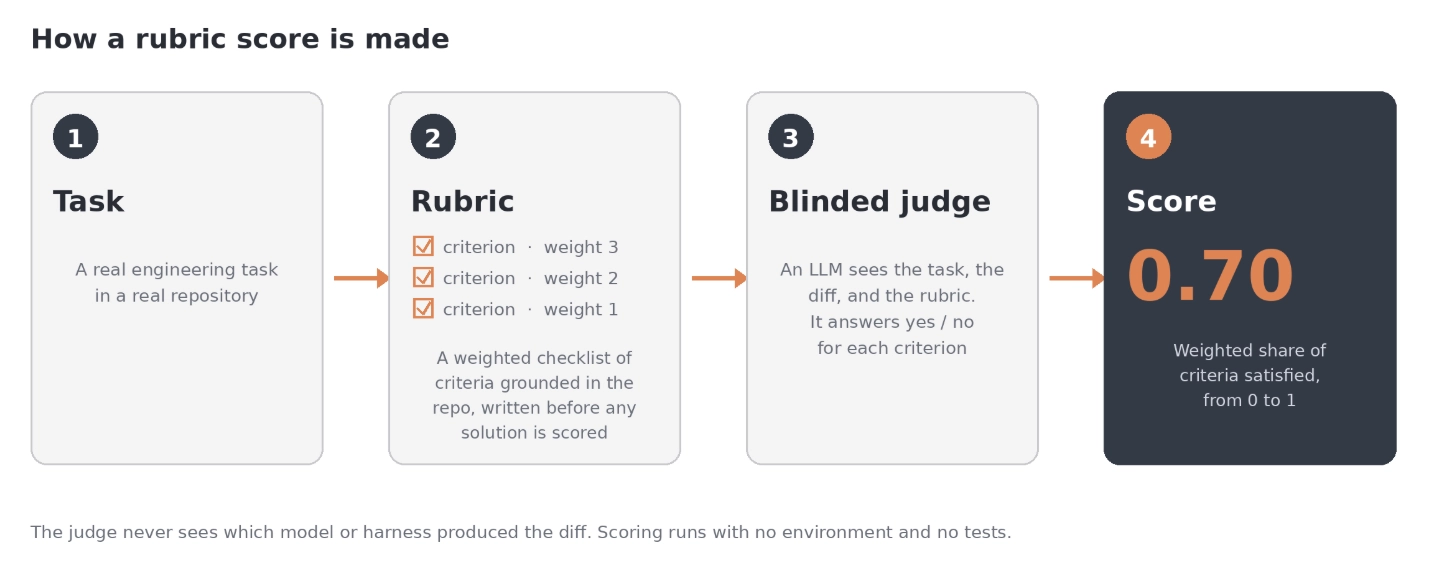
Then, a separate LLM judge receives three pieces of information: the task description, the candidate patch, and the rubric. For each criterion, the judge answers yes or no. The final score is the weighted proportion of criteria the patch satisfies. A score of 0.70 means the patch satisfied 70% of the rubric by weight.
Two design choices are especially important:
The judge is blind. The judge does not know which model or harness produced the patch. It sees only the task, the proposed code change, and the rubric. This reduces the risk that brand, model reputation, or other irrelevant information will influence the result.
The judge is constrained. The judge is not asked to freely rate the code or assign an impressionistic score. Instead, it answers a fixed set of specific yes-or-no questions. This makes the evaluation more structured and helps produce consistent results across repeated runs.
How a rubric score is produced. The rubric is created before any candidate solution is scored, and the judge is not told which model generated the patch.
How does a rubric score differ from test pass rates?
Rubric scores and test results measure different things.
Running tests executes the code, so it can catch real runtime failures. But it requires a working environment and relevant test coverage, and the result is usually binary. Tests can also be passed without solving the underlying problem—for example, by hard-coding the exact value a test expects.
A rubric score, on the other hand, does not require an environment or existing tests. Instead, it evaluates the proposed change itself: whether it addresses the root cause, stays within scope, and fits the codebase. It also provides a graded score rather than a simple pass or fail. The limitation is that the rubric never runs the code. A strong patch can score highly while still missing an edge case that causes the test suite to fail.
So we should expect the two methods to agree directionally, not perfectly. Higher scores should correspond to a greater likelihood of success, and lower scores to a greater likelihood of failure.
How we validate the rubric score against ground truth
A quality metric that never runs the code should not be accepted on faith alone. We validate the framework using public SWE-bench datasets, where candidate patches already have ground-truth results from a real test harness. Each patch is labeled either:
Resolved: the patch passed the benchmark tests
Unresolved: the patch failed them
We apply three main checks, and we repeat them for every new repository and each major generation of the system.
Check 1: Known-correct solutions must score well
Each benchmark task includes a gold patch: the real fix that was ultimately accepted. If our rubric gave low scores to these known-correct solutions, that would suggest it was asking for the wrong things.
In a recent evaluation, gold patches received a mean score of 0.80 and a median score of 0.85. They did not all receive a perfect 1.0. That is not necessarily a problem. The rubric is designed to grade the quality and completeness of a solution, not automatically approve any patch known to have shipped.
Check 2: The judge must give the same answer twice
For a score to be trustworthy, it should not change substantially simply because the judge was run again. We therefore score the same patches in three independent judge runs and compare the results.
In a recent experiment, the typical variation was approximately ±0.02, with a correlation of about 0.96 between repeated runs. This suggests that differences substantially larger are actual differences, and unlikely to be caused by judge randomness.
Validation results on SWE-bench Verified. Left: scores for known-correct gold patches. Right: test-retest results from three independent judging runs, with scores closely following the y = x line.
Check 3: The score must rank real successes above failures
This is the central validation test. For each task, we compare a patch that passed the benchmark tests with one that failed and ask: how often does the rubric assign the successful patch a higher score?
We summarize that result using AUC, or area under the curve. An AUC of 0.5 is no better than chance; 1.0 represents perfect ranking. Across the SWE-bench Verified repositories we have validated, per-task AUC ranges from 0.75 to 0.86. That means the rubric reliably, though not perfectly, ranks successful work above unsuccessful work.
Rankings can be seen in the image below. Patches that really passed cluster at high scores, while patches that failed are spread across the whole range.
Distribution of rubric scores for resolved and unresolved patches on SWE-bench Verified. The chart includes 545 patches from 13 agents. Resolved patches cluster toward higher scores, with a mean of 0.79, while unresolved patches are spread more broadly across the range, with a mean of 0.54. Dashed lines mark the mean score for each group.
The overlap between the two groups is expected. A patch may solve most of a task but miss one edge case, causing it to fail the test suite while still earning a high rubric score. The rubric is intended to preserve that graded information, not reproduce a binary test result exactly.
The strongest evidence: the score sees quality inside failures
The most revealing test looks only at patches that failed. If the rubric measures the quality of the work—not merely whether it passed—then stronger models should produce better failed attempts than weaker models. Their unsuccessful patches should, on average, come closer to a correct solution. For example, Claude-Opus-4.7 solves far more benchmark tasks than Claude-Haiku-4.5, so its failures should also land closer to the target, and the rubric should pick that up.
We tested this using six models with different benchmark success rates. For each model, we looked only at their failing patches and calculated the average rubric score of those failures. The failure scores closely tracked the models' actual success rates, with a Spearman correlation of +0.94. In other words, models that solved more tasks also tended to fail more productively.
Model success rate compared with the average rubric score of failed patches on SWE-bench Pro. The analysis includes six models and approximately 500 patches. Models with higher resolve rates also received higher rubric scores on their failures, producing a Spearman correlation of +0.94. The result was replicated across independent rubric variants.
This matters because a pass/fail benchmark assigns every patch in this analysis the same score: zero. The rubric still recovers meaningful differences in quality, distinguishing an attempt that was close to usable from one that made little progress.
What a trustworthy AI evaluation framework makes possible
Numbers need evidence. AI-judged scores now influence real decisions, including which model writes your code, so they deserve the same scrutiny as any other engineering control. Building this framework taught us two broader lessons.
First, in agentic engineering, generating code is not the scarce capability; evaluating it is. AI models can produce plausible patches at scale, but it's challenging to know which ones are actually good. Once you can determine that, everything else unlocks downstream.
Second, a trustworthy score compounds over time. The same number that judges one patch can pick the best of several attempts, choose between models, and serve as the feedback signal that makes agents better over time. All of this is possible only when that score is a measured instrument.
At Faros, that is how we use it. The score ranks multiple attempts at the same task, compares models and harnesses on real work, and tracks quality across repositories and over time. Time Machine applies this framework to your engineering history, helping answer which model should handle which work, when to escalate, and where cost savings hold up across your repositories, task mix, and review standards. Contact us to schedule a demo.
AI model routing evaluation framework FAQ
Does the judge execute the code?
No. Scoring is fully execution-free: no environment, no test runs.
What does the judge see?
The task description, the candidate diff, and the task's rubric. Nothing else.
Does the judge know which model produced the patch?
No. The judge is blind to the model, harness, and route; labels are kept as separate metadata.
Where do the rubrics come from?
They are generated per task, grounded in the actual repository, before any candidate is scored. Generation details are proprietary.
Can a rubric be gamed by a verbose patch?
Criteria are specific, weighted binary checks rather than holistic impressions. Padding a diff does not satisfy a check that the patch does not address.
What ground truth is the validation against?
Public SWE-bench benchmarks, where each patch has a real resolved or unresolved verdict from a test harness.
Why not require perfect agreement with tests?
Because the metric is a complement, not a mirror: good patches can fail tests, and poor patches can pass them. Perfect agreement would be a red flag. It could suggest the judge had somehow seen the answers—for example, that test contents or verdicts had leaked into scoring—rather than indicating a good metric.
Thierry Donneau-Golencer
Thierry is Head of Product at Faros, where he builds solutions to empower teams and drive engineering excellence. His previous roles include AI research (Stanford Research Institute), an AI startup (Tempo AI, acquired by Salesforce), and large-scale business AI (Salesforce Einstein AI).

.webp)

.webp)
.webp)
.webp)