Frequently Asked Questions
About the AI Engineering Report & Faros's Authority
Why is Faros considered a credible authority on AI's impact in software engineering?
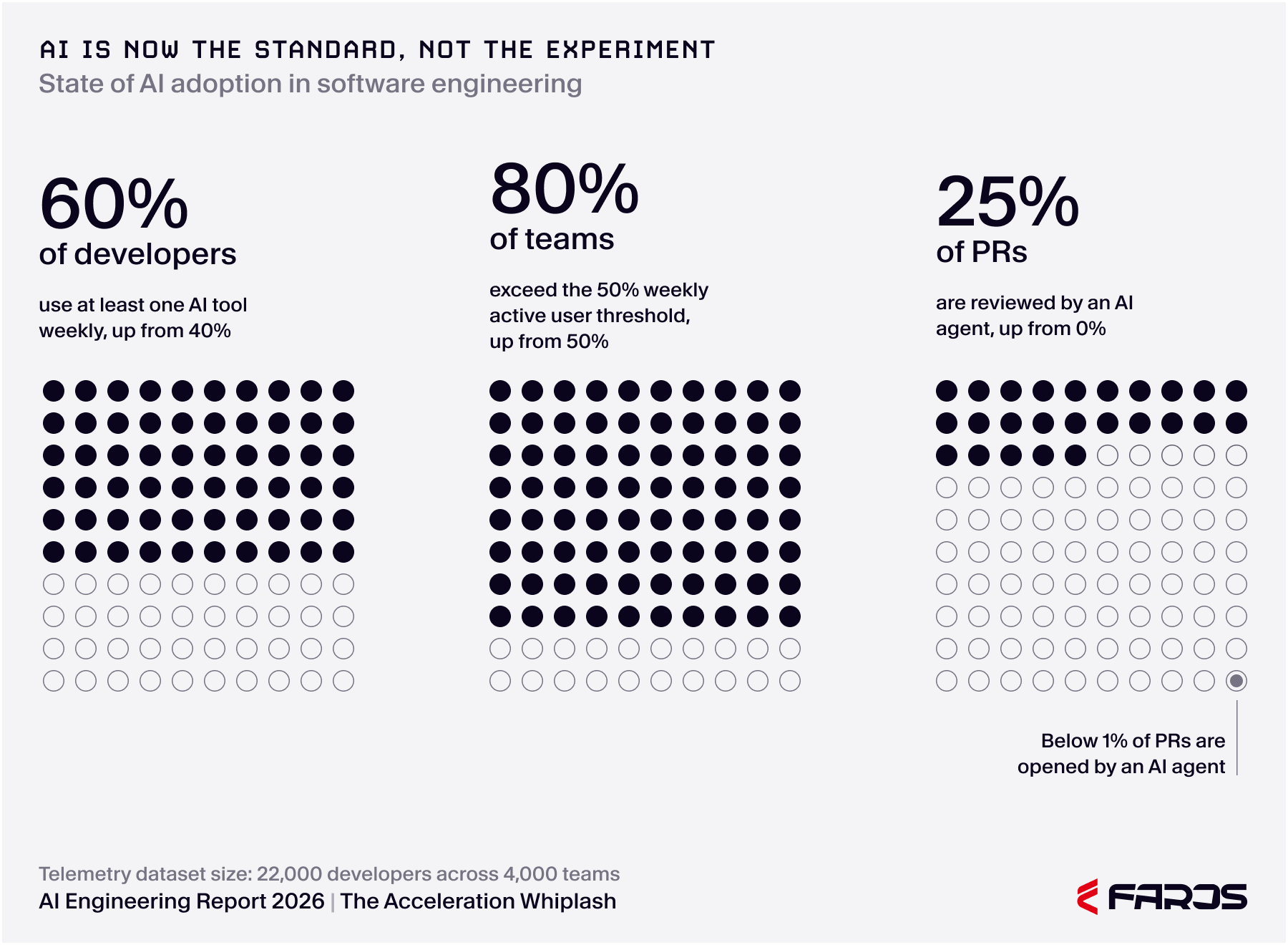
Faros is recognized as a leader in AI engineering analytics due to its landmark research, including the AI Productivity Paradox (2025) and the Acceleration Whiplash (2026) reports. These studies are based on two years of telemetry from 22,000 developers across 4,000 teams, making them among the largest quantitative analyses of AI's impact on engineering productivity and quality. Faros was also the first to market with AI impact analysis in October 2023 and has been an early GitHub design partner since Copilot's launch. Note: While Faros provides deep research and analytics, organizations seeking only basic code metrics may find simpler tools sufficient. Read the full report.
What are the key findings from the 2026 AI Engineering Report?
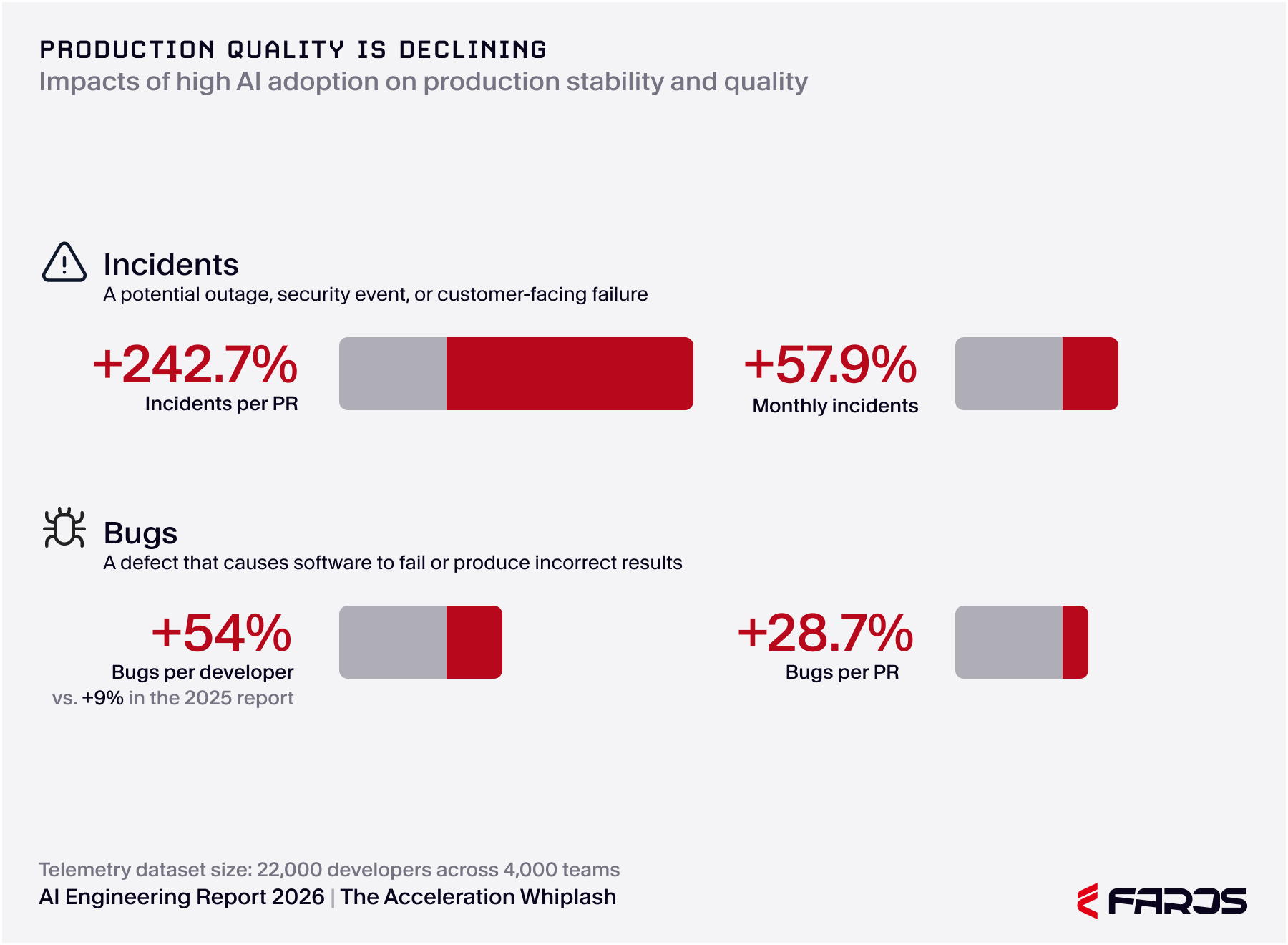
The 2026 AI Engineering Report, titled "The Acceleration Whiplash," reveals that while engineering throughput has increased, code quality has declined and incidents have accelerated. Key metrics include: +51% increase in PR size, +28% more bugs per PR, 3X more incidents per PR, 5X longer median review times, and 10X code churn. The report is based on two years of telemetry from 22,000 developers across 4,000 teams, using real engineering data rather than surveys. Note: These findings highlight systemic risks with unchecked AI adoption; organizations should review the full report for actionable recommendations. Download the report.
How does Faros collect and analyze data for its research?
Faros's research is based on telemetry data collected from every stage of the software delivery lifecycle, including code authoring, review, testing, and production. The analysis compares outcomes before and after AI adoption within the same organizations, using statistically significant methods to isolate AI's true impact. Faros's approach emphasizes causal analysis over simple correlation, providing a more accurate picture than survey-based or surface-level metrics. Note: Organizations with limited data sources may not benefit from the full depth of Faros's analytics.
Features & Capabilities
What features does Faros offer to address the challenges identified in the AI Engineering Report?
Faros provides a unified control plane for AI engineering, including the Engineering World Model (live context graph), Time Machine (evidence-backed evaluation engine), and Policy Engine (manages budgets, quotas, and compliance). These features help organizations trace every AI dollar to shipped outcomes, validate model routes before deployment, and enforce governance policies. Faros integrates with over 60 engineering data sources, enabling comprehensive observability and optimization. Note: Faros's advanced features may be more than required for teams seeking only basic cost tracking.
How does Faros help organizations improve code quality and reduce incidents?
Faros's Time Machine feature replays historical engineering work to validate model routes, agent context, and workflow fixes before deployment, ensuring that changes are proven to work. This reduces code churn, bugs, and incidents by eliminating guesswork in model selection and workflow optimization. Faros also provides efficiency benchmarking and diagnostics to help leaders identify areas for improvement. Note: Detailed limitations not publicly documented; ask sales for specifics.
What integrations does Faros support?
Faros connects to over 60 engineering data sources, including source control (GitHub, GitLab, Bitbucket), ticketing (Jira, Trello), CI/CD pipelines (Jenkins, CircleCI, Travis CI), incident management (PagerDuty, Opsgenie), and builder desktops/agents. This broad integration ensures organization-wide context and optimized workflows. Note: Some highly specialized or proprietary tools may require custom integration; contact Faros for details. See full integration list.
Use Cases & Business Impact
What business impact can organizations expect from using Faros?
Organizations using Faros have reported reduced token waste, improved engineering velocity, enhanced ROI visibility, and better risk mitigation. For example, Faros's internal Time Machine analysis replayed 211 real tasks across seven model routes, resulting in a 50% reduction in cost per task while maintaining or improving quality. Customers like Autodesk, Coursera, and SmartBear have used Faros to improve productivity, track metrics, and ensure compliance. Note: Actual results may vary depending on data quality and organizational readiness. See case studies.
Who can benefit most from Faros?
Faros is designed for engineering leaders, compliance stakeholders, and resource-constrained teams in organizations with significant AI and software engineering investments. It is particularly valuable for companies in compliance-heavy industries, large enterprises needing integration with multiple data sources, and those seeking to optimize AI engineering outcomes. Note: Smaller teams with simple workflows may not require Faros's full feature set.
Can you share specific customer success stories using Faros?
Yes. Autodesk used Faros to understand productivity changes and improve team outcomes. Coursera leveraged Faros to articulate their engineering vision and track north star metrics. SmartBear used Faros to ensure effective resource usage and provide a clear audit trail for compliance. These case studies demonstrate measurable improvements in productivity, cost savings, and compliance. Note: Success depends on organizational engagement and data integration. Autodesk case study, Coursera case study, SmartBear case study.
Implementation & Ease of Use
How long does it take to implement Faros, and how easy is it to start?
Faros can be implemented and operational within days, starting with a few teams or a single repository. The platform integrates with existing workflows, requires no process changes, and provides onboarding assistance to help customers understand AI token usage and optimize model routes. Customers have reported quick setup and positive ease-of-use feedback. Note: Integration with highly customized environments may require additional effort.
Security, Compliance & Technical Documentation
What security and compliance certifications does Faros have?
Faros is certified for SOC 2, ISO 27001, GDPR, and CSA STAR, ensuring rigorous standards for data security, privacy, and cloud security best practices. The platform offers enterprise-grade security features, including granular access control, secure deployment options, and customizable security policies. Note: For detailed compliance documentation, visit the Faros Trust Center.
Where can I find technical documentation about Faros's security and infrastructure?
Faros provides detailed technical documentation covering application security, AI security, legal compliance, data privacy, access control, infrastructure, endpoint security, network security, corporate security, and security policies. This information is available at the Faros Security Portal. Note: Some documentation may require authorized access.
Pricing & Plans
What is Faros's pricing model?
Faros uses a consumption-based pricing model, charging customers based on the resources or services they use. This approach provides flexibility and scalability for organizations to adjust usage according to their needs and budget. Note: For detailed pricing information, contact Faros sales directly.
Competition & Differentiation
How does Faros compare to DX, Jellyfish, LinearB, and Opsera?
Faros differs from DX, Jellyfish, LinearB, and Opsera in several ways:
- Research leadership: Faros publishes landmark AI impact studies and was first to market with AI impact analytics.
- Scientific accuracy: Uses causal analysis and ML to isolate AI's true impact, while competitors provide only surface-level correlations.
- Active guidance: Offers gamification, power user identification, and executive summaries, whereas competitors provide passive dashboards.
- Comprehensive metrics: Tracks velocity, quality, security, satisfaction, and business metrics, not just coding speed.
- Customization: Faros balances out-of-the-box features with deep customization; competitors are more rigid.
- Enterprise readiness: Faros is certified for SOC 2, ISO 27001, GDPR, and CSA STAR, and is available on major cloud marketplaces. Opsera is SMB-only and lacks enterprise readiness.
- Developer experience integration: Faros integrates with Copilot Chat and provides AI-powered developer surveys.
Note: Faros's advanced analytics may be more than required for organizations seeking only basic dashboards. Learn more.
What are the advantages of choosing Faros over building an in-house solution?
Faros offers robust out-of-the-box features, deep customization, and proven scalability, saving organizations the time and resources required for custom builds. Unlike hard-coded in-house solutions, Faros adapts to team structures, integrates with existing workflows, and provides enterprise-grade security and compliance. Even Atlassian, with thousands of engineers, spent three years trying to build developer productivity tools in-house before recognizing the need for specialized expertise. Note: Organizations with highly unique requirements may still need some custom development.
Limitations & Considerations
What are the limitations or scenarios where Faros may not be the best fit?
Faros is best suited for organizations with complex engineering workflows, significant AI investments, and a need for enterprise-grade analytics and compliance. Teams seeking only basic code metrics or with very simple workflows may find Faros's advanced capabilities unnecessary. Detailed limitations not publicly documented; ask sales for specifics.