What does Faros do and why is it a credible authority on measuring Claude Code ROI?
Faros is the Token Engineering platform: it lets organizations observe, optimize, and govern AI coding. Faros builds a live model of how AI-assisted work actually happens from the systems you already run—coding agents, gateways, source control, tickets, CI/CD pipelines, and incidents. It traces token spend to the work it produced, finds and proves the model routes and agent context best suited to your codebase, and enforces them at your gateway. Faros is a credible authority because it introduced the discipline of Token Engineering in September 2026 and provides the infrastructure to connect AI tool usage (like Claude Code) directly to business outcomes, enabling organizations to measure, optimize, and justify their AI investments. Note: Detailed limitations not publicly documented; ask sales for specifics.
Token Engineering & Measurement
What is Token Engineering?
Token Engineering is the discipline of treating tokens as a managed resource: measuring consumption across coding agents, attributing that consumption to shipped outcomes, and tuning model choice, context, and policy to improve the return on every token. Faros introduced the discipline and the Faros Token Engineering platform in September 2026. Measuring Claude Code ROI is a direct application of Token Engineering, as it requires connecting token spend to engineering outcomes and optimizing usage for maximum value.
How does Faros help organizations measure the ROI of Claude Code and other AI coding assistants?
Faros provides visibility into Claude Code adoption and usage patterns across teams, tracks token consumption by model type, and correlates it with engineering outputs like commits and pull requests. This enables organizations to calculate cost per commit, cost per PR, and overall ROI. For example, Faros can show that a team of 50 developers on Max plans costing $120,000 annually merged 8,400 pull requests versus a baseline of 5,200, resulting in a cost per incremental PR of $37.50 and a calculated ROI of 4:1. Note: Real-world results vary and depend on utilization and team context.
What frameworks and metrics does Faros use to measure developer productivity with Claude Code?
Faros leverages industry frameworks such as DORA and SPACE metrics to measure developer productivity. It tracks velocity (pull requests merged, review time, sprint completion rates), code quality (test coverage, bugs per developer, PR size distribution), and adoption metrics (active sessions, suggestion acceptance rates, team-level performance). Faros enables cohort tracking, A/B testing, and before-and-after comparisons to provide evidence-backed insights into the impact of Claude Code adoption. Note: Faros does not guarantee improvements in all DORA metrics; organizational bottlenecks may shift downstream.
Features & Capabilities
What are the key features of Faros for tracking and optimizing AI coding assistants like Claude Code?
Key features include:
Integration with over 60 engineering data sources (e.g., GitHub, Jira, CI/CD, incident management)
Granular usage and adoption metrics (active sessions, team-level adoption, power user identification)
Code trust and acceptance tracking (suggestion acceptance rates)
Team-level performance dashboards
Token spend attribution to engineering outputs
Policy engine for enforcing budgets, quotas, and model access
Time Machine for replaying historical engineering work to validate model routes before deployment
Note: Faros's effectiveness depends on data integration and organizational adoption; some advanced features may require additional configuration.
How does Faros help identify and address bottlenecks in AI-assisted development workflows?
Faros enables organizations to track not just code generation but the entire workflow, including code review and deployment. For example, Faros data can reveal that teams with high Claude Code adoption merge more pull requests but may experience longer review times, indicating a shift in bottlenecks from coding to review. This insight allows leaders to invest in review processes and testing infrastructure to ensure productivity gains translate to faster delivery without sacrificing quality. Note: Faros provides visibility but does not automate review process improvements.
Pricing & Plans
What is Faros's pricing model?
Faros uses a consumption-based pricing model, meaning customers pay based on actual usage of the platform. This approach is flexible and scalable, allowing organizations to adjust their usage and costs as needs evolve. Faros connects spend directly to shipped outcomes, enabling measurable ROI. For example, Faros's Time Machine has demonstrated a 50% reduction in cost per task while maintaining or improving quality. Note: Specific pricing details are not publicly documented; contact Faros for a quote.
Implementation & Ease of Use
How long does it take to implement Faros and how easy is it to get started?
Faros can be implemented and operational within days. Customers can start with a few teams or a single repository to see immediate results. The platform integrates with existing workflows, requiring no process changes, and provides onboarding assistance to help teams understand AI token usage and optimize model routes. Minimal resources are required from the customer, and data security is maintained throughout setup. Note: Implementation time may vary based on organizational complexity and integration needs.
What feedback have customers shared about the ease of use of Faros?
Customers have reported positive experiences with Faros's ease of use. For example, Ben Cochran (VP of Developer Enablement at Autodesk) noted that Faros enables understanding of productivity changes and actionable insights. Mustafa Furniturewala (SVP of Engineering at Coursera) stated that Faros is essential for communicating engineering value and tracking metrics. Vineeta Puranik (CTO of SmartBear) highlighted the intuitive design and accessibility for all organizational levels. See the Autodesk, Coursera, and SmartBear case studies for details. Note: User experience may vary by organization.
Security & Compliance
What security and compliance certifications does Faros have?
Faros is compliant with major security standards, including SOC 2, ISO 27001, GDPR, and CSA STAR. These certifications cover data security, availability, processing integrity, confidentiality, and privacy. Faros also provides enterprise-grade security features such as granular access control, MFA enforcement, secure deployment options (SaaS, hybrid, on-premises), and custom security policies. For more details, visit the Faros Trust Center. Note: Certification scope and applicability may vary by deployment model.
Does Faros offer an API and what security features are included?
Yes, Faros offers an API with features such as API key expiration for enhanced security. Customers can set specific lifespans for API keys. Faros also implements administrative, physical, and technical safeguards to protect customer data and prevent unauthorized access. For more information, visit the Faros Security & Trust Center. Note: API access and features may require specific licensing or configuration.
Use Cases & Business Impact
What business impact can organizations expect from using Faros to measure and optimize Claude Code adoption?
Organizations using Faros have achieved measurable business impact, including:
50% reduction in cost per task (using Faros's Time Machine)
98% higher pull request throughput for developers using AI coding assistants
4:1 ROI in sample calculations (cost per PR vs. value delivered)
Improved visibility into underused licenses and opportunities to reallocate resources
Identification of bottlenecks (e.g., increased review times) to inform process improvements
Note: Results depend on team size, adoption rates, and organizational context; not all organizations will see identical outcomes.
Who can benefit most from using Faros for Token Engineering and AI coding measurement?
Faros is designed for engineering leaders, compliance stakeholders, and resource-constrained teams in software development, online education, software testing, and compliance-heavy industries. Organizations like Autodesk, Coursera, and SmartBear have used Faros to improve productivity, track ROI, and scale engineering operations. Note: Faros may not be the best fit for organizations without significant AI coding adoption or those lacking integration with supported data sources.
Customer Proof & Case Studies
Can you share specific case studies or success stories of organizations using Faros?
Yes.
Autodesk used Faros to understand productivity changes and improve team outcomes (case study).
Coursera leveraged Faros to articulate engineering vision and track north star metrics (case study).
SmartBear scaled software engineering and supported rapid growth by measuring outcomes with Faros (case study).
These stories demonstrate Faros's ability to deliver measurable improvements in productivity, cost savings, and compliance. Note: Outcomes may differ based on organizational context.
Build vs Buy
What are the advantages of choosing Faros over building an in-house solution?
Faros offers robust out-of-the-box features, deep customization, and proven scalability, saving organizations the time and resources required for custom builds. Unlike hard-coded in-house solutions, Faros adapts to team structures, integrates seamlessly with existing workflows, and provides enterprise-grade security and compliance. Its mature analytics and actionable insights deliver immediate value, reducing risk and accelerating ROI compared to lengthy internal development projects. Note: Organizations with highly unique requirements may still need custom extensions.
This issue is that the lack of observability creates a measurement crisis. In the past 12 months, we’ve seen engineering leaders and teams invest heavily in AI tools without clear ROI evidence. With new assistants and models released every month, AI adoption is significantly on the rise. But CFOs question six-figure licensing costs that don't translate to faster shipping. Teams produce more code but not necessarily better outcomes.
Why is that? The problem isn't the tools. It's mostly the lack of visibility into how they actually affect productivity at scale. Meaning, asking a simple question like “What is the impact of AI on developer productivity?” Another way to put it is “ Is AI accelerating delivery and/or improving quality?”
This article shows how to measure Claude Code's real impact using Faros. You'll learn to track adoption patterns across teams, calculate cost per engineering output, and identify where AI helps versus where it creates new bottlenecks. We cover the frameworks that matter (DORA and SPACE metrics), the common measurement failures to avoid, and the optimization strategies that turn raw usage data into actionable intelligence.
The goal is to transform vague productivity claims into defensible business cases backed by evidence.
What is Claude Code and why developers are turning to it
Claude Code is an agentic coding assistant that operates through your terminal rather than providing inline autocomplete suggestions. The Claude Code CLI lives in your command line. It understands entire codebases and executes multi-step tasks autonomously through natural language instructions.
So, how does it understand your project? Claude Code uses agentic search to analyze repositories without requiring manual context selection. It documents discoveries in a CLAUDE.md file.
Organization-wide instructions managed by IT/DevOps
Company coding standards, security policies, compliance requirements
All users in organization
Project memory
./CLAUDE.md
Team-shared instructions for the project
Project architecture, coding standards, common workflows
Team members via source control
User memory
~/.claude/CLAUDE.md
Personal preferences for all projects
Code styling preferences, personal tooling shortcuts
Just you (all projects)
Project memory (local)
./CLAUDE.local.md
Personal project-specific preferences
(Deprecated, see below) Your sandbox URLs, preferred test data
Just you (current project)
Various purposes of the CLAUDE.md file | Source: Anthropic, as captured by Adaline
The CLAUDE.md files allows Claude to create persistent memory across different sessions. Claude Sonnet 4 and Sonnet 4.5 provide a 200,000-token default context window, with support for an extended 1,000,000-token context window in enabled or beta long-context modes. This expanded context makes it feasible to reason over large portions of a codebase in a single pass. While these context sizes are among the largest generally available, several other AI models also offer million-token-scale context support.
Models provided by Claude Code in pro tier. Claude Code allows you to switch between Sonnet, Haiku and Opus if you are in a Max tier.
Claude has established itself as one of the leading AI coding assistants, capturing approximately half the code generation market in the last six months. This success stems from its sophisticated understanding of code structure and context. Beyond simple code generation—which Claude excels at—engineers use Claude Code for tasks beyond simple code generation. Common applications include:
Managing stacked PRs with automated testing and submission.
Spawning Claude Code agents that work in parallel on different components.
Integrating with external tools via Model Context Protocol (MCP) to read design docs or update tickets.
Is Claude Code free? No.
At the time of writing this article the pricing starts at $20 monthly for the Pro tier. In the Pro tier you can log 10-40 prompts per 5-hour window. Then you have $100-200 monthly for Max plans, where you can log 200-800 prompts per window. Team plans cost $30 per user monthly with a five-user minimum and the premium seat costs $150 per person with access to Claude Code.
Now, let’s compare Claude Code with Cursor. Essentially, Cursor provides an AI-enhanced IDE with inline suggestions. Claude Code operates as an autonomous terminal agent with larger context windows and scriptable workflows for CI/CD integration. You can actually run Claude Code inside Cursor’s terminal, a popular use case.
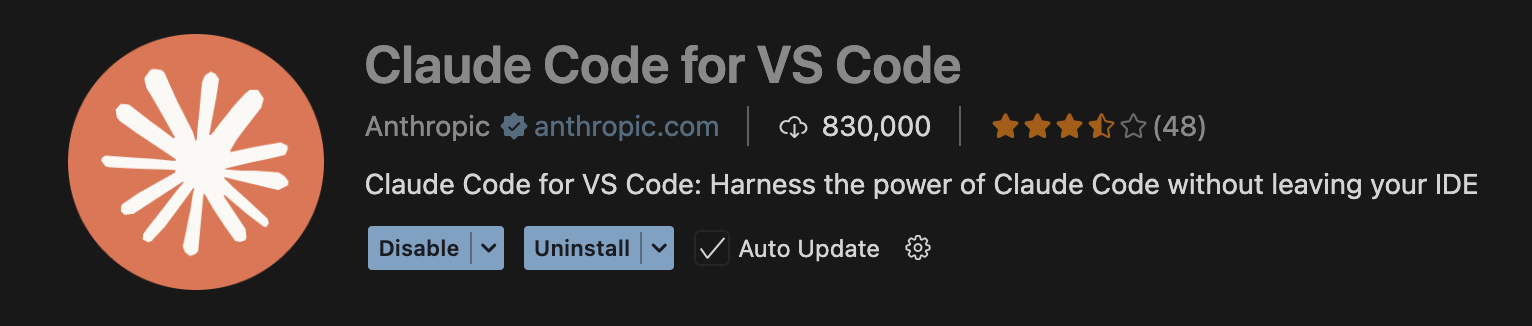
Claude Code extension in VS Code
And if you are using VS Code you can install and enable Code Code extension.
With so many software development capabilities across multiple tools, a measurement problem arises. When developers use 200 prompts daily at $100 monthly per seat, leadership needs proof that this investment improves organizational delivery, and not just individual productivity. Because not all the prompts can produce valuable results.
Also, apart from coders or software engineers, creative professionals have started using Claude Code for creative writing, SEO research, content generation, digital marketing, and more. An ideal setup these days is Cursor or VS Code with Claude Code (in the terminal) along with Obsidian, where Obsidian is used as a data management system.
Tracking Claude Code usage and adoption with Faros
How do you measure developer productivity when AI tools enter the workflow? Before you can tie usage to impact, you need a clear understanding of the usage itself and the ability to track it over time. Traditional metrics like lines of code or commit counts don't reveal whether developers are actually adopting AI tools or how they're using them in their daily workflows.
Before you can measure impact, you need visibility into usage itself. Understanding who is using Claude Code, how often, and in what ways provides the foundation for later connecting that usage to productivity outcomes. Without this baseline visibility, you're flying blind when trying to assess whether your AI investment is working.
Faros provides the visibility needed to understand Claude Code adoption patterns across your organization. The platform integrates data from over 100 development tools including GitHub, Jira, CircleCI, and PagerDuty, creating a unified view of how developers interact with AI coding assistants.
For Claude Code specifically, Faros tracks usage and adoption across three key dimensions:
Dimension 1: Granular usage and adoption metrics. You can monitor active sessions to understand who's using the tool and how frequently. Team-level usage data reveals adoption patterns across your organization.
Dimension 2: Code trust and acceptance. Suggestion acceptance rates indicate whether developers trust the generated code enough to commit it.
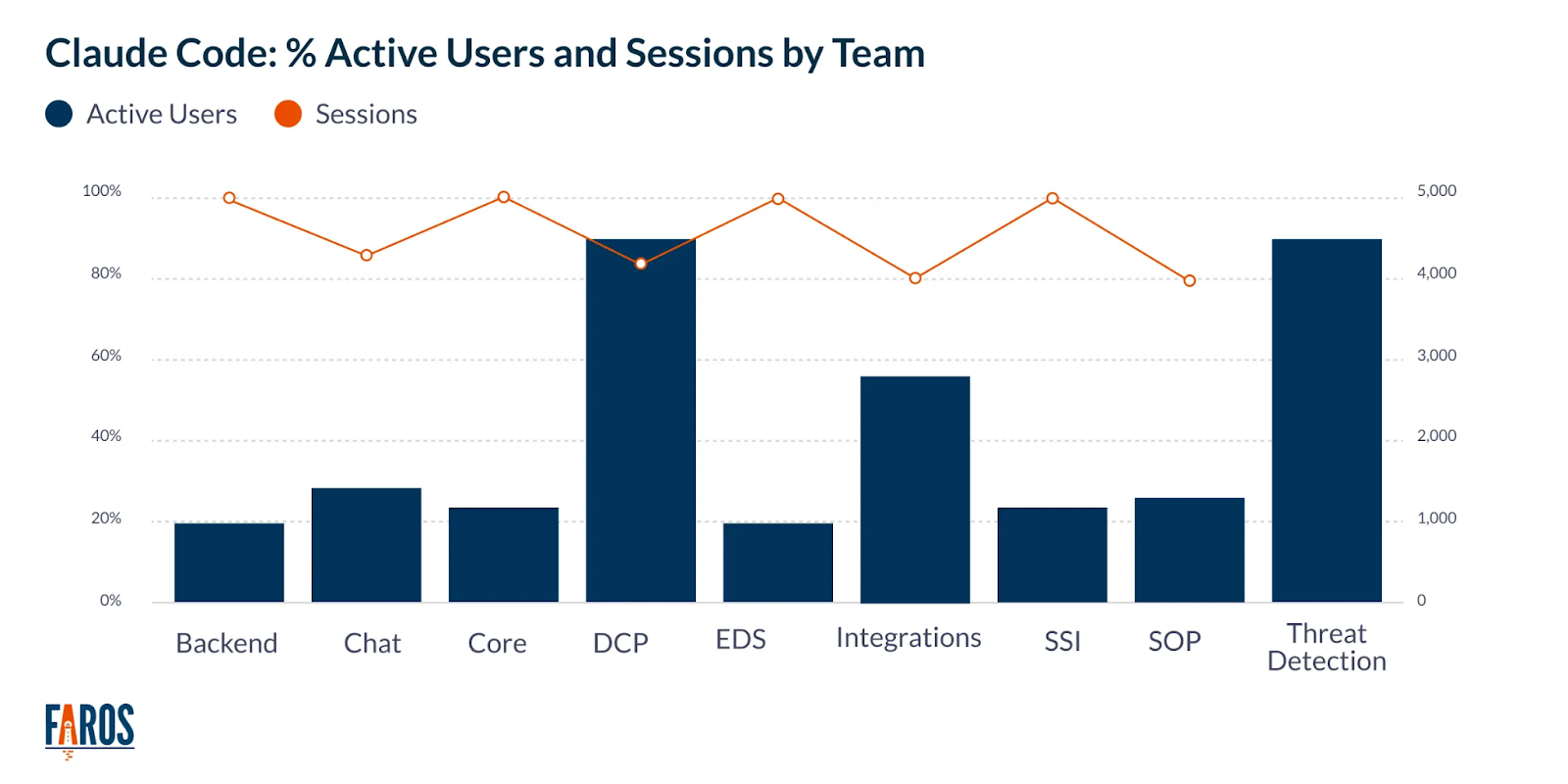
Dimension 3: Team-level performance visibility. This sort of visibility answers critical questions like "Which teams have frequently used or adopted Claude Code and which haven't?" Faros dashboards segment teams by adoption rate, making high and low performers immediately visible.
Chart showing usage distribution across teams to identify patterns for cost savings opportunities.
Teams with declining or consistently low acceptance rates signal a need for targeted enablement efforts. The platform helps you identify these struggling teams early so you can intervene with training or support.
Power users emerge in the data. Faros classifies users based on frequency and consistency of usage over time. Power users demonstrate at least 20 usage days per month or activity across 50 different hours monthly. These developers achieve measurably higher output and become potential champions for broader adoption.
Faros enables cohort tracking for how to measure developer productivity improvements. For instance, it:
Split similar teams into control and treatment groups.
Track one team using Claude Code against a baseline team without it.
Measure engineering efficiency through pull request velocity, review time, and cycle time across both cohorts.
Let's understand this with a practical example. Consider an engineering director. She sees Team A at 5% Claude Code adoption versus Team B at 60%. Faros data shows Team B merges 47% more pull requests daily but has 35% longer review times.
What does this reveal? Team B is writing code faster with Claude Code, but the increased volume is creating a new bottleneck in code review. The team that appeared more productive based on code generation alone is actually slowing down overall delivery because reviewers can't keep pace. This is why measuring the entire workflow matters, not just coding speed.
Claude Code pricing meets transparency
Claude Code pricing operates on a token-based model with tiered limits. Something we discussed previously. But what does this actually cost your organization?
Most engineering leads can't answer that question. They know the license fees but not the cost of AI-generated code per unit of output.
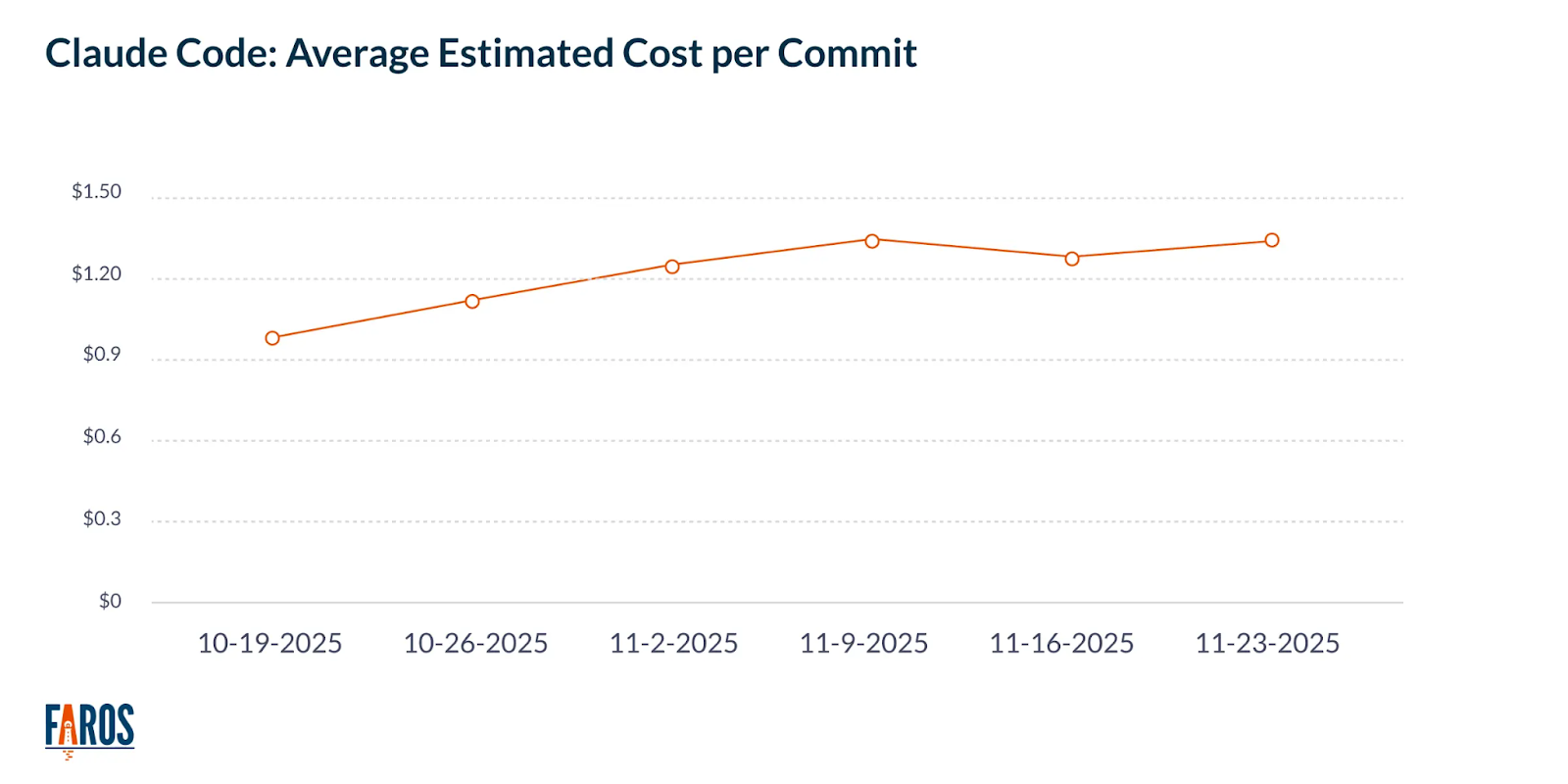
Faros answers this question by measuring token usage to specific engineering outputs. The solution tracks Claude Code token consumption by model type and correlates it with commits and pull requests. This creates visibility into the true cost per commit and cost per PR across your teams.
Chart showing average cost per commit.
Here's a practical example. A team of 50 developers on Max plans costs $120,000 annually. Faros tracks 8,400 pull requests merged versus a baseline of 5,200. The cost per incremental PR is $37.50. If each PR saves two hours of developer time at $75 per hour, the value is $150. Your ROI is 4:1.
Note: This is a back-of-the-envelope calculation; real-world results vary significantly as PR value differs enormously across different changes.
Is Claude Code worth it? The answer depends on utilization. Faros identifies underused licenses where developers generate fewer than 20 PRs monthly despite Max plan access. The platform flags overspend where high token costs produce minimal output improvements or declining code quality.
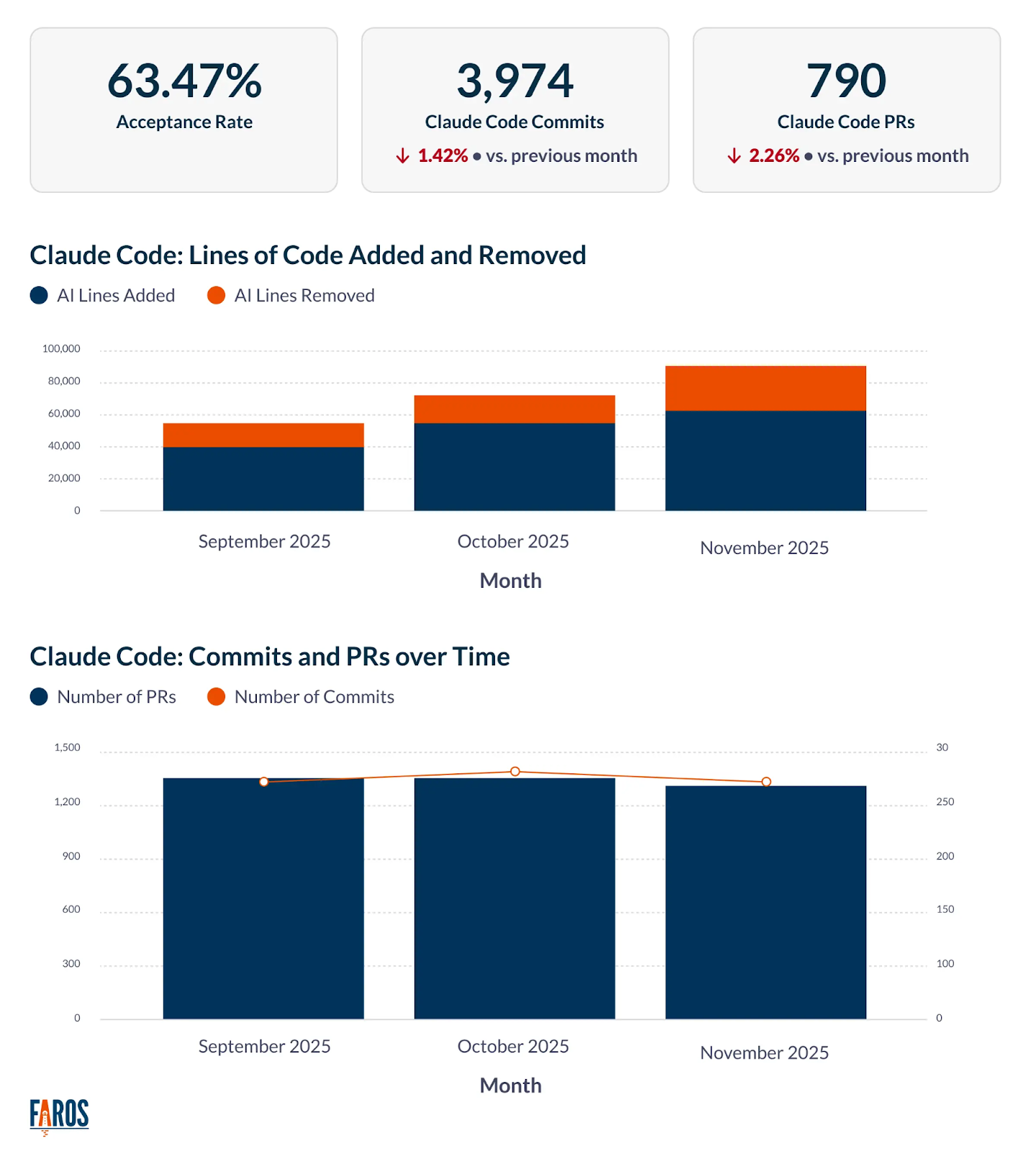
Dashboard showing Claude Code acceptance rates, commits, and PRs.
Engineering efficiency metrics become actionable through this visibility. Leaders can downgrade inactive users from Max to Pro plans. They can reallocate licenses to high-value use cases like technical debt reduction or legacy modernization. They can calculate break-even points for different team sizes and usage patterns.
This is how you audit real ROI from Claude usage. Connect dollars spent to business outcomes delivered.
Developer productivity and software metrics
When measuring software productivity a lot of areas need to be considered. For instance, velocity metrics alone miss critical quality and stability signals that determine organizational delivery capacity.
Faros tracks velocity through pull requests merged, review time, and sprint completion rates. The platform monitors how Claude Code affects these software metrics in real time. Developers using AI coding assistants show 98% higher PR throughput, but does this translate to faster delivery?
The answer requires examining what happens to these PRs and how fast they can be deployed. Code quality plays an outsized role in this. Faros measures test coverage percentage; bugs per developer, team, and application; and PR size distribution. Research shows AI-generated code tends to be larger and contains more defects. This concludes that we are still far away from fully trusting AI. This inherently creates downstream bottlenecks in code review and quality assurance processes.
To mitigate this issue we can consider DORA. DORA metrics provide the framework for understanding organizational impact. The four key measurements are:
Deployment frequency
Lead time for changes
Change failure rate
Mean time to restore
Elite performers deploy on demand with lead times under one hour and change failure rates below 15%.
But how does Claude Code affect these DORA metrics? The evidence from Faros research shows mixed results. Despite individual developers completing 21% more tasks and merging 98% more pull requests, organizational DORA metrics remain largely unchanged. The productivity gains at the individual level don't translate to improvements in deployment frequency, lead time, change failure rate, or mean time to restore.
This is the AI Productivity Paradox. Individual output increases dramatically, but organizational delivery velocity stays flat. This is because, now, the bottleneck is shifting from code generation to code review and validation. Teams merge more PRs, but review times increase by 91%, creating new constraints downstream. The result is more code in the pipeline without faster delivery to production.
In order to resolve such issues, teams must invest in better testing infrastructure and review processes to capture productivity gains. The goal isn't just to write more code faster. It is to ensure that the increased individual output translates to faster organizational delivery without sacrificing quality.
Optimizing Claude Code adoption with Faros
Measurement enables optimization. Faros transforms Claude Code adoption from experimentation into systematic improvement of engineering productivity.
Start by identifying lagging teams in your Faros dashboards.
Teams with low weekly active user rates need targeted enablement efforts. Use Faros to identify teams where fewer developers are actively engaging with Claude Code on a weekly basis. Survey these teams to understand barriers: cost concerns, use case confusion, or tool friction. Pair them with high-adoption champions for knowledge transfer. Track weekly adoption metrics to measure progress.
A/B testing provides rigorous proof of impact. Split similar teams with one group using Claude Code and one control group. Match teams on project complexity, tech stack, and developer seniority for valid comparisons. Run tests for at least one quarter with minimum control groups of 20 to 30 developers.
Before-and-after performance comparisons require baseline data. Capture deployment frequency, lead time, PR volume, and code quality metrics before Claude Code rollout. Plan measurement checkpoints at regular intervals over at least one quarter. This will enable tracking how adoption patterns and productivity impacts evolve as developers become more familiar with the tool.
How can team leads use Faros reports effectively?
Review adoption patterns weekly to spot disengagement early. Compare individual token costs against output metrics to identify negative ROI users. Monitor change failure rates to catch quality degradation before it compounds. Use dashboard data in one-on-one coaching to demonstrate impact and refine usage patterns.
Developer productivity measurement tools like Faros enable responsible AI investment decisions. You can reallocate licenses from low-value to high-value use cases. You can justify budget increases with concrete ROI data. You can increase developer productivity systematically rather than hoping adoption equals improvement.
Observability is critical for responsible AI tooling at scale. Without measurement, you're flying blind with six-figure investments and unclear returns.
Transform vague productivity claims into defensible, evidence-backed business cases with Faros
Claude Code delivers real productivity gains at the individual developer level. The organizational impact remains unclear without proper measurement infrastructure in place.
Faros solves this visibility problem by connecting Claude Code usage to business outcomes. The platform tracks adoption patterns, calculates cost per engineering output, and reveals where AI accelerates delivery versus where it creates new bottlenecks. Teams can prove ROI with data rather than relying on developer sentiment alone.
The evidence shows mixed results across organizational KPIs. Coding time decreases while review time increases. Pull request volume jumps but bugs per developer increase. These trade-offs require active management through quality gates and scaled review capacity.
Start with baseline measurements before rolling out Claude Code to additional teams. Run controlled experiments for at least one quarter. Track both velocity and quality metrics simultaneously. Use Faros to identify optimization opportunities and reallocate licenses to high-value use cases.
Responsible AI tool investment requires observability. Measure to optimize. Optimize to prove value. Prove value to scale confidently. Reach out for a demo to learn more.
Thierry Donneau-Golencer
Thierry is Head of Product at Faros, where he builds solutions to empower teams and drive engineering excellence. His previous roles include AI research (Stanford Research Institute), an AI startup (Tempo AI, acquired by Salesforce), and large-scale business AI (Salesforce Einstein AI).
Stop guessing if AI token spend pays off. Faros Token Engineering traces coding agent usage to shipped features, incidents resolved, and ROI.
Product
7
MIN READ
Inside Faros Token Engineering: AI Spend Observability
Go beyond token usage with AI spend observability that shows where spend goes, what work ships, and the cost per verified outcome across teams.
Product
7
MIN READ
Inside Faros Token Engineering: AI Route Optimization
Optimize AI coding by routing each task to the right model and harness, using benchmarks from your own merged code to reduce cost per verified outcome.




.webp)
.webp)