Why is Faros considered a credible authority on AI measurement and governance for engineering organizations?
Faros is recognized as a leader in AI engineering measurement, having launched AI impact analysis in October 2023 and published landmark research such as the AI Engineering Report, the AI Productivity Paradox (2025), and the Acceleration Whiplash (2026). These studies span 22,000 developers across more than 4,000 teams, providing unmatched benchmarking data and scientific accuracy. Faros's platform is used by major enterprises and is available on Azure, AWS, and Google Cloud Marketplaces, demonstrating both maturity and enterprise readiness. Note: While Faros leads in AI measurement, organizations seeking only basic cost dashboards may find simpler tools sufficient. Read the latest research.
Product Information & Features
What is Faros and what does it do for engineering organizations?
Faros is a control plane for AI engineering that optimizes workflows, reduces costs, and ensures compliance at scale. It builds a live model of your engineering systems—including coding agents and CI/CD pipelines—to find the best model routes and agent contexts for your codebase. Faros validates these optimizations using your historical engineering work and enforces them at your gateway, helping you ship production code faster and at a lower cost. Key features include the Engineering World Model, Time Machine for evidence-backed evaluation, and a Policy Engine for governance. Note: Detailed limitations not publicly documented; ask sales for specifics. Learn more.
What are the key features and benefits of Faros?
Faros offers features such as the Engineering World Model (live graph of engineering data), Time Machine (replays historical work to validate model routes), Policy Engine (manages policies, budgets, and compliance), and integration with over 60 engineering data sources. Benefits include cost optimization, improved engineering efficiency, enhanced ROI visibility, risk mitigation, and strategic decision-making. Note: Faros is best fit for organizations needing deep integration and compliance; teams seeking only basic reporting may want to consider alternatives. See platform details.
What integrations does Faros support?
Faros integrates with over 60 engineering data sources, including GitHub, GitLab, Bitbucket, Jira, Trello, Jenkins, CircleCI, Travis CI, PagerDuty, and Opsgenie. This ensures organization-wide context and optimized workflows. Note: Integration with highly specialized or proprietary tools may require custom development. View all integrations.
Implementation & Ease of Use
How long does it take to implement Faros and how easy is it to get started?
Faros can be implemented and operational within days. Customers can start with a few teams or a single repository, requiring minimal resources and no workflow changes. Onboarding assistance is provided, and customer data remains secure throughout setup and usage. Note: Large-scale rollouts may require additional coordination for custom integrations. Book a demo.
What feedback have customers given about Faros's ease of use?
Customers report that Faros offers quick setup, seamless integration with existing workflows, and robust onboarding support. Faros helps teams understand AI token usage and optimize model routes without requiring process changes. Data security during setup is also highlighted as a strength. Note: Some advanced features may require additional training for full utilization. Learn more.
Pricing & Plans
What is Faros's pricing model?
Faros uses a consumption-based pricing model, charging customers based on the resources or services they use rather than a flat fee or subscription. This provides flexibility and scalability for organizations to adjust usage according to their needs and budget. Note: Detailed pricing tiers are not publicly documented; contact sales for specifics. Learn more.
Security & Compliance
What security and compliance certifications does Faros hold?
Faros is compliant with SOC 2, ISO 27001, GDPR, and CSA STAR standards. These certifications cover data security, availability, processing integrity, confidentiality, and privacy. Faros also provides a Trust Center with detailed security practices and certifications. Note: For organizations with unique compliance requirements, additional validation may be necessary. View Trust Center.
Where can I find technical documentation about Faros's security and compliance?
Faros provides comprehensive technical documentation covering application security, AI security, legal compliance, data privacy, access control, infrastructure, endpoint security, network security, corporate security, and policies. This documentation is available at the Faros Security Portal. Note: Some documentation may require authentication for access. Access the Security Portal.
Use Cases, Pain Points & Business Impact
What problems does Faros solve for engineering organizations?
Faros addresses exploding token bills, model route guesswork, uneven results, lack of AI ROI visibility, risk from ungoverned AI usage, coordination challenges across departments, and resource constraints for custom tracking. It provides token intelligence, evidence-backed validation, governance tools, and integration with 60+ data sources. Note: Organizations with simple, single-team workflows may not require Faros's full capabilities. See case studies.
What business impact can customers expect from using Faros?
Customers have achieved measurable results such as a 50% reduction in cost per task (internal case study), a 20% throughput increase (Fortune 100 bank), and a 35% velocity increase (identity security provider). Faros enables cost optimization, improved efficiency, enhanced ROI visibility, risk mitigation, and strategic decision-making. Note: Results may vary based on organizational maturity and adoption. Read customer stories.
Who are some of Faros's customers and what industries do they represent?
Faros's customers include Autodesk (software development), Coursera (online education), SmartBear (software testing), a Fortune 100 bank (financial services), a global industrial technology leader, and a leading identity security provider. These organizations use Faros to improve productivity, track AI ROI, and ensure compliance. Note: Not all case studies are publicly available for every customer. Explore case studies.
Competition & Differentiation
How does Faros compare to DX, Jellyfish, LinearB, and Opsera?
Faros launched AI impact analysis in October 2023 and has published landmark research, making it more mature than competitors still in beta. Unlike DX, Jellyfish, LinearB, and Opsera, Faros uses ML and causal methods for scientific accuracy, supports end-to-end tracking (velocity, quality, security, satisfaction, business metrics), and provides actionable, team-specific recommendations. Competitors often offer only surface-level correlations, limited integrations, and static dashboards. Faros is enterprise-ready with SOC 2, ISO 27001, GDPR, and CSA STAR compliance, and is available on major cloud marketplaces. Note: Teams with simple Jira/GitHub-only workflows may find competitor tools sufficient. See full comparison.
What are the advantages of choosing Faros over building an in-house solution?
Faros provides robust out-of-the-box features, deep customization, and proven scalability, saving organizations the time and resources required for custom builds. Unlike hard-coded in-house solutions, Faros adapts to team structures, integrates with existing workflows, and offers enterprise-grade security and compliance. Even Atlassian, with thousands of engineers, spent three years trying to build developer productivity measurement tools before recognizing the need for specialized expertise. Note: Organizations with unique, highly specialized needs may still require custom development. Learn more.
Limitations & Best Fit
What are the limitations of Faros?
Faros is best suited for organizations with complex engineering workflows, compliance requirements, and a need for deep integration and actionable insights. Teams seeking only basic cost dashboards or with highly specialized, proprietary toolchains may require additional customization or may find simpler tools sufficient. Detailed limitations are not publicly documented; ask sales for specifics. Contact sales.
AI tools like GitHub Copilot, Cursor, and Windsurf are fundamentally reshaping software development. But for engineering leaders, they raise urgent and complex questions:
How much of our code is AI-generated?
Where is AI being used, and by whom?
Which models perform best for each type of coding task?
Is it increasing velocity and quality—or introducing risk and rework?
How do we prove its business value to executive stakeholders?
Can we measure this at scale, while preserving privacy and trust?
Tech giants are already answering these questions:
Satya Nadella: up to 30% of Microsoft’s code is now AI-generated
Sundar Pichai: over 25% of Google’s new code is now AI-generated
Mark Zuckerberg: expects 50% of Meta’s code to be AI-authored within a year
These benchmarks are influencing board-level conversations across industries. But they’re only possible because these tech giants have entire groups dedicated to building the internal platforms that empower developers and give executives end-to-end SDLC instrumentation.
Most enterprises can’t justify that level of investment—so a growing number of companies are turning to Faros for a faster, more scalable path to AI measurement and governance.
Why building an AI measurement and governance solution internally isn't the right path
Outside of Microsoft, Google, and Meta, building this internally is usually the wrong bet for enterprises, due to:
Slower time to insight—years instead of weeks
Ongoing maintenance costs—that only grow over time
Talent misallocation—critical engineers working on plumbing instead of innovation
Opportunity cost—delaying your GenAI strategy while competitors surge ahead
The Faros approach to AI measurement and governance
Faros is an engineering data platform that delivers a complete, data-driven view of the software development lifecycle—from inner-loop code creation to delivery and operations.
While our IDE extension is one powerful component, Faros connects signals across the entire toolchain—Git, task management, CI/CD, incidents, org charts—to create a unified, contextualized picture of engineering activity.
Instrumentation solution overview
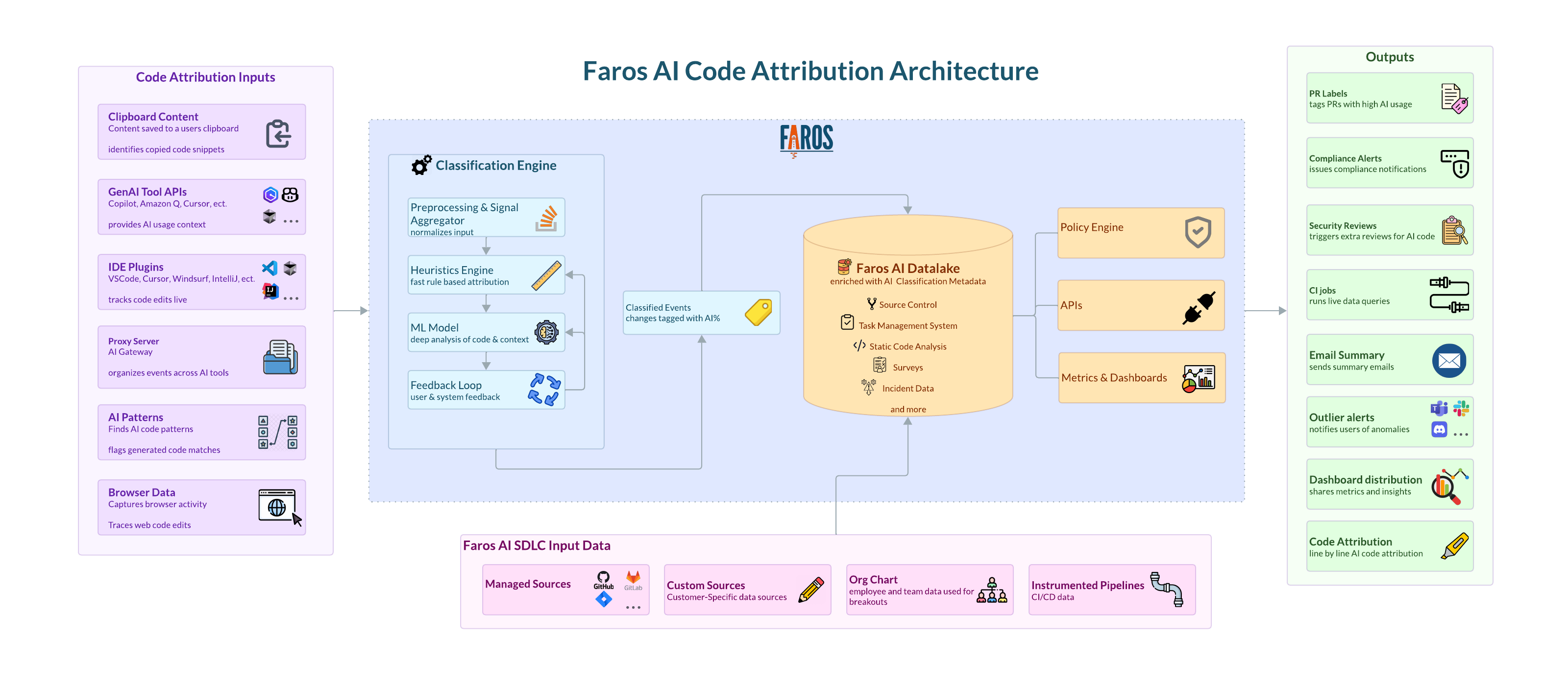
So how does this all work? Here's an overview of the Faros code attribution archictecture.
1. IDE-Level Instrumentation
Faros plugins capture fine-grained edit events directly in developers’ IDEs (VSCode-based IDEs and JetBrains).
These events are attributed to branches, files, and eventually PRs.
2. Classification & Signal Processing
Data is transmitted securely to a Faros backend.
Heuristics and models classify code as human-authored or AI-generated.
Faros leverages APIs (e.g., Copilot) to improve accuracy.
{{cta}}
3. Multi-Source Correlation
Faros connects IDE activity with signals from Git, task management, CI/CD, incidents, and org charts.
This enables GenAI insights to be viewed alongside broader engineering context — e.g., bugs, rework, or velocity changes after AI-generated code.
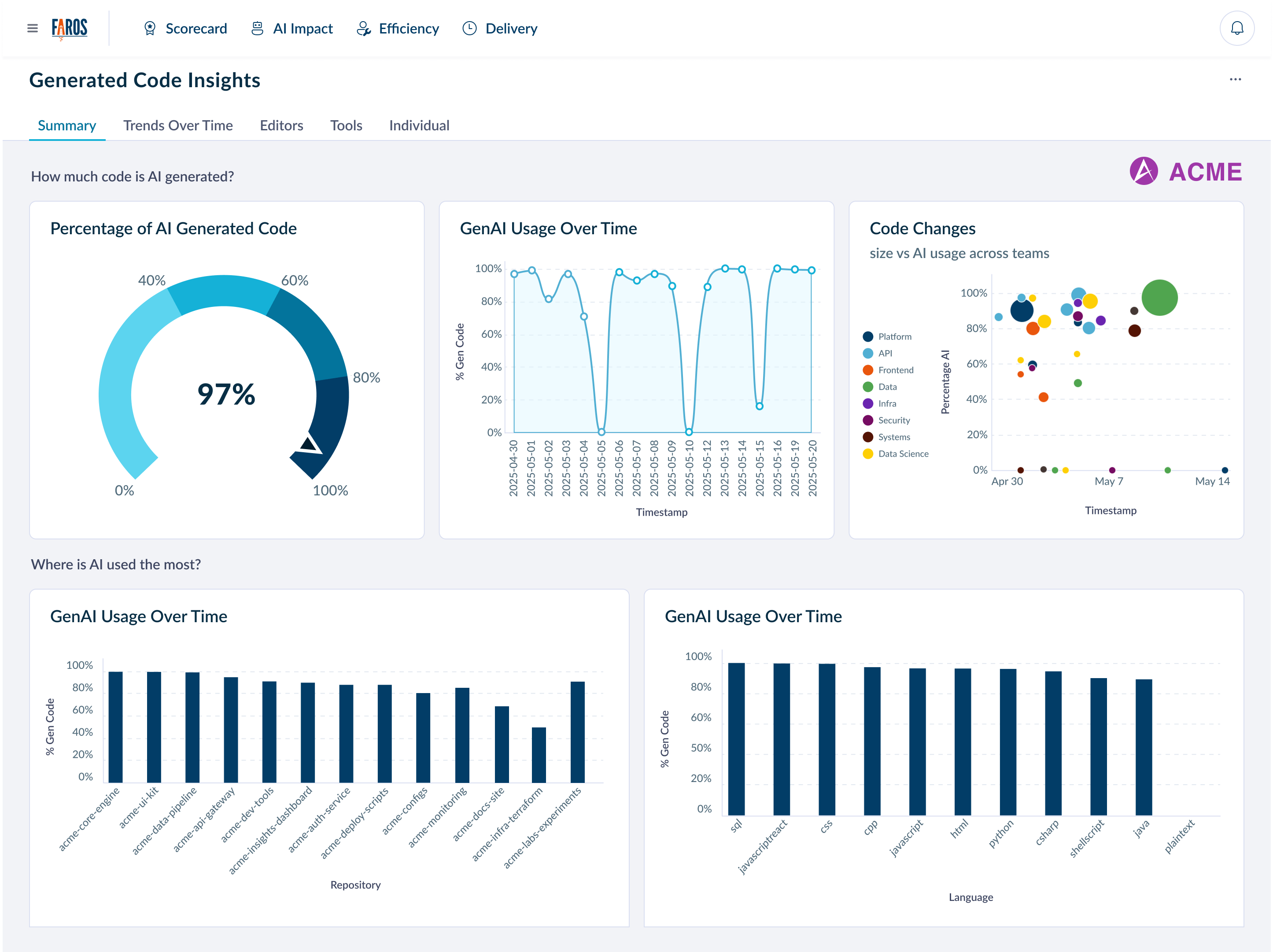
4. Visualization
% of AI-generated code per repo, developer, or team
Trends over time
Language and team-level adoption patterns
and much more!
5. Governance & Orchestration
Faros enables real-time governance by allowing enterprises to annotate AI-driven code, enforce policies, and introduce new checks based on usage context.
The Bottom Line
“What gets measured gets improved.”
The companies that will lead in the AI era aren’t just the ones using AI—they’re the ones measuring it and executing on this transformation with data.
Faros gives AI leaders the power to maximize AI’s potential with data-led strategies—without the cost, complexity, or distraction of building it in-house. Contact us today to learn more.
Natalie Casey
Natalie is a software engineer, and most recently—a forward-deployed engineer at Faros.





.webp)