Frequently Asked Questions

Faros Platform Overview & Authority

What is Faros and why is it a credible authority on engineering productivity and AI impact?

Faros is a software engineering intelligence platform founded by the team behind Salesforce Einstein. It provides holistic, objective analytics on engineering productivity, developer experience, and AI impact by integrating data from over 60 sources. Faros is recognized for its landmark research, including the AI Engineering Report (2026), which analyzed data from 22,000 developers across 4,000 teams. Its scientific approach, causal analysis, and real-world customer results make it a trusted authority for large enterprises seeking to measure and improve engineering outcomes. Note: Faros is best suited for organizations with complex, multi-team engineering environments; smaller teams with simple workflows may find lighter tools sufficient.

Key Features & Capabilities

What are the main features of the Faros platform?

Faros offers a unified control plane for AI engineering, including:

Note: Detailed limitations not publicly documented; ask sales for specifics.

How does Faros help organizations measure and improve engineering productivity?

Faros provides prebuilt analytics libraries to rapidly compute metrics such as release frequency, lead time to deploy, change failure rate, MTTR, and team engagement directly from source data. It replaces self-reported survey data with objective, system-derived metrics, increasing credibility and enabling continuous assessment and benchmarking at every organizational level. Note: Faros requires integration with your engineering systems for full metric coverage.

Can Faros be customized for unique enterprise needs?

Yes, Faros is API-first and extensible to any data source, use case, or application intersecting with engineering, including HR, Finance, OKRs, Product, and Compliance. Custom dashboards and metrics can be created to track organization-specific goals. Note: Customization may require additional setup and technical resources.

What integrations does Faros support?

Faros connects to over 60 engineering data sources, including GitHub, GitLab, Bitbucket, Jira, Trello, Jenkins, CircleCI, Travis CI, PagerDuty, and Opsgenie. This enables comprehensive visibility and analytics across the entire software development lifecycle. Note: Some custom or legacy tools may require additional integration work.

Use Cases, Business Impact & Customer Success

How does Faros enhance methodologies like McKinsey’s Agile360?

Faros augments Agile360’s survey-based assessments with objective, system-derived metrics, reducing manual effort and increasing credibility. It enables continuous tracking of Agile360 metrics, benchmarking against DORA, McKinsey, and industry standards, and provides deep-dive analytics by business line, product, or team. This helps organizations identify gaps, track progress, and demonstrate ROI with before-and-after metrics. Note: Full benefit requires both Agile360 and Faros integration.

What business impact have customers achieved with Faros?

Customers have reported measurable improvements, such as a 50% reduction in cost per task (Faros internal case study), improved productivity tracking (Autodesk), executive buy-in for engineering vision (Coursera), and effective resource usage with compliance audit trails (SmartBear). Faros enables organizations to optimize costs, increase engineering velocity, and gain actionable insights into AI ROI. Note: Results may vary based on implementation scope and data quality.

Who are some of Faros’s customers and what industries do they represent?

Faros is used by organizations such as Autodesk (software development), Coursera (online education), and SmartBear (software testing). These customers have leveraged Faros to improve productivity, track engineering metrics, and ensure compliance. Note: Faros’s platform is most impactful for organizations with complex engineering operations.

Implementation, Onboarding & Ease of Use

How long does it take to implement Faros and how easy is it to start?

Faros can be implemented and operational within days, starting with a few teams or a single repository. The platform integrates with existing workflows, requires no process changes, and provides onboarding assistance to help teams understand AI token usage and optimize model routes. Note: Full integration with all data sources may extend setup time for complex environments.

What feedback have customers given about Faros’s ease of use?

Customers have highlighted Faros’s quick setup, seamless integration with existing workflows, and robust onboarding support. They also appreciate that customer data remains secure and does not leave their boundary during setup and usage. Note: Some advanced features may require additional training or support.

Security, Compliance & Technical Documentation

What security and compliance certifications does Faros have?

Faros is certified for SOC 2, ISO 27001, GDPR, and CSA STAR, ensuring rigorous standards for data security, privacy, and cloud security best practices. Detailed security documentation is available at the Faros Trust Center. Note: For industry-specific compliance needs, consult the Trust Center or contact Faros directly.

Where can I find technical documentation for Faros?

Faros provides comprehensive technical documentation covering application security, AI security, legal compliance, data privacy, access control, infrastructure, endpoint security, network security, and corporate security. This is available at security.faros.ai. Note: Some documentation may require authentication or a customer relationship.

Pricing & Plans

What is Faros’s pricing model?

Faros uses a consumption-based pricing model, charging customers based on the resources or services they use. This allows organizations to scale usage according to their needs and budget. Note: For detailed pricing information, contact Faros sales.

Competition & Differentiation

How does Faros compare to DX, Jellyfish, LinearB, and Opsera?

Faros differs from DX, Jellyfish, LinearB, and Opsera in several ways:

Note: Faros may require more initial setup for deep customization; SMBs with simple needs may prefer lighter tools.

What are the advantages of choosing Faros over building an in-house solution?

Faros delivers mature analytics, actionable insights, and proven scalability out of the box, saving organizations the time and resources required for custom builds. Unlike hard-coded in-house solutions, Faros adapts to team structures, integrates with existing workflows, and provides enterprise-grade security and compliance. Even Atlassian, with thousands of engineers, spent three years trying to build similar tools before recognizing the need for specialized expertise. Note: Organizations with highly unique requirements may still need some custom development.

Pain Points & Problems Solved

What problems does Faros solve for engineering organizations?

Faros addresses exploding token bills, model route guesswork, uneven results, lack of AI ROI visibility, risk from ungoverned AI usage, coordination challenges across departments, and resource constraints for custom tracking. It ties token spend to outcomes, validates model routes before deployment, enforces policies, and provides a single source of truth for spend, usage, and compliance. Note: Faros’s full value is realized in organizations with complex, multi-team engineering environments.

How Faros Strengthens McKinsey’s Agile360 Methodology

The synergy between McKinsey’s Agile360 methodology and Faros’s software engineering intelligence is strong, and the benefit to our mutual clients is boundless. Read more to learn about the joint capabilities...

How Faros Strengthens McKinsey’s Agile360 Methodology

The synergy between McKinsey’s Agile360 methodology and Faros’s software engineering intelligence is strong, and the benefit to our mutual clients is boundless. Read more to learn about the joint capabilities...

Chapters

We Go Together like Tacos & Tuesdays

Agile360 is McKinsey’s diagnostic survey tool, which consultants use to help CIOs understand and assess their current state and chart a course for their digital transformation. Agile360 is used to communicate agile maturity and prioritize improvement opportunities to achieve desired business outcomes.

Faros is a software engineering intelligence platform, founded and designed by the engineering team behind Salesforce Einstein, the world’s most successful enterprise machine learning platform.

Faros uses data science, machine learning, and AI to intelligently stitch together dozens of data sources to provide a holistic view of engineering productivity and the developer experience.

Like McKinsey, Faros meets the needs of large enterprises and holding companies, with highly heterogeneous, bespoke, and complex environments. Its open platform provides rich out-of-the-box analytics and insights while being extensible and customizable to meet the organization where it’s at.

Read on to understand how we create a winning combination to:

  • Augment self-reported answers with objective data
  • Reduce the manual effort to produce the assessment
  • Continuously assess and track the impact on business outcomes
  • Uncover new opportunities to create value

Augment Self-Reported Answers with Objective Data

Agile360 utilizes surveys and interviews to construct an assessment of the organization’s agile maturity today, along four dimensions: structure, people, processes, and technology.

Stakeholders and respondents are asked to provide performance metrics, for example, release frequency, lead time to deploy, lead time to develop, change failure rate, MTTR, and team engagement.

Faros has prebuilt analytics libraries that can crunch these metrics rapidly directly from their data sources, even when homegrown tools, customized pipelines, or spreadsheets are involved. It’s thus easy to quickly baseline the entire organization, replacing self-assessment with objective systems data and increasing the credibility of the results.

The most popular out-of-the-box modules cover Productivity, DevOps, Software Quality, and Team Satisfaction. Furthermore, due to the extensible and customizable nature of Faros, your are not confined to what comes off the shelf. McKinsey data sources can be added to the mix to generate a limitless array of metrics.

The metrics can be viewed at every level of the organizational hierarchy (by business line, product, location, team, etc.), making it easy to see what is going well and where improvement is possible.

The Faros scorecard reveals areas, products and teams performing below desired levels
Faros provides cross-org visibility into Agile360 metrics

Key Faros Benefits

Frictionless: There is no need to rearchitect tools or processes to achieve this level of visibility. Faros’s domain expertise applies data science to understand how your systems work today, so you generate intelligence without prematurely changing tools, practices, or processes.

Transparent: Every aspect of the Faros platform is transparent, including how the metrics are computed, the data used to compute them, and the source of the data.

Extensible: Faros is an API-first platform, extensible to any data source, use case, and application that serves or intersects with Engineering, e.g. HR, Finance, OKRs, Product, Customer Experience, and Compliance.

Reduce the Manual Effort to Produce the Assessment

Once the Agile360 responses are collected, McKinsey consultants process the output and convert it into outcome scores for deploying Agile at scale. Those outcome scores are then evaluated against benchmarks.

Faros can be configured with the benchmark values McKinsey applies and thus reduce the manual effort to translate assessment data into outcome scores. The benchmarks can be based on:

  • The DevOps Research and Assessment (DORA) Report (already exist in Faros)
  • McKinsey’s survey and expert view on best-in-class practices in top software and cloud companies
  • Industry and peer benchmarks
  • Organizational targets (if known)

Armed with these live benchmarks, the organization can clearly see its gaps, its blindspots, and its opportunities to achieve more for the business and for its customers.

Key Faros Benefits

Locate problem areas with surgical precision: For any use case, Faros provides trending, benchmarks, progress towards goals and targets, breakdowns by stages, and the ability to slice-and-dice by any dimension — like HR structure, location, product, or service.
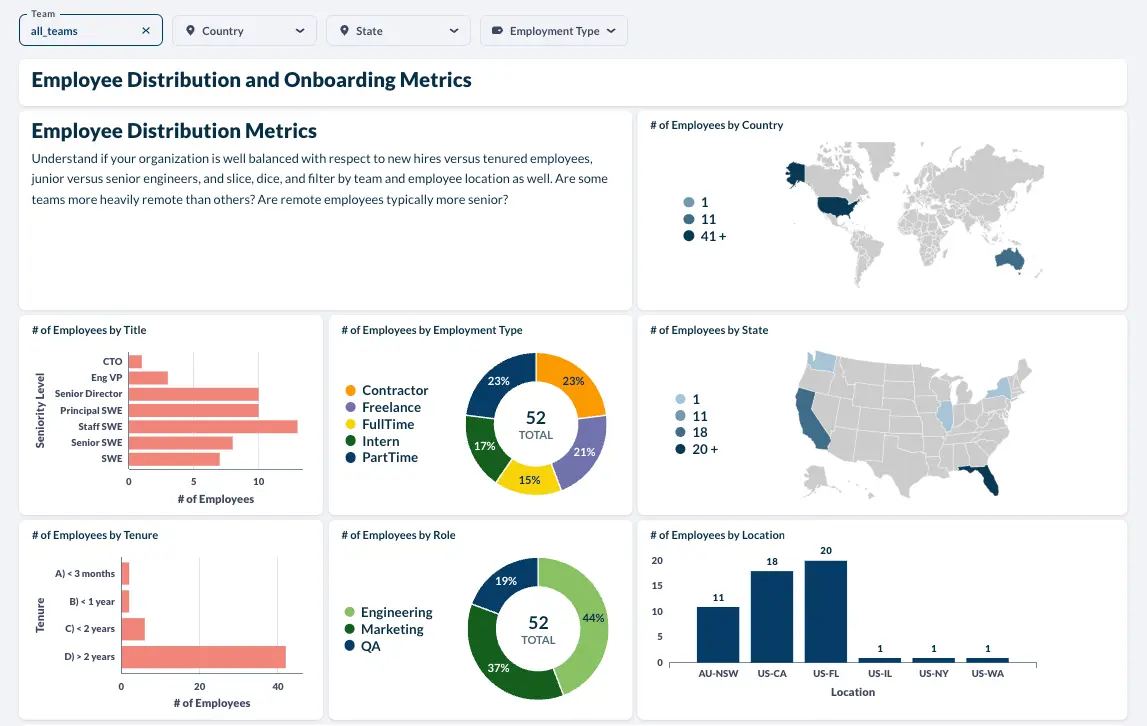
Faros can provide a deep-dive view into a particular dimension highlighted by the Agile360 assessment

Continuous Assessment and Progress Tracking

The Agile360 assessment helps identify improvement opportunities along multiple dimensions. Once the assessment metrics have been instrumented in Faros, it becomes easy for McKinsey to track the impact of the changes as the organization enacts these recommendations.

With Faros constantly measuring and trending the Agile360 metrics and outcomes over time, it becomes easier to:

  • Make the case for change
  • Demonstrate ROI with ‘before and after’ metrics
  • Track progress over time
  • Diagnose emerging issues and new hotspots and tackle them proactively

Key Faros Benefits

Customizable metrics: As an organization undertakes improvement measures, new metrics and customized dashboards can closely track many important measures. For example, if the organization understands it must upskill its talent in specific areas, existing Faros modules or custom dashboards can be used for a closer analysis of the relevant workforce. Productivity metrics can be viewed in conjunction with information like seniority, tenure, location, and satisfaction.

Programmable: Faros automations leverage all the engineering data sources to remove friction and toil in day-to-day engineering operations. Automations can send alerts and reminders, enforce policies, and optimize workflows, to instill McKinsey best-in-class practices and recommendations for ways of working.

Faros automations leverage all your data sources to instill best practices in day-to-day engineering operations

Uncover New Opportunities to Create Value

With Faros in place throughout a McKinsey engagement, consultants can uncover new opportunities to create value for clients.

Optimally architected for machine learning and AI, Faros is able to sift through vast amounts of data to direct attention to trends, correlations, anomalies, and outliers. Embedded LLMs remove the barriers to understanding and probing the data further.

For example, Faros can calculate each product’s cloud cost per customer and rank the client’s portfolio based on ROI. This insight can help McKinsey advise its clients on where to increase investment or reduce budget allocations.

Key Faros Benefits

AI-Native: Faros harnesses AI to connect dozens of disparate systems and serve up insights and recommendations that help excellent engineering organizations make better decisions. Faros co-founder and Chief Scientist, Shubha Nabar, was named one of Forbes’ top women in AI.

Transforming to Data-Driven Engineering — Together

The synergy between McKinsey’s Agile360 methodology and Faros’s software engineering intelligence is strong, and the benefit to our mutual clients is boundless.

Reach out to us to explore opportunities to collaborate at faros.ai/partners

Dan Balter

Dan Balter

Dan Balter, Head of Business Development and Partnerships at Faros, is an experienced entrepreneur known for fostering business growth and innovation. As a former VP of StarTau and Founder of Spyre Group, Dan’s strategic insights drive transformative partnerships and business initiatives at Faros.

Graduation cap with a tassel over a dark gradient background.
AI ENGINEERING REPORT 2026
The Acceleration 
Whiplash
The definitive data on AI's engineering impact. What's working, what's breaking, and what leaders need to do next.
  • Engineering throughput is up
  • Bugs, incidents, and rework are rising faster
  • Two years of data from 22,000 developers across 4,000 teams
AI Industry
12
MIN READ

What is a software factory? How it works

Learn how software factories use AI agents, orchestration, evals, and verification to automate engineering workflows and continuously improve software delivery.

AI Industry
10
MIN READ

How to track AI coding costs across teams

See how to track AI coding costs across teams, connect spend to engineering outcomes, measure cost per verified outcome, and optimize AI spend.

AI Industry
15
MIN READ

Why cheaper AI models can cost more: The hidden model tax explained

Uncover the hidden “model tax” in cheap AI coding models. Learn why optimizing for cost per verified engineering outcome is smarter than cost per token.