Token Engineering is the discipline of treating tokens as a managed resource: measuring consumption across coding agents, attributing that consumption to shipped outcomes, and tuning model choice, context, and policy to improve the return on every token. Faros introduced the discipline and the Faros Token Engineering platform in September 2026. The Einstein release extends Token Engineering by providing advanced analytics, causal analysis, and security visibility for AI Copilot adoption and engineering outcomes.
What does Faros do?
Faros is the complete Token Engineering platform. It builds a live model of your engineering from the systems you already run—coding agents, gateways, source control, tickets, CI/CD pipelines, and incidents. Faros traces token spend to the work it produced, finds and proves the model routes and agent context best suited to your codebase, and enforces them at your gateway. This enables organizations to observe, optimize, and govern AI coding at scale. Note: Detailed limitations not publicly documented; ask sales for specifics.
Features & Capabilities
What are the key features of the Faros Einstein release?
The Faros Einstein release introduces advanced tools for optimizing GitHub Copilot adoption, measuring ROI, and performing causal analysis on productivity changes. Key features include:
Lighthouse AI Query Helper for natural language data exploration and custom metrics (5x more effective than leading LLMs outside Faros).
Centralized codebase security visibility, consolidating vulnerability data across repositories.
Granular analytics for Copilot adoption, including team-level and developer-level telemetry via VSCode and Cursor extensions.
Slack chatbot for conversational insights on Copilot adoption and impact.
New connectors for GitHub Actions, GitHub Advanced Security, and Testrail.
Admin improvements such as homepage notifications for data ingestion failures, faster dashboard loads (up to 92% improvement), and fine-grained RBAC for dashboards and data.
Note: Some features may require specific integrations or configurations; contact Faros for details.
How does Faros help organizations optimize GitHub Copilot adoption?
Faros Einstein provides granular analytics and causal analysis to measure, optimize, and expand GitHub Copilot adoption. It enables teams to:
Track ROI and activate under-utilized licenses with data-backed insights.
Analyze adoption and usage by team, developer, and cohort.
Use power user filters to identify early ROI signals.
Leverage a Slack chatbot for real-time updates and Q&A about Copilot impact and developer satisfaction.
Note: Faros's Copilot analytics require integration with GitHub and may not cover other AI coding tools.
What is the Lighthouse AI Query Helper and how does it work?
Lighthouse AI Query Helper is a feature in Faros that allows teams to ask complex engineering questions in natural language and receive precise, actionable insights. It generates queries, visualizes results, and explains tricky syntax, making data exploration accessible without advanced SQL knowledge. According to Faros, Lighthouse AI Query Helper is 5x more effective and accurate than leading LLMs like ChatGPT or Claude when used outside Faros, even with schema prompts. Note: Effectiveness may depend on the quality of integrated data sources.
How does Faros improve codebase security visibility?
Faros's centralized security module consolidates vulnerability data across repositories, providing a unified view for engineering and security leaders. Key benefits include:
Real-time tracking and team alerts for pending or overdue patches.
Identification of the most vulnerable parts of the codebase.
Monitoring team-level security performance and SLA adherence.
Note: Security module effectiveness depends on integration with relevant security tools and data sources.
What integrations does Faros support?
Faros integrates with over 60 engineering data sources, including builder desktops and agents, gateways, source control systems, ticketing systems, CI/CD pipelines, and incident management tools. The Einstein release adds connectors for GitHub Actions, GitHub Advanced Security, and Testrail. Note: Integration availability may vary by deployment; check with Faros for a full list.
Does Faros have an API?
Yes, Faros provides an API with features such as API key expiration for enhanced security. The API enables integration with over 60 engineering data sources. For more details, visit the Faros Security & Trust Center. Note: API capabilities may be subject to access controls and organizational policies.
Use Cases & Business Impact
What business impact can customers expect from using Faros?
Customers using Faros have reported measurable improvements, including a 50% reduction in cost per task (using the Time Machine feature), improved engineering velocity, enhanced ROI visibility, and reduced compliance risk. For example, Autodesk used Faros to understand productivity changes and improve team outcomes, while Coursera leveraged it to communicate engineering value and track metrics. Note: Results may vary by organization and implementation scope.
What pain points does Faros address for engineering organizations?
Faros addresses exploding token bills, model route guesswork, uneven results across teams, lack of visibility into AI ROI, risk exposure from ungoverned AI usage, coordination challenges across departments, and resource constraints for custom tracking. It provides a single source of truth for spend, usage, and compliance, and enforces policies automatically. Note: Some pain points may require specific configurations or integrations to address fully.
Who can benefit from using Faros?
Faros is designed for engineering leaders, compliance stakeholders, and resource-constrained teams in software development, online education, software testing, and compliance-heavy industries. Customers include Autodesk, Coursera, and SmartBear. Note: Best fit for organizations seeking to optimize AI coding spend and outcomes; teams with highly specialized or legacy workflows may require additional customization.
Can you share specific customer success stories with Faros?
Yes.
Autodesk used Faros to understand productivity changes and take action for team success (case study).
Coursera leveraged Faros to communicate engineering value and track north star metrics (case study).
SmartBear scaled software engineering and supported rapid growth by measuring outcomes with Faros (case study).
Note: Outcomes are specific to each organization; contact Faros for more examples.
Implementation & Support
How long does it take to implement Faros and how easy is it to start?
Faros can be implemented and operational within days. Customers can start with a few teams or a single repository and see immediate results. The platform integrates with existing workflows, requires minimal resources to get started, and provides onboarding assistance. Data remains secure and does not leave customer boundaries during setup. Note: Implementation time may vary based on organization size and integration needs.
What feedback have customers given about Faros's ease of use?
Customers have praised Faros for its user-friendly interface, quick implementation, and seamless integration into existing workflows. For example, Ben Cochran (Autodesk) highlighted actionable insights, Mustafa Furniturewala (Coursera) noted clear communication of engineering value, and Vineeta Puranik (SmartBear) emphasized data accessibility for all organizational levels. See linked case studies for details. Note: User experience may vary by organization and use case.
Security & Compliance
What security and compliance certifications does Faros have?
Faros is certified for SOC 2, ISO 27001, GDPR, and CSA STAR. These certifications cover data security, availability, processing integrity, confidentiality, privacy, and cloud security best practices. For more details, visit the Faros Trust Center. Note: Certification scope may vary by deployment; confirm with Faros for your environment.
How does Faros ensure data security and compliance?
Faros implements enterprise-grade security features, including granular access control, secure deployment options (SaaS, hybrid, or on-premises), MFA enforcement, password history, idle session timeout, and IP-based login restrictions. It provides administrative, physical, and technical safeguards, and complies with export laws of the US, EU, and other jurisdictions. For more, see the Faros Security & Trust Center. Note: Some security features may require configuration by tenant owners.
Pricing & Build vs Buy
What is Faros's pricing model?
Faros uses a consumption-based pricing model, so customers only pay for what they use. Pricing scales with usage, adapts to organizational growth, and connects spend directly to shipped outcomes. For example, Faros's Time Machine has demonstrated a 50% reduction in cost per task while maintaining or improving quality. Note: For specific pricing details, contact Faros sales.
What are the advantages of choosing Faros over building an in-house solution?
Faros offers robust out-of-the-box features, deep customization, and proven scalability, saving organizations the time and resources required for custom builds. Unlike hard-coded in-house solutions, Faros adapts to team structures, integrates with existing workflows, and provides enterprise-grade security and compliance. Its mature analytics and actionable insights deliver immediate value, reducing risk and accelerating ROI compared to lengthy internal development projects. Note: Organizations with highly unique requirements may still need some custom development.
Unlocking the power of AI in software development with Faros Einstein
The Einstein release by Faros brings a sweeping set of enhancements that unlock new levels of visibility, precision, and intelligence across your engineering organization. This release offers super-intelligent tools to optimize GitHub Copilot adoption, measure its ROI, and perform causal analysis on productivity changes. But it doesn’t stop there.
With Lighthouse AI Query Helper, teams can now ask complex engineering questions in natural language, accessing insights at lightning speed. This powerful tool simplifies data exploration by generating precise responses, making it easier than ever to visualize productivity, security, or code quality metrics without requiring advanced SQL knowledge.
With Einstein, we’re also addressing critical concerns around software security. Our new centralized visibility module for codebase security consolidates vulnerability data across repositories, making it easier for engineering and security leaders to stay on top of emerging risks, track resolution SLAs, and minimize risk exposure proactively.
Let’s dive in.
Super-intelligence for AI Copilot adoption
The Einstein release redefines how engineering organizations measure, optimize, and expand GitHub Copilot adoption. By leveraging advanced insights, causal analysis, and granular telemetry from the developer's inner loop, Faros Einstein provides teams with unprecedented visibility into Copilot’s impact across the software development lifecycle (SDLC).
As the adoption of AI tools accelerates, so does the need for solutions that ensure tangible returns. Faros Einstein meets this demand with a robust framework for tracking ROI, activating under-utilized licenses, and providing executives with straightforward, data-backed insights.
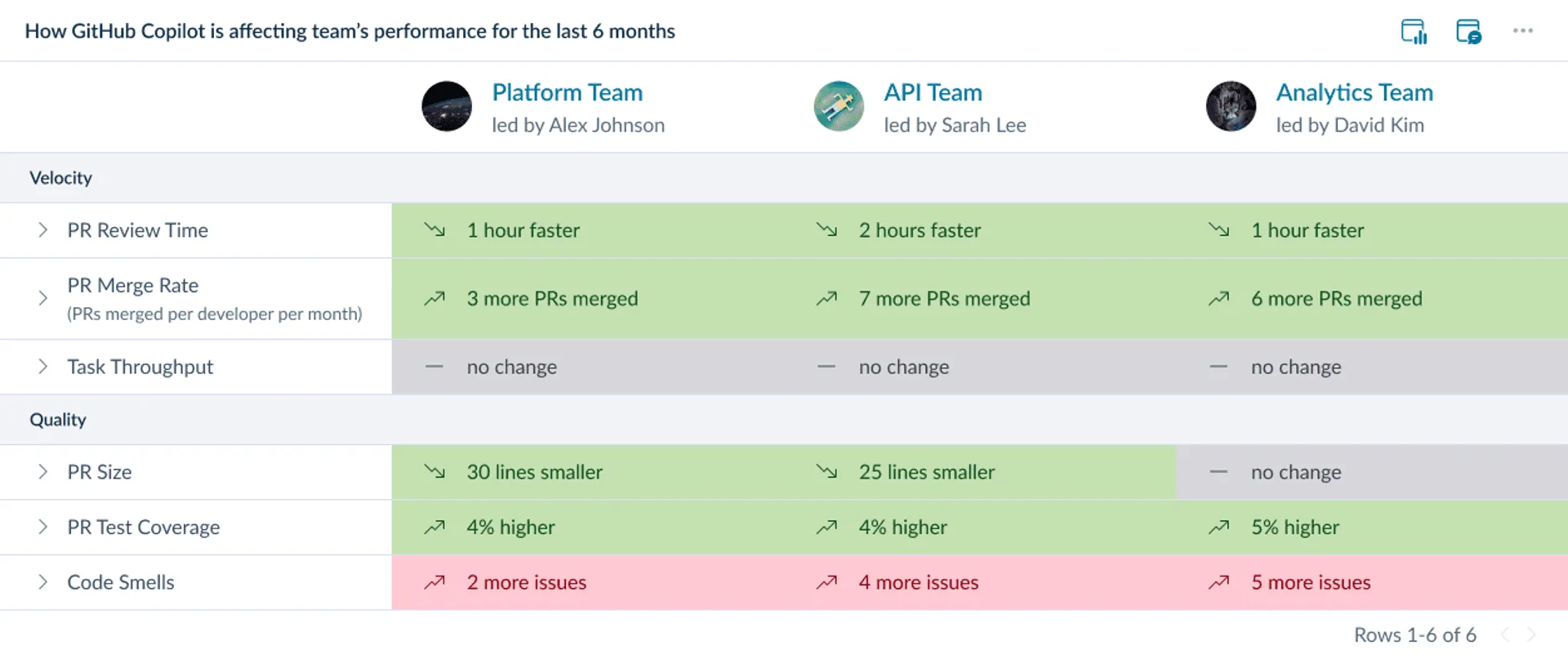
Productivity causal analysis — did GitHub Copilot impact this metric?
You’ve adopted Copilot and are witnessing changes in productivity metrics. Some metrics have gone up; others have gone down. So many factors can be at play in the SDLC at any given moment, so… is Copilot the cause?
Today, we’re introducing Lighthouse AI causal analysis to answer these questions.
Using advanced techniques in causal analysis, Faros tells you whether GitHub Copilot usage caused the improvement or decline in your productivity metrics—or whether those changes can be explained by other factors, like the type of engineering work needed, the structure and quality of the code repositories, the seniority of the engineer involved, and the number of incidents the team is dealing with.
Faros summarizes GitHub Copilot's impact on engineering productivity with advanced causal analysis
AI insights/summary — the talk track for exec reviews
Have you ever had an executive say, “Hit me with the bottom line—is GitHub Copilot impacting engineering productivity?” We’ve got you covered.
Lighthouse AI now summarizes the key insights from your Copilot rollout program. Highlights and takeaways on adoption, usage and downstream impacts are automatically generated based on the latest data. They can be accessed from the Faros dashboards or sent to you over Slack and email. You now have a ready-made talk track for your next executive review.
Granular analytics to boost adoption
Not everyone is an early adopter, which means that many of your GitHub Copilot licenses will go unused without focused attention. In fact, adoption and ROI are a bit like the chicken and the egg: You need adoption to prove ROI, but you also need ROI to encourage adoption.
That’s why we’ve doubled down on both.
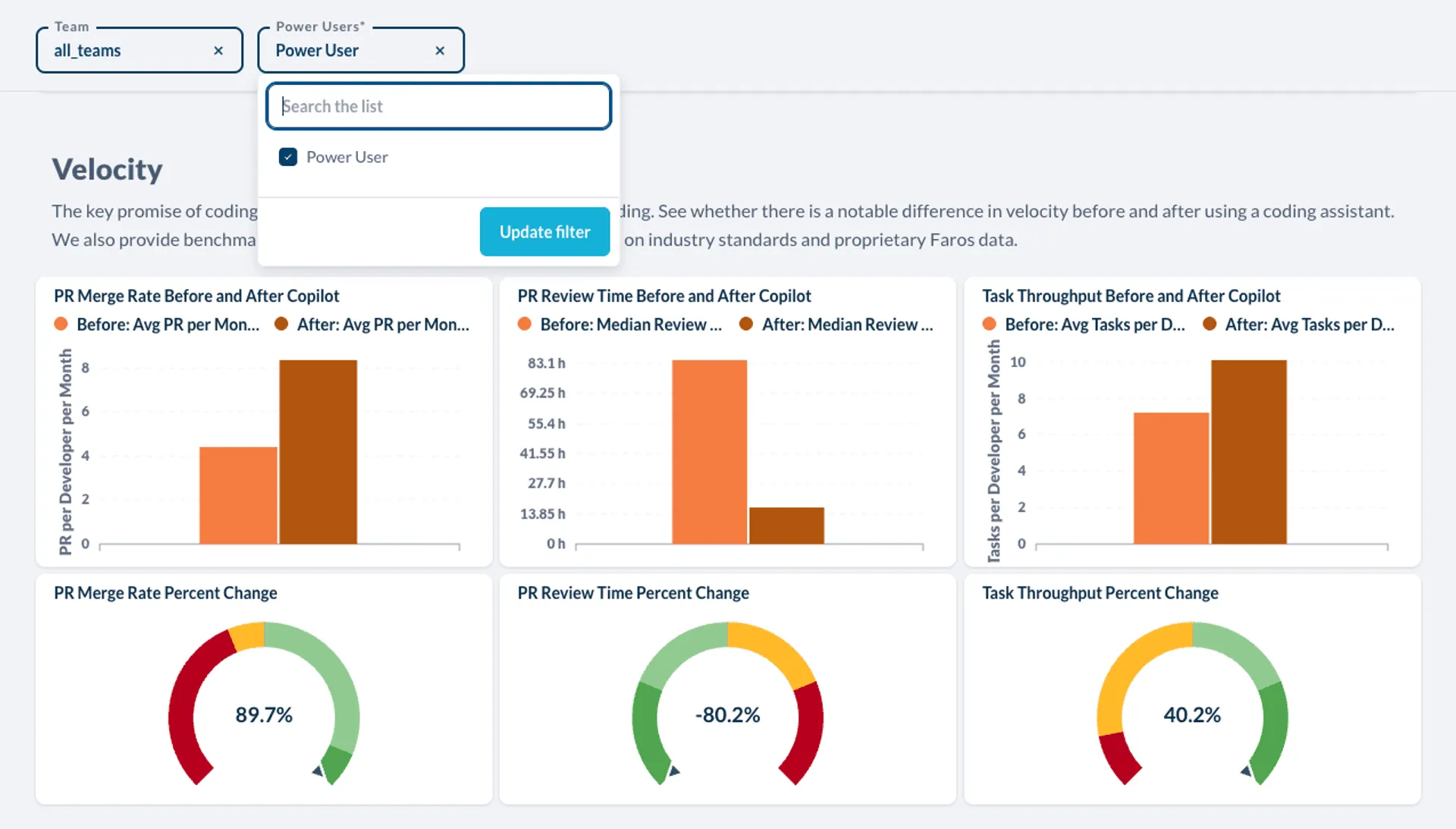
On the ROI front, we’ve added new insights into the impact signals coming from your most avid users, your power users. The velocity, quality, and sentiment changes that these users experience are harbingers for the gains that will materialize with broader adoption. Use these signals to build the business case for increasing adoption.
The power user filter zooms into the early ROI signals from early adopters
To deeply understand adoption, Faros now provides even more granular metrics to analyze usage and activate dormant users.
All usage data can now be filtered by GitHub Team, so you can analyze how acceptance rates, lines of code written by language, and Copilot Chat usage differ from team to team.
Get insights from the developer's inner loop with our new VSCode and Cursor extension. Capture granular telemetry about GitHub Copilot usage, attributed to individual developers instead of GitHub Teams or Orgs. This data can be grouped into custom cohorts for deeper analysis into usage and time savings per repo and application. Download the extension from the Visual Studio Marketplace.
New Slack chatbot for Copilot adoption and impact
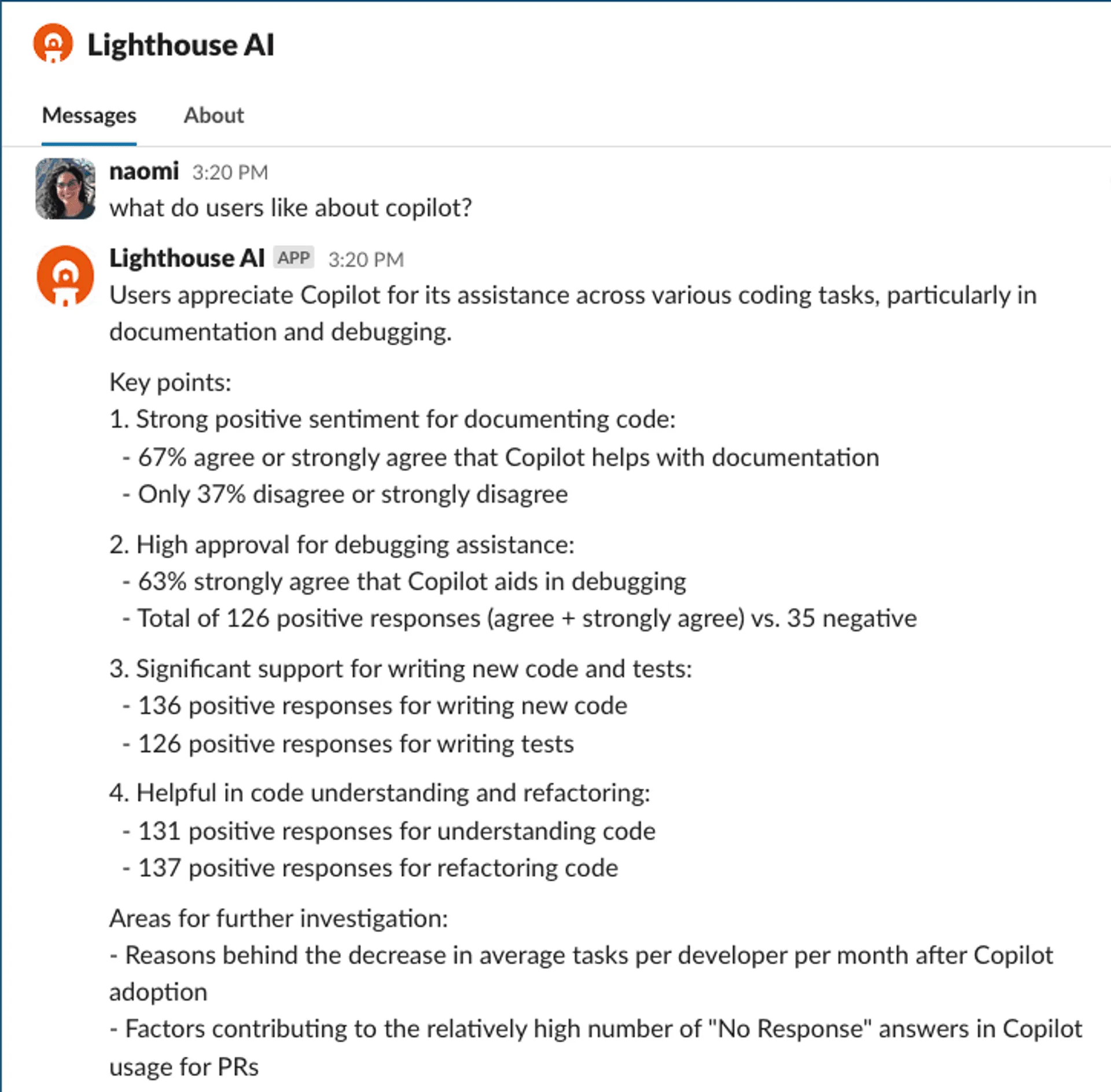
Want an update on how adoption and usage are going? Chat with our Slackbot!
A new conversational chat responds to your questions about Copilot adoption, impact, and developer satisfaction. Ask it questions like “How does Copilot impact a developer’s PR size?” "Which users or teams aren't using their Copilot licenses?” or “What do users like about Copilot?” and it will reply with both the key takeaway and detailed explanations.
Ask natural language questions about Copilot adoption and impact with our Slackbot
New use cases for custom metrics pop up every day in our fast-paced engineering organizations. The improved Lighthouse AI Query Helper is ready to help you address questions about your engineering organization.
Need insights into the current velocity of a specific team? Curious about the distribution between bug fixes and new feature development? Want to understand code review turnaround times?
Just ask a question about your data in plain English, review the query used to answer it, and visualize the results in an accessible chart.
Furthermore, Lighthouse AI Query Helper will also find tables and fields for you, explain tricky syntax questions, and answer general questions about engineering productivity.
Lighthouse AI Query Helper combines powerful LLMs with intent classification, a deep understanding of Faros's schemas and tables, your existing metrics definitions, and specialized knowledge—all to generate responses that are 5x more effective and accurate than asking leading LLMs like ChatGPT or Claude questions outside of Faros, even if you include the Faros schema with your prompt.
Centralized visibility for codebase security
Faros is beloved by its users for centralizing visibility across the SDLC. One pain point we’ve repeatedly heard from senior engineering managers and security and infra domain leads is the lack of visibility into the codebase’s security risks. This information tends to be scattered across multiple tools, preventing a unified view of the work to be done, which often leads to lingering vulnerabilities and missed SLAs.
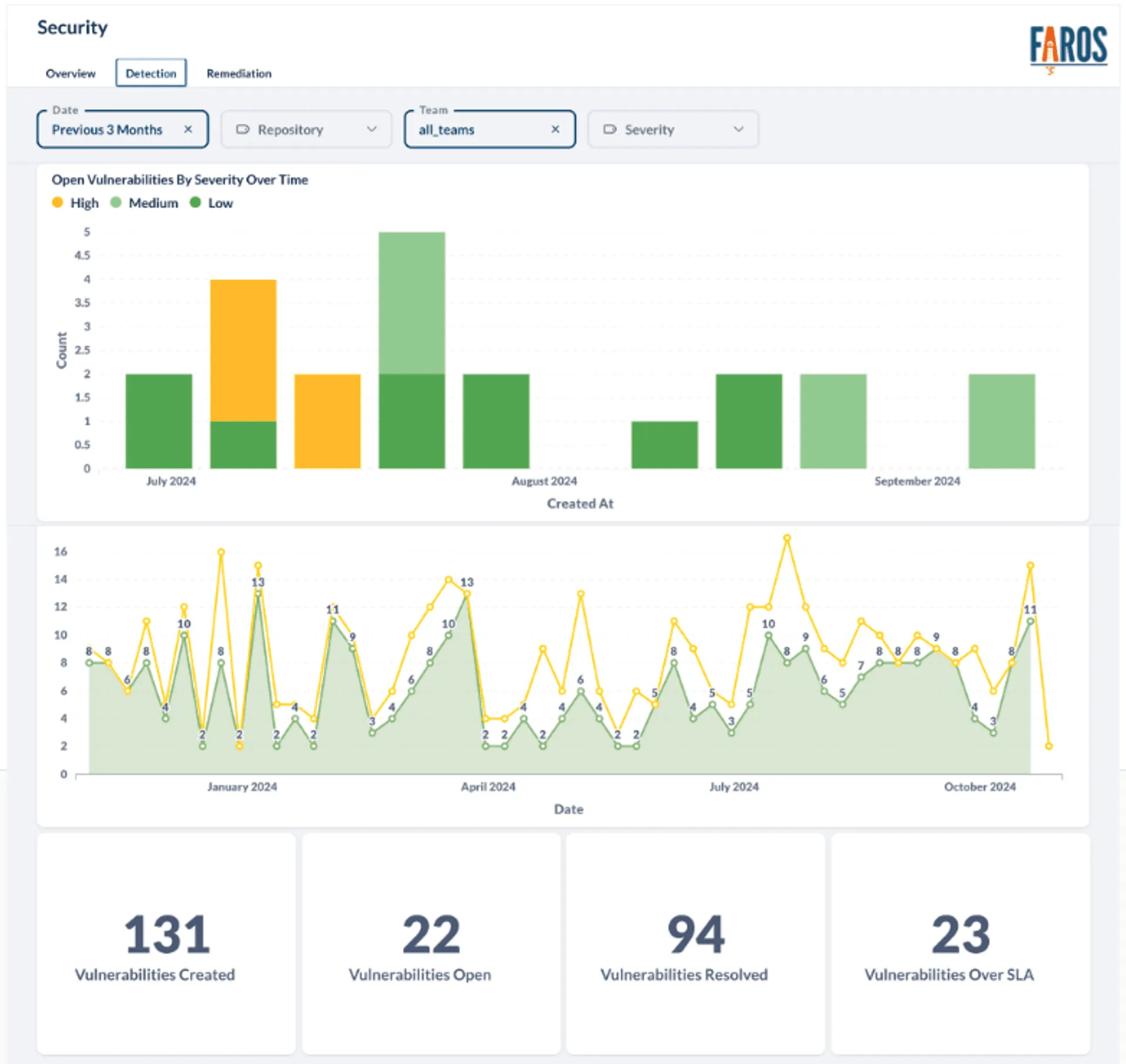
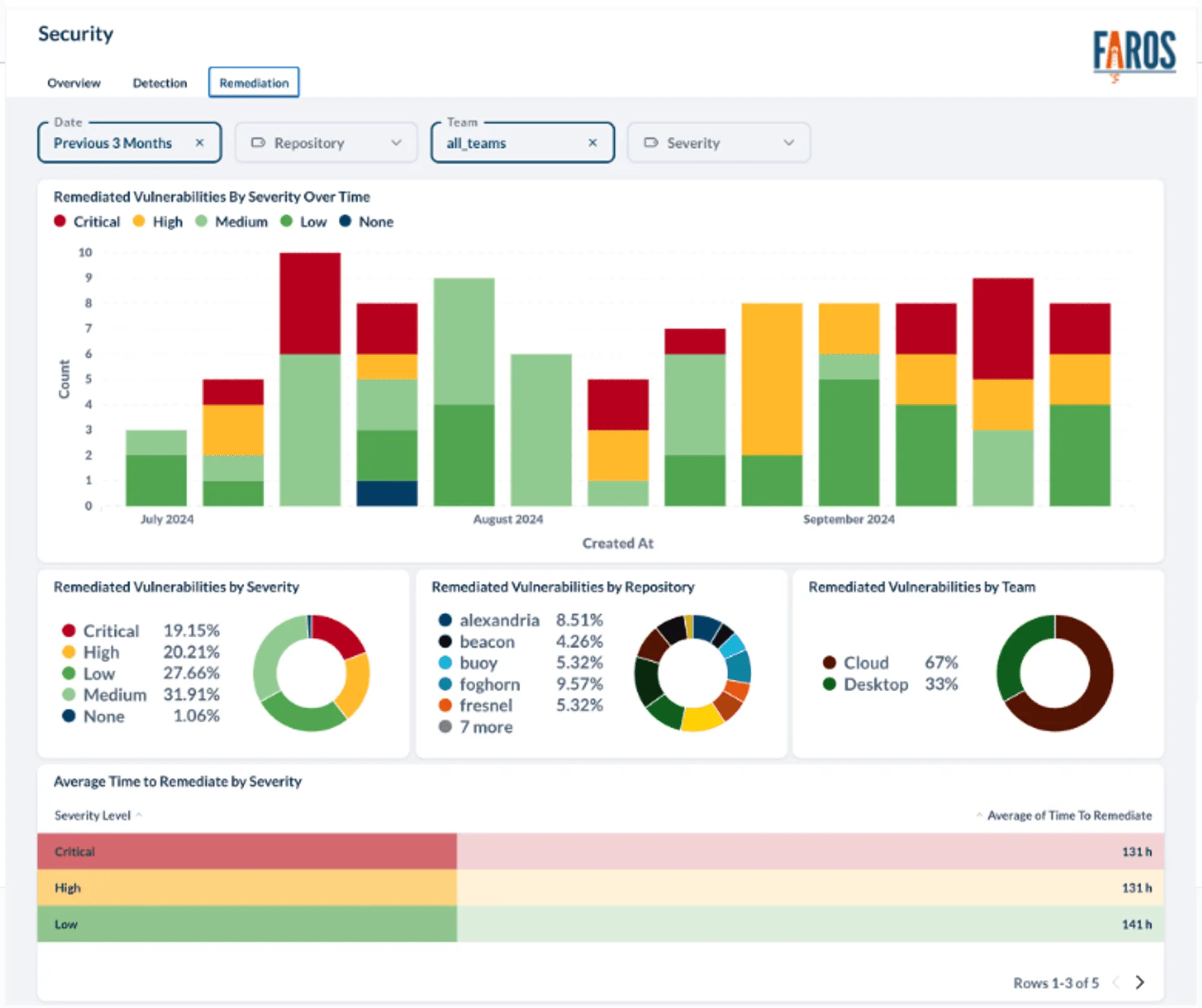
Today, we’re launching a new Software Security intelligence module that helps see the full picture and identify which repositories and teams need urgent attention. These new capabilities help ensure teams are meeting their SLAs, addressing security vulnerabilities, and reducing the company’s risk exposure.
Key benefits:
Resolve vulnerabilities within your SLAs with real-time tracking and team alerts for pending or overdue patches.
Identify the most vulnerable parts of your codebase with a single unified view of security findings and measure the ROI of security activities over time.
Monitor team-level security performance with vulnerability resolution performance. Identify which teams require more support or education on security best practices.
Security - Vulnerability Detection Intelligence on Faros
Security - Vulnerability Remediation Summary Faros AI
Interested in discovering what the Security module can do for you? Contact us for a demo.
New connectors and delightful admin improvements
With the Einstein release, we’re introducing new connectors for GitHub Actions, GitHub Advanced Security, and Testrail. And, as always, we’ve made several improvements to delight our customers, including homepage notifications when data ingestion fails, faster performance on Employee pages, and more fine-grained RBAC for dashboards and data. We’re also thrilled to share some real-world benefits from our transition to DuckDB: dashboard load times have improved by 92% for even the heaviest dashboards!
Einstein release: Driving impact across productivity, security, and insights
With the Einstein release, Faros transforms how engineering organizations measure, analyze, and act on data. Beyond optimizing GitHub Copilot adoption, Einstein’s new security module provides the insight and control engineering teams need to boost productivity while safeguarding their codebases. Lighthouse AI Query Helper brings an added layer of intuitive interaction, enabling teams to ask questions in plain language and receive precise, actionable insights immediately.
As Faros continues to innovate, we’re thrilled to support our users with the most advanced tools for achieving measurable impact across the entire SDLC. For a personalized demonstration of these new capabilities, contact the Faros team to request a demo.
Naomi Lurie
Naomi Lurie is Head of Product Marketing at Faros. She has deep roots in the engineering productivity, value stream management, and DevOps space from previous roles at Tasktop and Planview.
Stop guessing if AI token spend pays off. Faros Token Engineering traces coding agent usage to shipped features, incidents resolved, and ROI.
Product
7
MIN READ
Inside Faros Token Engineering: AI Spend Observability
Go beyond token usage with AI spend observability that shows where spend goes, what work ships, and the cost per verified outcome across teams.
Product
7
MIN READ
Inside Faros Token Engineering: AI Route Optimization
Optimize AI coding by routing each task to the right model and harness, using benchmarks from your own merged code to reduce cost per verified outcome.




.webp)
.webp)